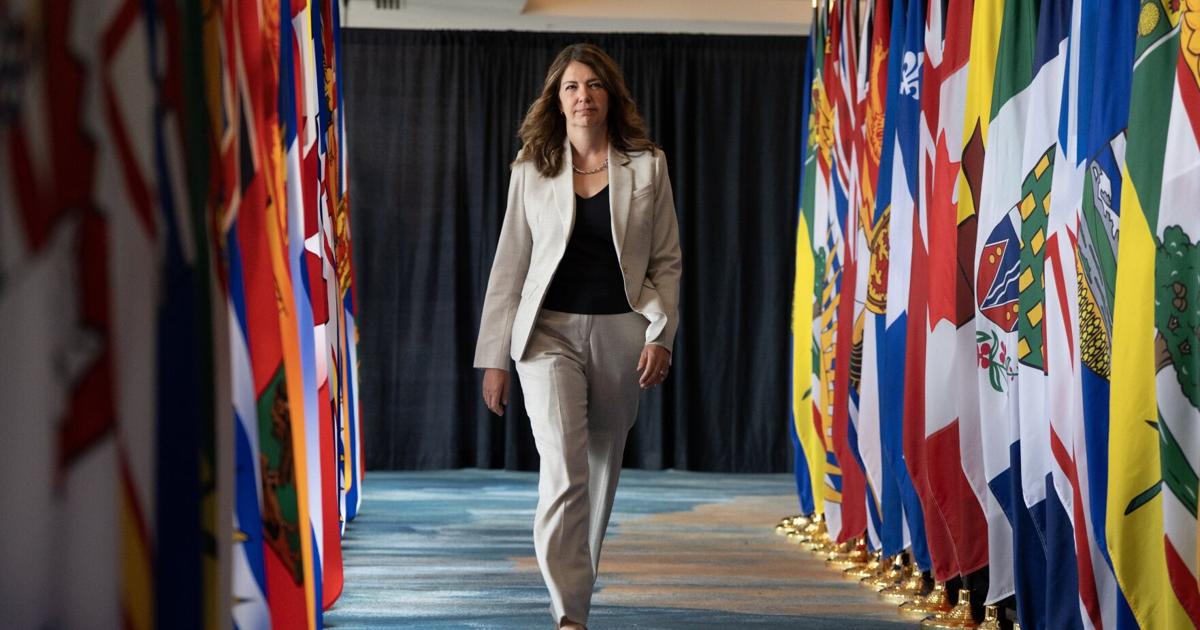
OTTAWA — The federal government’s reluctance to weigh in on an Alberta law that could expand private health care is becoming entangled with Ottawa’s aversion to fuelling separatist sentiment in the province, health advocates charge.
Alberta’s Health Statutes Amendment Act became provincial law late last year and would, in its most controversial application, create a “dual-practice” framework allowing some physicians to provide publicly insured care while also offering certain privately paid services.
“When your physician refers you to a surgeon, you’ll be given an appointment six to eight months down the road. And if a patient calls and is willing to pay four times as much as the surgeon will get paid from the government for that service, they can get a booking within a week or two,” said Dr. Braden Manns, a physician and professor of health economics at the University of Calgary.
“If a surgeon can get paid four times as much in the for-pay system, they’re going to prioritize their time there, and that’s going to mean less of their time is available in the public system.
“I mean, this is the essence of two-tiered health care.”
But the Carney government’s hesitation to take a position on the law — which has yet to be fully implemented but has sparked concerns about potentially breaching the Canada Health Act — may reflect its unwillingness to pick a fight with a province preparing to decide whether it should remain in Canada, Manns said.
The government “doesn’t want to inflame the small proportion of voters who might be willing to vote ‘yes’ in the separatism referendum,” the kidney specialist said.
“Personally, I think they should also be worried about all of us … who are going to vote against separatism, and that they should be considering what we want as well.”
Alberta’s law, also known as Bill 11, was the focus of a campaign mounted by the Canadian Health Coalition last week in Charlottetown, where the country’s premiers and Prime Minister Mark Carney convened.
The message, said Steven Staples, the group’s national director of policy and advocacy, was to encourage Alberta Premier Danielle Smith “not to go the route of two-tier, U.S.-style health care” and to urge Ottawa to ensure the law doesn’t inspire other provinces to follow suit.
“I don’t think it’s news to anybody that the federal government is watching the separatist movement, and that this is a context in which everything about Alberta is being viewed,” Staples said.
The Liberal government hasn’t tied its silence on the law to Alberta separatism, which will go to a vote this fall when Albertans decide whether a binding referendum on separation should be triggered.
Key details about how the law will work in practice were left up to regulations, some of which were recently released. Physicians approved to offer procedures under the dual model can begin to do so this fall: the initial rollout primarily captures non-emergency surgeries like orthopedic procedures, which would be conducted — for now — in private facilities rather than public hospitals.
“Health Canada is taking the time to review the regulations carefully and engage with Alberta officials to better understand their components and potential impacts before they are implemented,” a spokesperson for federal Health Minister Marjorie Michel wrote.
“Albertans care deeply about protecting the integrity of the public health care system, and we are listening to those concerns. The Government of Canada will always uphold the Canada Health Act and protect Canada’s universal, public health care system, including access to care.”
The Alberta government has remained adamant that the law doesn’t contravene the Canada Health Act, which sets out the conditions provinces must meet to receive federal transfer payments for health care. Those conditions include prohibitions on extra-billing by physicians and user charges for insured health services, giving Ottawa the ability to deduct transfer payments if principles are violated.
“The (Canada Health Act) does not prohibit private practice operating outside the publicly insured system,” a spokesperson for Alberta Hospital and Health Services Minister Adriana LaGrange wrote.
The Smith government has argued that the dual practice model will boost surgical capacity and reduce wait times, while safeguards will be put in place to ensure eligible physicians still work a certain number of hours in the public sphere.
Not everyone is sold on Alberta’s insistence that its legislation respects federal law.
“Bill 11 does contravene the Canada Health Act, there’s no doubt about that,” veteran Liberal MP Hedy Fry told the Star.
That doesn’t mean the Carney government should immediately withhold funding, said Fry, who practised family medicine in B.C. before becoming a member of Parliament.
“I don’t know if you will notice that this government is trying to work with provinces in a different way,” Fry said. “It’s, can we talk, see how we can make the federation work, how we can discuss with provinces what are the issues they’re finding troubling, and how can we find a way to resolve them in a manner that … continues to agree with (the) rule of law.”
In early July, the Canadian Health Coalition had the law firm Goldblatt Partners review Bill 11 and some of its regulations.
“In our opinion, the two-tiered structure for the provision of medical services created by Bill 11 cannot and will not be cured by the regulations announced by the Alberta government. Even if these regulations are ultimately implemented, the legislation will continue to contravene the core principles of the Canada Health Act,” wrote Goldblatt’s Emma Phillips.
Heather McPherson, the NDP’s sole Alberta MP, said she’s been wondering why the Carney government has yet to speak up.
“I’ve thought about this an awful lot. One (reason) is that he doesn’t want to ruffle feathers because of the separatist movement,” McPherson told the Star.
“But anyone from Alberta will tell you that protecting our public health care system — showing that Canada, the country, the nation, the federation, the confederation, works for Albertans — is one of the best ways to ensure that Albertans recognize the value of being part of Canada.”
Error! Sorry, there was an error processing your request.
There was a problem with the recaptcha. Please try again.
You may unsubscribe at any time. By signing up, you agree to our terms of use and privacy policy. This site is protected by reCAPTCHA and the Google privacy policy and terms of service apply.
Want more of the latest from us? Sign up for more at our newsletter page.