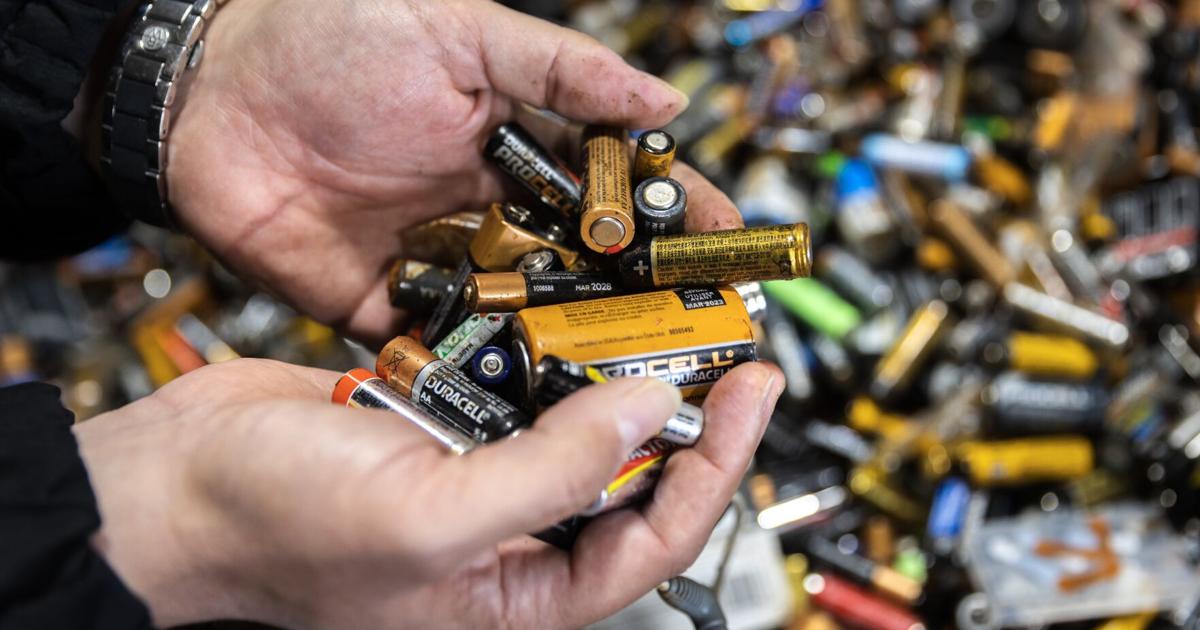
Three of Canada’s biggest battery manufacturers have agreed to invest more money into Ontario’s recycling infrastructure in exchange for a reduction in fines levied after the companies failed to meet 2023 recycling targets.
The investment though — and even the fines — will really be paid for by consumers, who pay environmental handling fees on battery purchases to cover recycling.
The deal is part of a settlement reached after Duracell, Energizer and Panasonic appealed $2.8 million in fines levied by the Resource Productivity and Recovery Authority (RPRA), which oversees recycling in Ontario, after the companies fell short of 2023 recycling targets for single-use batteries.
As part of the settlement, Call2Recycle, a third-party that handles battery recycling for the companies, will invest $2.8 million over three years to expand private and public battery collection sites, such as an office building or a retailer, as well as annual curbside pickup events in new communities.
Call2Recycle will also pay $1.5 million in fines on behalf of the battery producers, which recycled only 19 per cent of single-use batteries, such as AA or AAA, that were sold in Ontario in 2023, short of the 40 per cent target.
The resource authority says the deal is a good one because the provincial oversight body is more concerned about environmental outcomes than collecting fines.
The settlement was announced this month, after the case went to the Ontario Land Tribunal, an independent provincial body that hears environmental, land use planning and municipal disputes.
“As the Ontario Land Tribunal said in its ruling approving the settlement, ‘it will benefit Ontario residents more than the original penalty orders would have,’” said Wilson Lee, RPRA’s chief of programs and public affairs.
The settlement also means RPRA won’t pursue any administrative penalties against the producers for recovering 33 per cent of single-use batteries in 2024, falling short of the target to collect, reuse, refurbish or recycle 45 per cent of the batteries sold by weight on the Ontario market.
Lee said the deal will also ensure more batteries are recycled than provincial regulations require while avoiding a lengthy legal dispute.
Camille Vandeerstraeten, Call2Recycle’s director of communications, said in an email that the tribunal “concluded that the original administrative penalties were unreasonable in light of Call2Recycle’s commitments to enhance collection efforts,” a reference to the investments agreed to in the settlement.
Vandeerstraeten said the tribunal also “found that the settlement agreement satisfies the statutory requirements, and that the revised outcome better serves the public interest than the original penalty orders.”
Has Ontario weakened its recycling rules?
Not everyone agrees the deal is good for consumers.
“It seems like (the battery companies) are paying less than they should be paying for actually managing batteries correctly at end of life, said Karen Wirsig, a senior program manager with the non-profit Environmental Defence.
“They got away with a deal,” said Wirsig, “and of course consumers are going to be paying for that deal because of the fees we pay when we buy batteries.”
Call2Recycle, which is referred to as a producer responsibility organization, or PRO, says it can’t reveal what Ontarians pay in eco-fees on batteries because the company works in a competitive environment, vying for recycling business with other PROs.
“Fee schedules are communicated directly to participating producers and are considered commercially sensitive information,” said Vandeerstraeten. “This approach is consistent across PROs operating in Ontario.”
In recent years Ontario’s recycling industry has been undergoing a massive transformation, from a model partially funded by municipalities and taxpayers, to one referred to as extended producer responsibility (EPR) or individual producer responsibility.
Both terms mean the same thing, and that is that recycling is now managed entirely by private companies and public organizations who are obligated by provincial regulations to recycle their products, paper or packaging, as well as other materials.
The idea behind EPR is to encourage competitiveness in order to bring recycling costs down and recycling rates up.
But the Ontario government has watered down the legislation, critics say, by combining the recycling target for single-use and rechargeable batteries, which are typically much heavier, into one category, making it easier for producers to hit their recycling targets, which are based on the weight of recovered batteries.
The change also disincentivizes producers to create recycling streams for single-use batteries, critics add.
The Ford government has also lowered recycling targets for tires, and put off planned Blue Box expansion to multi-residential buildings and schools, as well as some long-term care homes and retirement homes, until 2031. The province has also removed the requirement to expand Blue Box collection in public spaces.
The ministry of environment, which oversees recycling, didn’t respond to questions about recycling before press time.
“The original targets that were part of EPR have been lowered, at least temporarily, and the obligations have gone down and the performance is less,” said Wirsig. “And yet consumers are paying more and more in fees for what exactly?”
“The producers are at fault and they should be paying more than they are,” Wirsig said, “but this is actually a provincial government problem. We need to fix EPR once and for all and not let producers just get away with stuff like this.”