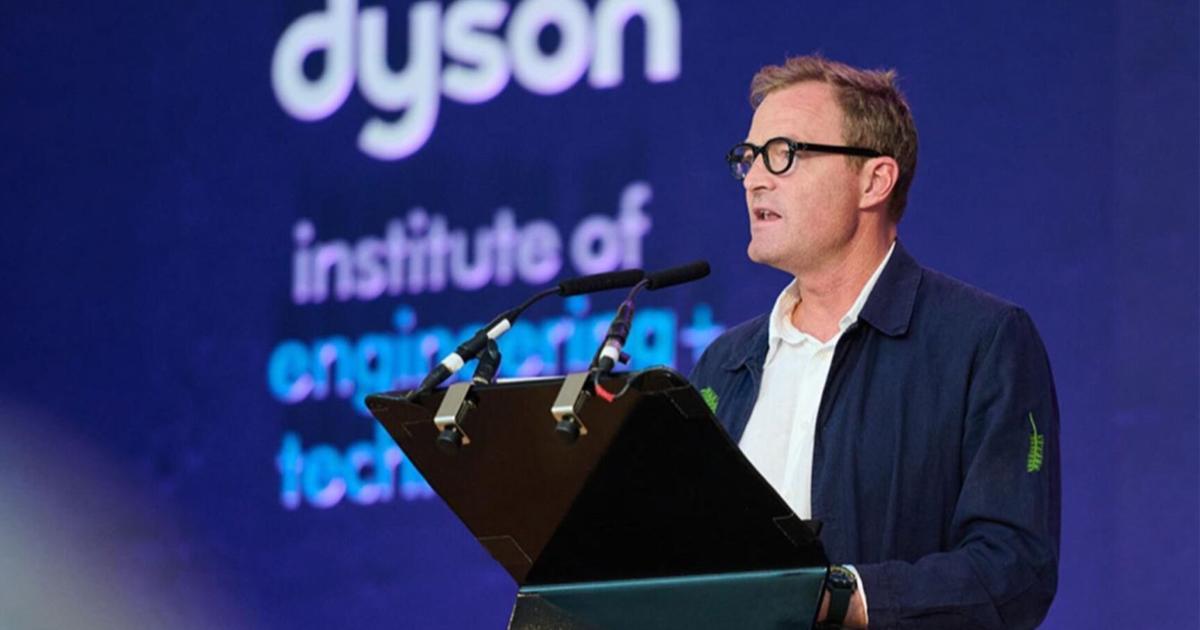
Since revolutionizing the vacuum cleaner in the 1990s, Dyson has designed products that leverage airflow.
Now, the company is entering a new phase, according to chief engineer Jake Dyson, designing products that leverage software.
The son of founder James Dyson says that many of the brand’s latest innovations utilize advanced computer vision systems, opening the door to new product categories he can’t reveal just yet.
“You’ll see something towards the end of the year,” he says. “We started off as a mechanical company, and we’re moving very much into a sort of technology, software-based company.”
After earning a degree in industrial design from Central St. Martins Arts College in London, Dyson worked as an interior designer. In 2004 he founded a lighting company, where he pioneered technology that dramatically increased the longevity of LEDs.
In 2015 Jake Dyson Light was acquired by his father’s company, at which point the younger Dyson joined the board as its director of research and development, before becoming the company’s chief engineer the following year.
Founded by James Dyson in 1991 in the town of Malmesbury, England, Dyson became a household name soon after launching the world’s first bagless vacuum cleaner, the DC01, in 1993.
Since then, the company has expanded into various products that manipulate air flow, from hair curlers and hand dryers to bladeless fans and noise-cancelling headphones.
Dyson officially launched in Canada in 2006, and now operates stand-alone demo stores in Yorkdale, CF Pacific Centre in Vancouver and CF Chinook Centre in Calgary. Today the company operates in 85 countries and employs more than 10,000 people.
After building its reputation developing products for people, Jake Dyson says the company is now grappling with the possibility that many household chores may soon no longer require a human touch.
“Within three years we’ll see humanoid robots in the home capable of doing every household chore,” he says. “Autonomy and performance open other areas in your home that haven’t changed for 50 years, and like the hair dryer, like the vacuum cleaner, we’re very interested in those areas.”
The Star spoke with Dyson remotely from the company’s head office in London, England about growing up with a famous father, how the premium brand seeks to reach budget-conscious buyers, and how the design-forward company is preparing for the age of robots in the home.
When did you realize your father was famous?
I was at Central St Martin’s College studying product design, and in the first year of lectures, they were talking about famous designers like Philippe Starck and Richard Sapper.
Then in third year they were projecting my father onto the screen, saying this is the future of innovation in manufacturing.
Did your classmates know?
No, I was quite overwhelmed by it, so I kept it under the radar.
Did the last name not give it away?
I mean, we had an offspring of one of the Beatles in class, so I wasn’t the most famous child in the room.
What was it about lighting that caught your eye?
I began my career as an interior designer, and I thought it was silly you had to buy different light bulbs at all different angles to fill a room. I thought it would be good to design a light that gave you all the angles — particularly uplighting, which is light that goes from the floor to light up the walls and corners of the room.
Understanding the limitations of what was available to interior designers led me to designing a product with an innovative optic design and a motorized system to allow the adjustment of the angles of light to cycle.
As I was finishing that product, they started to phase out incandescent and halogen lighting, and there was no way to achieve what I had done with that product other than with a halogen light source.
When I started looking into LEDs, I realized people were abusing the technology; they had the potential to last 60 years without any light degradation or colour shift, but people were selling them as cheap disposable light bulbs, without removing heat from the LED chips. To make them last a lifetime you need to hold the temperature of the diode at 50 degrees Celsius.
I worked with a big company in Asia called CCI that made heat pipes for satellites, and I designed my own method for attaching the LED chips to the heat pipe. Through that natural convection of air in the room, we managed to achieve 50 degrees junction temperature on the LED chips, which produce lighting that last 60 years with no degradation.
There’s one hanging above me now, and they’ve become very common in commercial buildings and inaccessible places.
When did you join Dyson?
I’ve been a board member for ten years, and I’ve been working here full time for nine.
Why then?
I had run my own company for 10 years, and it was quickly expanding.
At the time there was a fair amount of pressure over Dyson remaining a family business, and they were very keen on selling my lights. I thought it was quite interesting to advance the connectivity and apps for all the products, which provide an advantage for lighting, but also a big advantage for the future products of Dyson.
I brought my business into Dyson, and it’s been great fun designing other things for the company, but it took me a few years to understand how to navigate a business like this.
Is your dad still involved?
He is one hundred per cent still active, and still sharp as a button. He still has fantastic ideas, he’s designing every day, and he’s very in tune with the business on a macro level.
What do Dyson products have in common?
We’ve got about 45 products on the market right now, and the common thread is the manipulation of airflow using motors, starting with the vacuum cleaner and spinning off into many other applications. That’s what our engineers do best.
Moving forward we’re getting more into software features that create improvements for products. We started off as a mechanical company and we’re moving into becoming a software-based company as well.
We’ve got a robot vacuum with an on-board camera that detects stains on the floors, then cleans it, then checks the stains before going off to the rest of your room.
That’s machine learning, it’s computer vision, there’s a bit of inferred AI, and we’re moving from a company which developed the highest performing high-speed motors to a company where vision systems play a part in our products, along with high-speed motors.
What kinds of products would that enable?
We can’t say yet, but you’ll see something towards the end of the year.
Do you envision more robots in the home?
Within three years we’ll see humanoid robots in the home capable of doing every household chore that you do. They may not have legs, but they will have the upper body part, and they’ll do everything in your home, apart from some emotional or romantic connection.
They won’t be allowed in the home for eight to ten years, because of regulation, but they will be in factories in the next year or two.
You’re also going to see a big leap in driverless cars very shortly. China has the hardware, and they’re making high quality electric cars very affordable. Given the advances in AI in the western world, eventually the two will come together.
Is Canada part of that equation?
Canada has a DNA for engineering and industrialization.
Bombardier is a great example; we have a 1960s Bombrdier Ski Doo in our office in Toronto. I think a lot of our products serve the Canadian culture well.
Dyson tends to exist at the higher end of the market. Has that been a challenge in this economy?
New and improved technology always comes at a cost, but there are categories where the volume of competitors means that another company can make something and charge less money for it. They’re after volume, not margin.
When we first did a cyclonic vacuum cleaner, it was revolutionary, it was incredibly powerful, and it solved all these problems with bags and clogging. Twenty years later, we’ve gotten used to it, and we’ve come to expect it.
We are working very hard to continue to develop cutting-edge technology, which I’m bringing to market cheaper by working very, very hard with our manufacturing partners to make products more affordable.
We can also be clever in how we design products. We recently developed the HushJet Mini Cool fan, which costs $130, and can be important to people’s lives on those really hot days.
You can hang it around your neck or place it on a desk, and it instantly cools you down. That’s one example of how we can make things more affordable.
What should Canadians expect from Dyson moving forward?
What I’m working towards is more of a relationship with the customer based on trust, but also taking the pain points away in terms of purchasing, using, maintaining and troubleshooting their products.
Another area that’s important for us and true to our foundation is health. “Health” is a big word and something we’ve always cared about in terms of purifying air, hygiene of homes and your hair. I think there will be more advances in very useful products relative to your health.
And then more autonomy and performance open other areas in your home that haven’t changed for 50 years, and like the hair dryer, like the vacuum cleaner, we’re very interested in those areas.