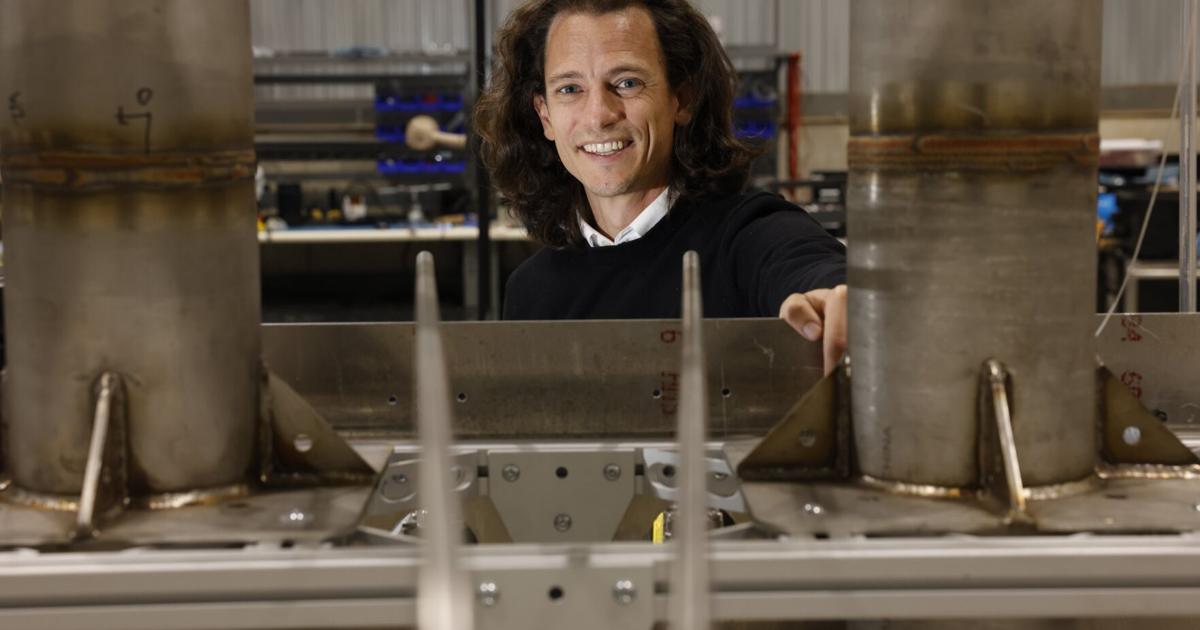
Hugh Kolias is looking to take on Elon Musk’s SpaceX with a made-in-Canada rocket.
The Calgary-born entrepreneur’s startup, Canada Rocket Company, is only nine months old but has already raised $22.5 million, moved into a 7,500-square-foot manufacturing facility in Etobicoke, and broke ground on a 12,000-square-foot rocket engine test site in London, Ont.
Now, the company is searching for a 500,000 square foot vehicle manufacturing facility, which it hopes to begin constructing next year, with the goal of putting a rocket into orbit by 2032.
Kolias always had an interest in space, but the Queen’s University mechanical engineering grad began his career in finance before launching a real estate management platform in 2016, which he sold in 2022.
After spending a year-and-a-half with the acquiring company, Kolias took time off to consider his next move — just as Canada’s interest in space was taking off.
Kolias says the world woke up to the importance of space after Russia jammed Ukraine’s communications systems, leaving Elon Musks’ Starlink as the only way to connect its internet-enabled defence and communications capabilities.
“Everyone kind of had this ‘wow’ moment of, ‘we’re all reliant on one individual,’” says Kolias. “Our drones, SATCOM (satellite communications), everything is reliant on these signals, and if that doesn’t work, we’re effectively sitting ducks.”
His ambitions were further fuelled by Ottawa’s sudden commitment to space sovereignty, and a possible gap in the market left by SpaceX’s impending retirement of its Falcon 9 rocket before Musk’s ‘Starship’ is finally up and running.
“Our ultimate opportunity in the next five to ten years,” Kolias says, “is becoming that medium-lift provider of choice.”
If successful, Kolias says Canada Rocket Company would offer a launch pad for Canada and its medium-power allies’ orbital technologies, while helping to secure national sovereignty.
The Star spoke with the co-founder and CEO from Canada Rocket Company’s Etobicoke manufacturing facility about his passion for space, the country’s recent entrance into a new kind of space race, and why now is the perfect time to build a rocket in Canada.
Have you always had an interest in rockets?
I was always interested in anything that moves fast. That’s why I went into engineering, but somehow, I got sucked away into finance for a few years and slowly worked my way back to my original passion.
I was fascinated by financial derivatives and ended up working on a trading floor for a summer, and the energy was just insane, so I thought finance would be a cool career. Then I worked for a hedge fund for a few years, which sent me around the world meeting with executives from Fortune 500 companies, but that just solidified my desire to be on the other side of the table.
I figured the barriers to entry for starting a software company were basically zero, so I taught myself how to code and started a software company in 2016.
My family was in property management, so I decided to build property management software. Over the next six years I ended up with about 35 staff, and our platform was used to manage 200,000 apartment units across Canada and Europe.
We had lots of people interested in acquiring us and at a certain point we hit a crossroads where we would need to enter the highly competitive U.S. market or sell. By that point my mind was already focused on hardware, and exploring my true passions, which were aerospace and motorsports.
We sold the business in 2022, and after a year-and-a-half with the acquiring company, I took some time off to consider my next idea.
Why start a rocket company?
I originally thought about starting a motorsports company.
I spent a lot of time at the Canadian Tire Motorsport Track in Bowmanville, and it’s a lot of fun, but I decided not to turn a hobby into work, because sometimes that makes you lose your passion for it.
After I decided to concentrate on aerospace, I travelled to industry conferences trying to understand what problems and opportunities there were. As a second time founder I didn’t want to spend years trying to find product-market fit — I wanted to get from idea to growth as quickly as possible.
That’s when I met my co-founder David Tenny, who was at SpaceX for about a decade and then in aerospace consulting for another decade.
We were considering different opportunities, like lunar permanence, or defence. Ironically in our first conversation I said I’d love to build a rocket but that’ll never happen. SpaceX’s Falcon 9 owned the market and takes 83 per cent of all payloads into space.
At that point Germany, France, Italy and Spain were all investing in launch vehicles, and Canada had very little ambitions within the space ecosystem. I was actually looking to either move to the U.S. or Europe.
Then while attending an event in Australia, talking to people in the Canadian space ecosystem, I kept hearing these rumours about Canada entering the field.
So, I sent a message to my cofounder and said how would you like to move your family from L.A. to Canada to build a launch vehicle here, because there’s a high probability the Canadian government is going to be super interested in supporting it. He got back to me within two hours saying yes.
How significant was Canada’s $182.6 million commitment to sovereign launch capability?
Without it, there would be no reason for launches to happen in Canada.
The money is one thing, and the way that it catalyzes the private market is a big part of the opportunity. The other piece is if the government doesn’t want launch capabilities, it would take years to go through all the regulations and permitting and approvals, which would make building a launch vehicle in Canada almost impossible.
Even hearing that they were contemplating the announcement gave us enough of an opportunity to assemble a small team, pitch investors and submit a proposal to the Department of National Defence’s Launch the North contest in January. We ultimately received $8.3 million from that competition and have raised another $14 million from private investors.
What changed in Ottawa?
Two years ago, the whole world realized that Elon Musk was the deciding factor in whether Ukraine would still be holding on as they are today.
In the early days of the war, Russia jammed their communications and all that was left was SpaceX’s Starlink. Everyone kind of had this a “wow” moment of, “we’re all reliant on one individual.” Our drones, SATCOM (satellite communications), everything is reliant on these signals, and if that doesn’t work, we’re effectively sitting ducks.
The same thing happened in Venezuela and Iran; the first shots were essentially fired in space, disabling communications infrastructure. It also highlighted how satellites power our entire economy, and we had all assumed they could exist peacefully above earth’s atmosphere, but Russia and China are working on ways to disable them.
That’s why in the last two years we’ve seen all these countries announce their sovereign space ambitions; because they don’t want to depend on other countries, and because the more satellites they have in orbit, the harder it is to disable their systems.
What is the current state of the company?
We moved into our 7,500 square foot Etobicoke manufacturing facility in July, and we’re excited to announce our new 12,000 square foot factory in London, which we’re naming after Canadian astronaut Jeremy Hansen, a London native.
This is where that regulatory headwind comes into play; this is going to be a rocket engine test site on international airport lands, a use-case that’s never been proposed in Canada before, and it was one of the fastest files to go through Transport Canada. Everyone was surprised that we got approvals in about two or three months, which is unheard of.
It’ll be the first of its kind in Canada, and it’ll be capable of testing engines that are the same size or larger than those on the Falcon 9. Very few of these engine sites exist, so it’s super exciting to put Canada on the map from that perspective.
We’re also actively looking for a 500,000 square foot facility to manufacture the vehicle, and we hope to either break ground or begin construction sometime next year, targeting 2032 for our first launch.
We’ve repatriated 12 Canadians with decades of launch experience, and brought on another 10 from around the world, essentially creating a brain gain. We’re probably the youngest company in Canadian history to get 20 temporary foreign worker permits approved, thanks to the Department of National Defence.
Is a 2032 launch realistic?
There’s an article every day or two about how supply is so constrained, people can’t get rides to space, and if they do, launch costs have gone up astronomically.
We’re effectively solving Canada’s sovereignty problem while addressing a massive global market opportunity, and to build that in Canada is a once in a lifetime opportunity, both for us and the nation.
Our innovation is being uninnovative and focusing on how we can get to orbit as quickly as possible with tried, tested and true technologies and people who have done it before. Speed is the most important thing both as a company and for the country.
People are floored at the progress we’ve made in less than a year. I am too. It’s unheard of, not just in Canada, but globally.