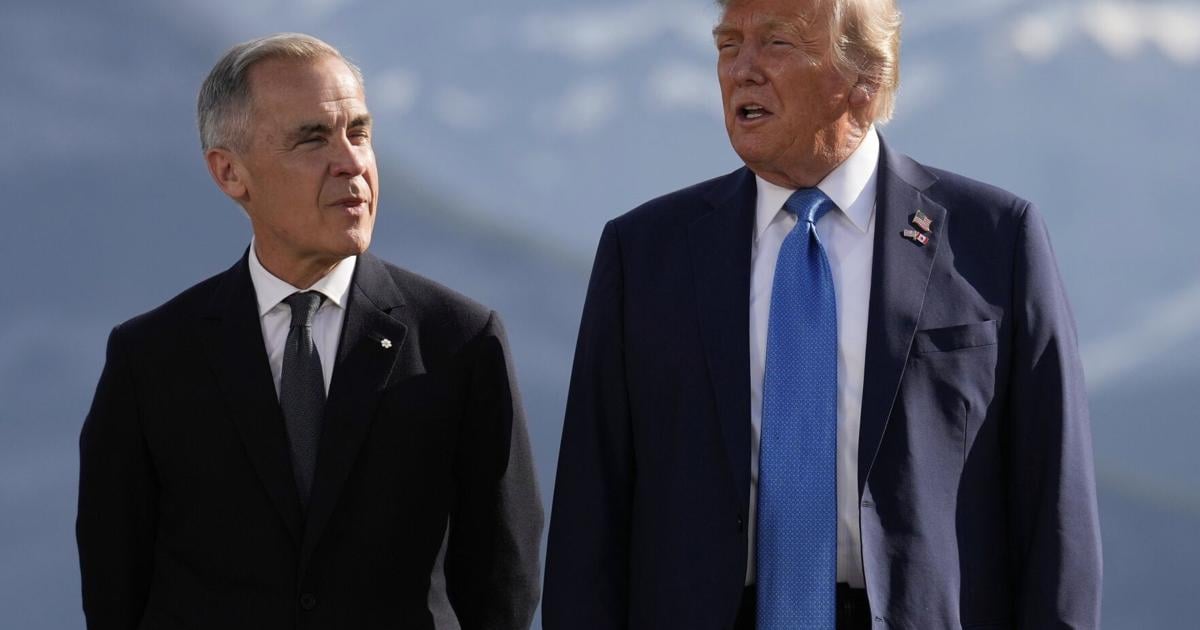
OTTAWA — Prime Minister Mark Carney says it’s fair to describe Canada’s approach to trade negotiations with the United States as “nasty,” after President Donald Trump used that word to slam Ottawa’s leaders as talks continue under the threat of a new round of American tariffs.
Revealing that he spoke with Trump directly last week, and will do so again as necessary, Carney told reporters at an aluminum plant in Quebec’s Saguenay region on Thursday that Canada is pushing hard for a deal that addresses Trump’s so-called “national security” tariffs that have hammered the sector.
Those duties have also been imposed on steel and the auto sector, while the Trump administration is planning another round of 50 per cent tariffs on some Canadian goods, set to kick in Aug. 19, which the White House has justified as retaliation for Canada’s dairy protectionism and actions taken last year by Ontario and other provinces to boycott American alcohol sales in government-run liquor stores.
“Yes, it’s a tough negotiation,” Carney said in French. “We could change the adjective and say ‘nasty,’ but for Canada it’s a question of jobs, Canadians’ jobs. It’s a question of the future of Canadian businesses.”
In English, he added, “Yes, we’re standing up for Canadian workers and Canadian businesses, as we always have from the start.”
Carney was responding to a comment that Trump made in Las Vegas on Wednesday night, when he called out several countries while claiming the U.S. has been “screwed by everybody for years.”
“Canada’s nasty. They are. They’re nasty,” Trump said. “I love the people, but they’re nasty. Nasty leadership.”
Meanwhile, for the second week in a row, Intergovernmental Affairs Minister Dominic LeBlanc and Canadian lead trade negotiator Janice Charette were in Washington, D.C. on Thursday for what Carney described as “detailed discussions” with the Americans on a “global” set of issues.
The pair met with U.S. Trade Representative Jamieson Greer for roughly an hour and a half — about an hour longer than scheduled, according to LeBlanc’s office. In a post on social media, LeBlanc said they had a “constructive and detailed meeting” and that Canada is still pushing for an agreement that “addresses sectoral tariffs” the U.S. has imposed on autos, steel, aluminium and other industries.
After Trump threatened the latest round of tariffs in July, Carney pledged that talks would intensify as Canada tries to convince the U.S. — which has ruptured the state of trade with much of the world by using tariffs in a bid to boost American industries — to lessen duties imposed since Trump returned to the White House last year.
Trump has recently escalated pressure on Canada by threatening to impose new tariffs over the wildfire smoke that blanketed U.S. cities from blazes in northern Ontario, on top of the 50 per cent import duties planned for Aug. 19. He has also threatened to block the opening of the $6.4-billion Gordie Howe International Bridge between Windsor, Ont. and Detroit, Mich., which Ottawa financed entirely, prompting Carney to agree to share a portion of proceeds from the tolled crossing with the U.S. for the next 15 years.
In St. John’s on Thursday, Conservative Leader Pierre Poilievre claimed Carney has made “concession after concession” to the Americans without yet landing a deal. Poilievre said that includes a decision last year to abandon a “digital services tax” that would have impacted large U.S.-based tech firms, as well as agreeing to “Mr. Trump’s demands on military spending,” as Canada and other North Atlantic Treaty Organization members have pledge to crank up direct defence spending to at least 3.5 per cent of gross domestic product by 2035.
“He promised he would have ‘elbows up.’ He promised he’d negotiate a win,” Poilievre said.
“Still no win. Still no deal. Still no elbows. A year and a half later.”
Carney said his government is focused on finding new trading partners, spending money to bolster Canadian businesses, and trying to attract more private and foreign investment to reduce Canada’s dependence on the U.S.
Declining to say whether Canada is discussing setting quotas for exports of material like aluminum to the U.S., Carney said there are “many options in terms of how a deal could be structured.” But he stressed that his government wants a “comprehensive” agreement that addresses sectors hit by Trump’s tariffs.
“Will we get all of that by the 19th of August? We’ll see. But we have to have pathways in order to get that,” he said.
With files from Stephanie Taylor
Error! Sorry, there was an error processing your request.
There was a problem with the recaptcha. Please try again.
You may unsubscribe at any time. By signing up, you agree to our terms of use and privacy policy. This site is protected by reCAPTCHA and the Google privacy policy and terms of service apply.
Want more of the latest from us? Sign up for more at our newsletter page.