It’s been what I’ll summarily describe as a difficult summer. In mid-July, my 86-year-old father slipped down the stairs at home in Toronto and broke his neck. (It turns out that’s not just a figure of speech.) Mercifully, almost miraculously, he did not suffer a spinal-cord injury.
After a couple of weeks at St. Michael’s Hospital, where he was in a great deal of pain, he was sent to a rehab facility where he’s slowly recovering. He fractured two vertebrae: C1 and C2. The C1 is memorably dubbed the Atlas; the first bone in the vertebral column, it sits right under the skull and supports the head, much like the Greek titan Atlas carried the weight of the world. My dad’s Atlas fracture felt symbolic, portending the collapse of a whole universe, or at least of our family’s emotional architecture.
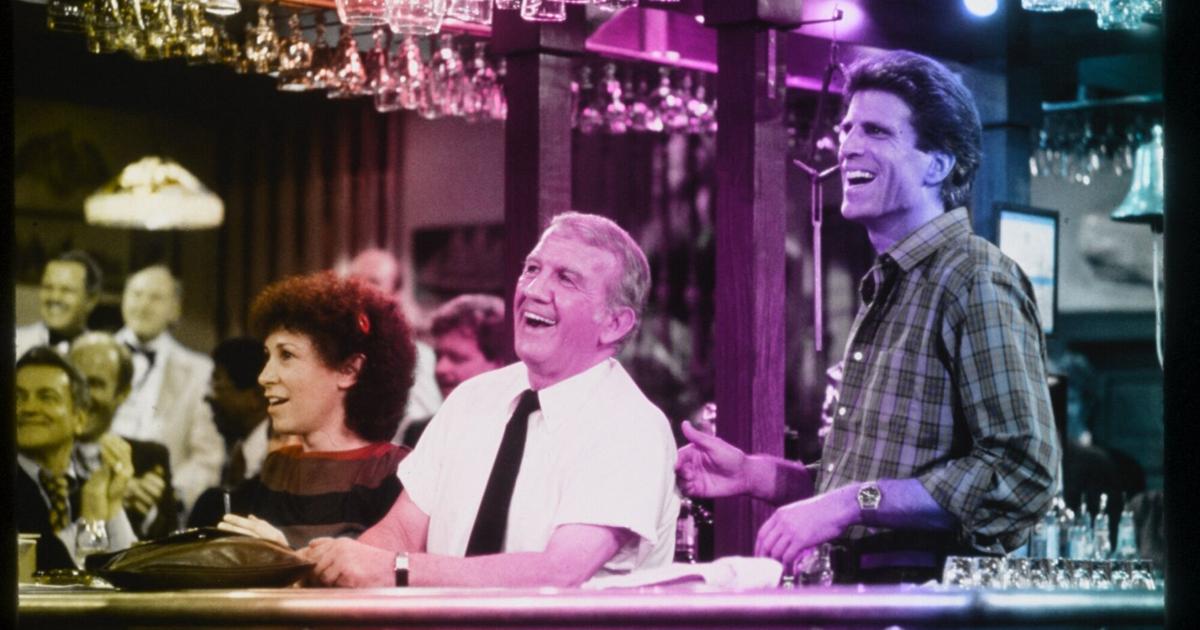
July was also the time that I announced my summer plans to my husband: “I’ve decided to rewatch ‘Cheers.’”
It’s a popular time to assume a new challenge; friends have told me about their warm-weather resolutions to take up marathon running, sailing or plein air painting. I felt motivated to rewatch 11 seasons of the iconic sitcom.
I’d once heard the actor Sean Hayes say that every few years, he and his husband revisit all 275 episodes of “Cheers,” and this struck me as inspired, as worthy a commitment as any. When the director, James Burrows, died on June 19 at 85, reading about his life and legacy reminded me of my deep affection for this series.
The timing was not initially connected to my dad’s accident, but it turned out to be a stroke of self-care brilliance. Life’s difficult periods call for cuddling up to the reassuring confines of a 30-minute sitcom, with its dependable laugh track and frothy witticisms. Cue the theme song: “Making your way in the world today takes everything you got/Taking a break from all your worries, sure would help a lot.”
“Cheers” first aired on September 30, 1982, when I was only 6 and deeply committed to the Smurfs, so I didn’t watch the show live. But my parents did, and I remember my mom laughing, rapt, as glued to the repartee between Sam and Diane as Norm was to his bar stool.
As a teen in the early ’90s, I watched the show in reruns and loved it, even though the jokes about Jung, Schopenhauer and Fraud sailed over my head the way they flew over Ted Danson’s mimbo mane. I didn’t know from real troubles at the time, but I remember adoring the line in the theme song: “You want to go where you can see/troubles are all the same.” It consoled me with the fantasy that even if adulthood brought times of turmoil, there would be bon mots, romance and community.
“Cheers” has frequently and deservedly been called one of the greatest programs in television history. The key lies in its sparkling dialogue and cast of unambivalent characters who “are all types, never stereotypes,” as British writer Brian Appleyard once observed in the U.K.’s now-defunct Independent.
Watching the frankly unmatched chemistry between Danson’s charming Lothario barman Sam and Shelley Long’s poetry-reading cocktail waitress Diane feels both palliative and replenishing. Listening to Carla spit insults at Cliff is as spiritually rehabilitating as any piece of art. Just beholding Sam move so easefully around the warm wood-panelled bar, polishing glasses with a dish towel tossed rakishly over his shoulder, is oddly soothing.
The series is as light as a beer sud but somehow also intense. It has an undercurrent of melancholy that’s never dark, a sincerity that’s never saccharine and a sophistication that’s never tainted with now-fashionable, and depressing, irony.
Ultimately, it’s a show about stasis. Despite the references to psychiatric luminaries and self-examination, the characters never actually evolve. Even the opening credits are static: a montage of archival photographs so familiar to me, they may as well belong to my own family album. The overarching theme is chosen family and home, or a sense of home where nothing ever changes.
If the setting captures a bygone golden era when you had to leave your house to find connection, “Cheers,” even at the time, was about nostalgia. To channel trivia-spouting Cliff Claven, the word nostalgia comes from the Greek nostos, meaning “return home” and algia, meaning pain or ache. Nostalgia literally means a painful longing for home.
A Swiss doctor coined the term in 1688 when he observed that his country’s soldiers fighting in Europe were prone to homesick pining and persistent weeping. For the next two centuries, nostalgia was believed to be a psychopathological disorder. I’m among the afflicted.
I shared my self-prescription with a friend, who was quick to enable my new habit: “The answer to most problems is to lie in bed and watch ‘Cheers,’” she said. Cheers to that.
After a decades-long absence, this binge-watch feels like its own return home. It’s a doubly nostalgic escape — I’m not only transported back to the Boston saloon but also to the child I was when I met these characters, when we were all young. I recently rewatched one of my favourite episodes, season 2, episode 11, in which Diane introduces Sam to her childhood best friend, and it was as satisfying as it was when I was 14. Thrillingly, nothing had changed.
Late summer is a particularly triggering time for the nostalgics among us. Change is in the offing. But I still have nearly eight “Cheers” seasons to carry me through seasonal shift, before the perfect series finale, which aired to a reported 93 million viewers, when Sam closes up for the last time, alone.
My dad, who just spent his 87th birthday in the hospital, is longing to go back home, to be not just a patient but a person. I get it. Sometimes you want to go where everybody knows your name.