
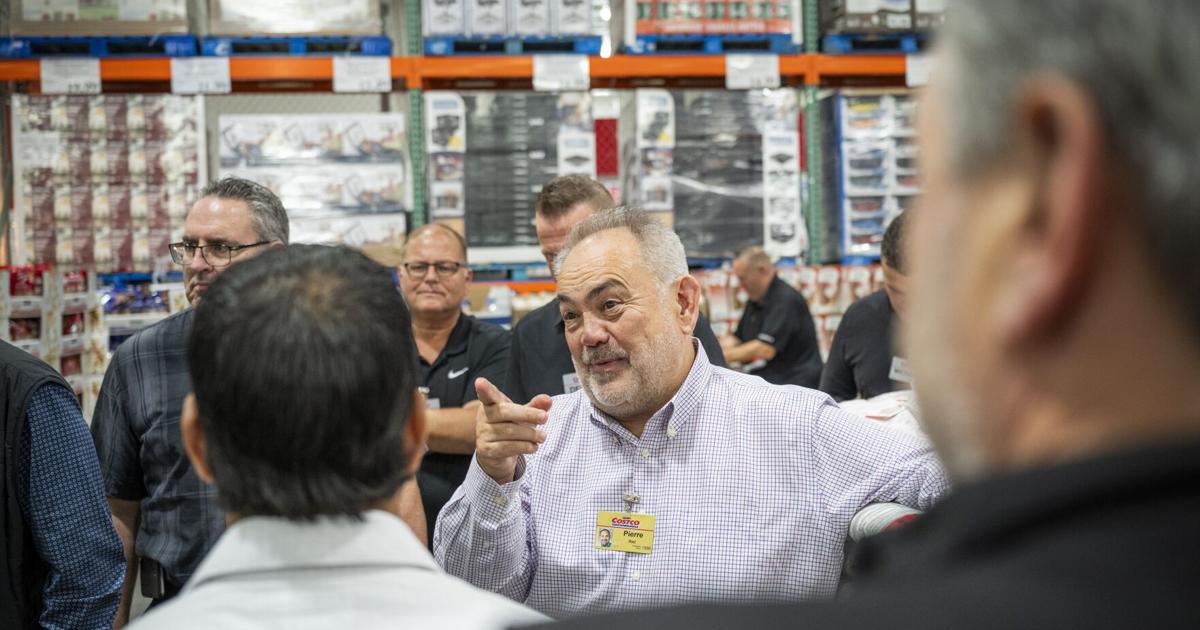
The meeting was in its third hour when Pierre Riel stood up and tapped his knuckle on the boardroom window. It was a new window, at Costco‘s Canadian head office in Ottawa, and there were clusters of little white dots on the glass.
Riel, who started as a forklift driver and is now Costco’s head of international operations, was visiting from the U.S. for just a few days and he was already behind schedule. At least half a dozen Canadian vice-presidents were waiting to update him on the latest developments in sneakers, garbage bags, Korean beauty products, the price of ground beef.
But he wanted to know about the dots. Did they somehow make the window harder to break?
“No,” said Gino Dorico, a Montrealer who runs Costco’s Canadian business and has known Riel for 38 years. “It’s for birds.”
“Ah,” Riel said, refilling his coffee cup. “For the birds?”
“It keeps birds from smashing into the window,” Dorico said, flatly. “It’s a requirement when you build new now.”
Another executive was trying to get through a slide presentation. Riel kept tapping his knuckle on the dots.
“You know how much more it is for this?” Riel asked.
“It’s a little more,” Dorico said. “I don’t know exactly. But it’s more.”
Riel returned to his seat at the centre of the boardroom table as discussion resumed about the Costco golf tournament, a fundraiser for the local children’s hospital.
Hundreds of Costco’s Canadian suppliers would be at the $1,000-a-ticket gala and Riel and his team planned to let them in on a secret. Costco is looking to open dozens of new stores in Canada over the next five years. Riel needed the manufacturers to be ready to boost production to fill the extra space.
“We want to serve our Canadian members better,” he said in the meeting. “We know our buildings are very tough to find parking, very busy.”
At that point, in mid-September, it was an awkward time to be making such an announcement. The U.S.-Canada trade war was getting uglier by the day. American tariffs and Canadian counter-tariffs were complicating supply chains. Trump’s threats of annexation weren’t helping. The mood in Canada was so acutely anti-American that even shopping at a U.S. retail chain felt for many Canadian consumers like an act of betrayal.
And here was Riel, a Canadian, living in the U.S., leading the expansion of an American giant deeper into Canada. He looked like a man torn between two forces: love of country, and love of Costco.
But in the boardroom in suburban Ottawa that morning, he was cheerful.
Riel’s meetings ended close to lunch time and he made his way to the test kitchen. Inside, cooks worked in silence, about 10 of them in all, wearing hair nets, beard nets and crisp aprons.
When Riel arrived they immediately began to feed him.
He tasted mushroom soup, which he believed needed a bit more cream and salt, a take-home ramen kit, heat-and-eat sliders for football season, and thin slices of Wagyu beef, simply cooked, which would be a new addition to the meat counter.
He didn’t use a spit cup during the tasting, which was slightly unusual. Spit cups are a disgusting but often-necessary part of test kitchens, because of the sheer amount of food you’re expected to taste. But Riel said his grandmother would have disapproved.
They presented him with a turkey pesto sandwich on a baguette, a new concept for the Costco food courts in Canada.
“Can I ask you a question?” Riel said.
The cooks perked up.
“Why is it important for us to put on a tomato?”
There was a pause.
“It gives it the acidity to break through the creaminess of the mayo,” one cook said.
“That’s the chef talking!” Riel hollered.
Louisa Pang, a buyer for the food court and bakery, tried being more practical.
“You also have some fibre in your sandwich,” she said.
But it was a hot sandwich and Riel worried the tomato would get mushy.
“We do put it under the cheese to try to protect it,” one cook said, futilely.
They hadn’t told him the price yet, but he could guess.
“I’m concerned it’s going to be too high,” he said. “You’re talking $7.99, in your mind?”
“You got it,” someone confessed.
Riel wanted the price to come down and worried about the extra labour involved in slicing the tomato.
“Never forget, our people working in the food court don’t have the same setup that you have here. It’s go go go, go go go. Start in the morning, busy with the members, rush for the pizza, rush for the hot dogs,” he said. “Personally, I don’t know if I would put the tomato.”
Riel opened the sandwich, peeled off the tomato and set it on the side of his plate.
Riel was born in 1963 and grew up in and around Maniwaki, up the Gatineau River from Ottawa in western Quebec. His mother died when he was three-and-a-half and he went to live with his grandparents.
“We were coming from not much,” he said. “A lot of love, food on the table, but never had a car when I was a kid.”
When he was 12, his grandfather, who worked in the lumber business, died. His grandmother raised him, his two siblings, and five foster kids. To help her, he worked in egg barns for 30 hours a week while he was going to high school. Later, he drove an ambulance and delivered newspapers.
“My dream was to buy the barns,” he said. “I wanted to be the egg guy.”
At some point, he pushed the owner to invest in a delivery truck but the owner didn’t want to put up the money.
“I said, ‘oh, I’m not at the right spot,’ ” he said. “I went back to school to become a nurse.”
So he moved to Montreal to go to nursing school. To help pay for tuition, he picked up a part-time job in 1986 as a forklift driver at a new store in Saint-Laurent, the first Canadian location of an upstart retail chain called Price Club.
Slowly, the store sucked him in. A supervisor job opened up and he took it. He held onto his nurse’s license as a fallback, but he kept getting promoted at Price Club, which merged with Costco in the early 1990s.
He managed a department, and then a store, in Montreal, then another in Quebec City, and one in Ottawa, as well as a Costco-owned meat packing plant. Within a decade he was an executive at the Canadian headquarters and by 2019, he was running all of Canada.
Today Riel is executive vice-president and chief operations officer for the international division. He oversees every country that Costco operates in outside of the U.S. and Mexico — roughly 250 stores in total, including 115 in Canada, 37 in Japan, 29 in the U.K. and 15 in Australia.
“I’ve toured the world maybe 13 times in the last four years,” he said. “I’m the Canadian in the room, anywhere I am. It’s obvious with my accent.”
When he’s working at Costco headquarters in Issaquah, Wash., he’s in his cubicle by 6:30 a.m., which gives him an hour to himself before meetings start. He reads each customer complaint that comes in through the website.
“Yeah, every one,” he said. “I have to.”
Riel said he sometimes feels like Obélix, the ancient Gallic warrior from the French comic strip Astérix, who gains superhuman strength from falling into a cauldron of potion.
In Riel’s case, Costco is the magic potion.
“I drank a little bit of it, and then, I fell in love with it.”
Costco’s double chocolate chunk cookie became a victim of the trade war in September. Costco stores in the U.S. and Canada sell the same cookie in their food courts, made with dough supplied by a California bakery. But due to its butter content, the dough was no longer allowed to cross the border into Canada without being subject to a 50 per cent tariff — part of Canada’s retaliation against Trump.
So executives in Costco’s Ottawa office decided to look for a Canadian bakery to produce the dough, which would save them more than 40 cents a cookie.
In the test kitchen, Larry Pifer, who heads Costco Canada’s fresh food division, wanted Riel to taste two options from two Canadian bakeries, plus the original from California. The Canadian cookies needed to be identical to the American ones, which was tough, since the Canadian bakeries had different water, different humidity, different butter, and different speeds on the mixers.
The cooks started to slice the cookies into smaller sample sizes but Pifer stopped them.
“Let him break it,” Pifer whispered.
He wanted Riel to see how the melted chocolate pulled apart.
The cooks stood in a semicircle, watching Riel taste each cookie. But he withheld his full endorsement. He needed to run it by Costco CEO Ron Vachris.
Because the cost would be lower for the Canadian-made version, he wanted the price to come down from $3.49 to $2.99.
As he started to leave, he had a final thought:
“And the sandwich. No tomato?” he asked.
“No tomato,” several cooks said in unison.
He nudged them one last time on price.
”$5.99?” he asked. “Or we say $6.99?”
Pifer intervened. “We started at $7.99,” he said.
“Just see how much you can get,” Riel said. “People are suffering right now.”
The rest of the afternoon was reserved for a store tour. Riel does 12 to 15 of them a week when he’s travelling and has a method of taking stock of any given store in the world.
“This is a machine,” Riel said, looking up at the store on Blair Towers Place in the east end of Ottawa. “This is one of the top buildings in Canada.”
He was in a car with Dorico and Michael Pinto, the Canadian vice-president of e-commerce, who doubles as an informal PR guy, though Costco rarely does media interviews.
They turned into the parking lot and drove directly to the back of the store so Riel could examine the loading dock.
“That’s good. Clean,” Riel said. “We don’t want empty pallets outside. We don’t want garbage.”
They circled around to the gas bar, checked for lineups, car flow, staff numbers, then drove back toward the store and parked in a spot as far from the front door as possible.
“We don’t ever park close to the door,” Pinto said. “We try to leave those spots (for customers).”
When Riel started at the Montreal store in the 1980s, it was different. “They were asking me to park my car at the front of the store so it looked busier.”
Most assume Costco’s prices are low because of its size. And it’s true that Costco turns over an enormous amount of product at high speed and can push for serious discounts from suppliers.
But Riel believes people see the size and ignore everything else that has been going on below the surface since the beginning.
“People say, ‘Oh yeah, Costco, you’re big, you can do those kinds of things,’ ” he said. “Costco was not always big.”
Costco caps its markup at 14 per cent, below most traditional supermarket chains in Canada. But unlike the supermarkets, Costco can rely on its membership dues for much of its profits.
“We hate to be greedy. We don’t want to be greedy,” Riel said, walking through the Ottawa store, trying to explain why Costco’s organic eggs are cheaper than most competitors.
Costco doesn’t carry as many products as supermarkets do, usually around 4,000 SKUs, compared to around 40,000 SKUs for a typical big grocer. (A SKU, or stock keeping unit, is a single variation of a specific product, so a Diet Coke in a 250 ml can gets its own SKU code, a two-litre bottle of Diet Coke gets another, and so on.)
That means Costco carries only one or two of everything — a single brand of anchovies, one size of Cheerios. That keeps it simple in stores, and simple in the factories, which helps bring down costs.
Then comes the obsession with efficiency. Costco buyers work with suppliers to develop a Costco-specific version of their product at the best possible price.
A typical negotiation goes something like this:
“What’s the cost of the raw ingredients? What’s the cost of the box? What’s the cost of shipping?” said Pietro Nenci, a senior vice-president of Canadian merchandising. “How much are you planning to do in marketing behind this item? Well, wait a second, we don’t need all that. Let’s strip it back.”
At one point during the store tour, Riel stopped at a display of pimple patches and tore a chunk of fancy branding off the box. Without the extra cardboard, they could fit more product into every shipment, and bring down costs. Someone made a note, and he continued on.
A flock of Canadian executives followed him. Every few steps, something caught his eye and he stopped to deliver a short lecture, sometimes to the group and sometimes whispered in a single ear, on the appropriate amount of sneaker SKUs on display, the right wattage on a portable jump starter, or the proper way to vacuum pack striploins, with as little blood in the bag as possible.
Walking past an aisle, he paused and pressed his fingers to his lips.
“Do we still have the ice-cream machine?” he asked.
He went down the aisle, searching for the at-home ice-cream makers, but they were gone, now summer was over.
“People will eat ice cream in winter,” he said.
The executives took notes.
He asked them when they thought the Costco food courts in Canada sold the most ice cream. They looked up in surprise.
“Look at your sales in winter,” he said. “It’s unbelievable.”
Unlike other major retail chains, Costco doesn’t use planograms — diagrams that map out where each product sits in a store. Instead, the company wants its store managers to learn how to make the right calls on their own. It is one of many tests a Costco employee must face as they move up the ranks.
“We’re a small business in a big business,” Riel said, one of several phrases he says over and over. “Do the right thing,” is another favourite, as is “Take care of your people.”
One of the biggest points of pride at Costco is that it pays well above minimum wage. The average Costco wage in Canada is more than $32 an hour, Riel said, and after about six years, a cashier can be earning $70,000 a year.
“But they work hard, man,” he said. “They deserve it. A Saturday in a Costco? At a cash all day? You deserve it.”
Riel does not have a green pen, wouldn’t ever want a green pen.
Costco’s co-founder and longtime CEO, Jim Sinegal, used green pens to personally sign off on every product for Kirkland Signature, Costco’s private label brand, which has a global cult following. With Sinegal now retired and in his 90s, no one at Costco signs in green pen, out of respect.
“It’s like you will take the number 4, of Jean Béliveau, and you say nobody can wear it,” Riel said. “I would never sign with a green pen.”
But Costco still has what it calls a “green ink process,” just without the green ink, where Riel and CEO Ron Vachris sign off on new Kirkland products.
“I’ll run into buyers and they’ll say, ‘I need to see you Friday for a green ink,’ ” Vachris said. “Anything to do with Kirkland Signature goes through Pierre first, if it’s international, and then it goes through me for final sign off.”
Vachris, who also started as a forklift driver, said Costco’s Canada office comes up with products that the company eventually cherry picks to send to its stores around the world. Riel claims Costco’s rotisserie chicken program started in Canada in the early 1990s, though Vachris said there is “fuzziness” about that.
“It’s up for debate still,” he said.
But both agreed that Costco Canada is responsible for developing Kirkland maple syrup, which is sold in most Costco stores around the world.
“That’s been a huge item,” Vachris said.
Partway through the store tour in Ottawa, Riel turned to Catherine Ward, assistant general merchandising manager for Costco’s food and sundries in Canada.
“Catherine, did you get the answer on the garbage bags?” he asked.
For more than a year, Ward had been trying to find a manufacturer in Canada that could make Kirkland’s garbage bags the same way they’re made in the U.S. Since Riel took over international operations, he has pushed for more of what he calls “in-country production,” instead of making everything in the U.S. and shipping it around the world.
Costco says 72 per cent of its food suppliers in Canada are Canadian. And nearly 70 per cent of Kirkland products sold here are made in Canada.
By that point in mid-September, Ward’s garbage bag project had become urgent. The new list of Canadian counter-tariffs had just been released and the Kirkland bags were on it.
Ward had two manufacturers that could produce the volume of bags Costco needed, to Kirkland’s specifications.
“We got green ink yesterday,” she said.
The process of making a garbage bag is a spectacular thing to watch. Air is injected into a batter of melted plastic, so it inflates like a bubble, shooting up about 20 metres to the top of the factory. By the time it reaches the ceiling, the plastic is thinner than a strand of hair. At the top, it’s folded and shot back down to the floor, where it’s cut and wrapped onto rolls.
Polyethics Industries, in Orillia, Ont., is one of two Canadian manufacturers that will start supplying Kirkland garbage bags, as soon as this month.
Bryon Wolff, an executive at Polyethics, waved across the empty expanse of his warehouse during a visit in October. When the Costco orders start, the whole place will be full of pallets and boxes, he said, and the plant will need more staff.
“That’ll all be finished goods,” he said.
Riel has bigger plans for the bags. Eventually, he wants other stores around the world to switch to the Canadian bags, so Costco in Europe and elsewhere could take advantage of a favourable exchange rate.
Costco’s leadership has been very public about its ambitions with Canada. They’ve been steadily adding store after store. There’s stores under construction in Oakville, Windsor, Wasaga Beach and Caledon, plus four in Alberta and one each in Manitoba and Saskatchewan. Vachris, the CEO, has said the company “has a very good path to expansion in Canada over the next five years,” starting with five new openings in the 2027 fiscal year. Riel is a major factor in all that.
“He’s been a giant advocate for the growth in Canada,” Vachris said.
A good way to understand that growth is to look at the garbage bags. They’re a textbook example of Riel’s theory about the circle of Costco.
The Canadian stores switch to a local factory, and that brings down freight costs, which are a big part of any sticker price. So the bags get cheaper. People buy more. Costco gives the local factory more business. The factory hires more people. And those factory workers can now afford to become Costco members.
“More Canadian jobs,” Riel said, means “more potential Costco members.”
So for Riel, love of Costco and love of country need not be opposing forces, even now — especially now.