People are forever tugging on my drinking arm at receptions or other public occasions and saying: “I’ve always wanted to write a book. How do I go about it?”
I used to have a long and complicated answer but I could see that their eyes were glazing over even though I was barely launched into my explanation. So, instead, I devised a two-sentence response that I use instead. Here it is: “Write 500 words a day. At the end of a year you’ll have more than enough for a book.”
People look at me in total disbelief, but I swear it’s true. When it comes to writing a book the firm rule that I apply is COD: concentration, organization and discipline. Those who say they plan to start a memoir when they take time off for a holiday or reach retirement age will never get launched. There is only one way to write a book and that is to get under way right now and keep at it until you’re done.
At the same time, you have to be passionate about your subject to maintain enthusiasm. For each of the eighteen books I’ve written, I’ve spent up to two years doing research, conducting more than 125 interviews on the topic or person involved all while drafting the work, so you have to care very deeply about what you’re doing. If there’s any chance you might get bored along the way, don’t take on the project. If you’re worried that you might lose interest in the topic, imagine how much worse your readers will feel!
OK, how do you recognize you have decided on the right topic? You can’t simply say to yourself, “I’ve always wanted to write a book,” you have to say, “I want to write a book about (fill in the blank).”
Sometimes, all it takes is a simple question to yourself to launch a book.
‘How could a Canadian icon … fall so far, so fast?’
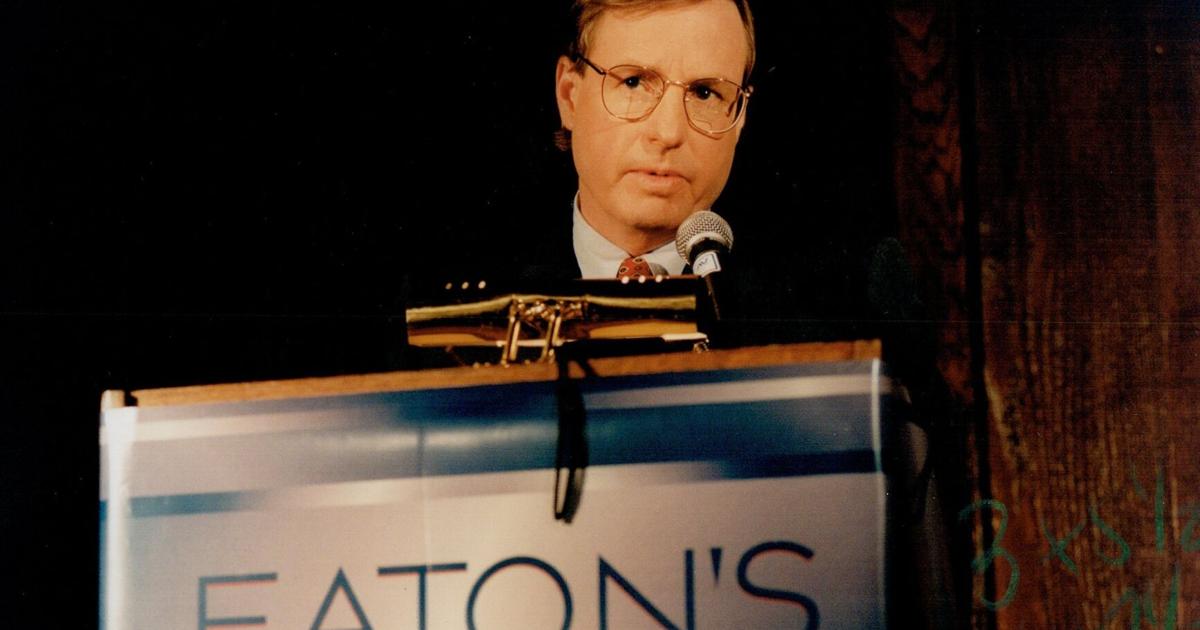
For example, in February 1997, George Eaton announced to the world at a news conference that T. Eaton Co. Ltd. was insolvent. He blamed the outcome on recent economic events, specifically the recession of the 1990s. I was at that news conference and I remember asking myself, “How could a Canadian icon, founded in 1869, fall so far, so fast?”
I interviewed George who was unable to expand upon what he’d said. George took over after his two older brothers, John Craig and Fred, had moved elsewhere. Thor had never been interested.
I soon discovered that Eaton’s had gone from a seemingly unassailable 58 per cent of department store sales in 1930 to a puny 10.6 per cent share in 1997. Most of that slide was the family’s own fault as their interests turned elsewhere to hockey rinks, racetracks, the world of diplomacy and recording studios.
My search for the answer included more than 200 interviews. My book on the Eatons came out in 1998 and won the Canadian Authors Association prize for history.
If instead you’re doing a memoir, much will come from memory or — if you’re lucky — letters you saved, a diary you kept, or family and friends who remind you about events long forgotten. In the case of my non-fiction writing, information came from research and interviews. Research includes secondary material (newspapers, magazine articles, encyclopedias) as well as primary material (archives, letters, authorized histories, interviews).
The three rules of writing a novel …
In the case of interviews, my first step is to make a list of everyone who might be able to tell me something about the person or the topic at hand. Then I start phoning and setting up sessions. At the end of every interview, I always ask two questions: “Is there anything I should have asked but didn’t?” and then “Who else should I talk to?” People usually are helpful, if only to get me off the phone or out of their office so they can get on with their lives.
If my focus is an individual, say a CEO or the head of a family business, I assume that by the time I’ve done fifteen interviews, they’ll have heard from some of those people about my project. By the time I’ve done thirty interviews, I hope the subject is itching to talk to me at length when I call, just to get their side of events on the record.
Of course, all of this applies only to non-fiction. Fiction is far more mystical. I’ve had a novel on the go for far longer than I care to say that may never see the light of day.
“There are three rules for writing a novel,” said Somerset Maugham. “Unfortunately, no one knows what they are.”