Donald Trump will go away someday. The millions of people who voted for him will still be there, as well as all the damage he’s wrought in Canada-U.S. relations.
That is the unsettling reality dawning on many of us in the two weeks since the collapse of the trade talks and the resulting stream of venom directed at Canada by Trump and his enablers.
Mark Carney has been talking about the rupture for a long time, but only now are we getting a real glimpse of how ugly it can get — also how dumb.
There’s been a real temptation, an understandable one, to see Trump’s tirades against Canada as simply ridiculous, and certainly there are voices in the United States saying the same thing.
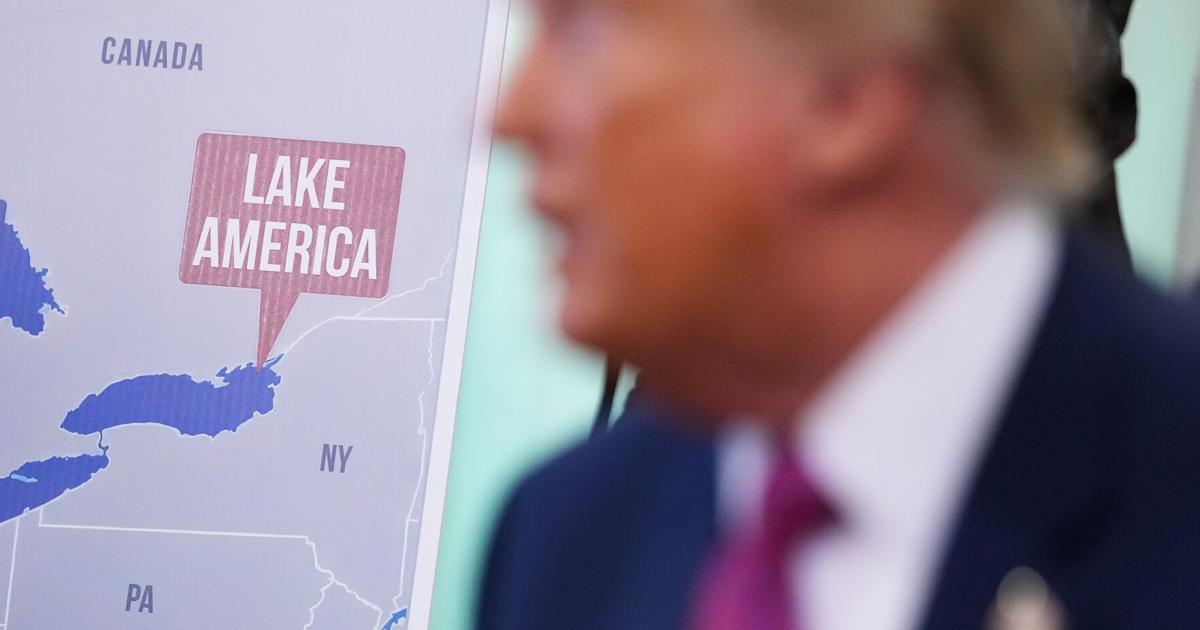
But then Canadians got to watch this week as Google and Apple went along with Trump’s renaming of Lake Ontario and suddenly his tantrum had reach.
They’ve watched too as the White House — yes, the White House — has been putting up anti-Canada memes and the “secretary of war,” Pete Hegseth, attempted to humiliate two young Canadian Army cadets with a social media post.
A new poll out this week from the Economist and YouGov showed that these rants are finding purchase with U.S. Republicans and perhaps beyond. A record 38 per cent of Republicans polled said they now saw Canada as unfriendly or an enemy of the United States and 28 per cent of the total polled, of all political stripes, said Canada had been treating the U.S. unfairly.
This is damage that doesn’t just vanish with the resumption of trade talks, and could only harden if Canada’s retaliatory tariffs on Sept. 8 trigger an even bigger escalation in the feud.
California Gov. Gavin Newsom, a Democrat, was recently interviewed by CTV’s Vassy Kapelos and he gave a lot of reassurances that Trump’s invective against Canada would go away when the president did.
“It’s just an extraordinary moment in world history, in American history, in the history between our two nations, and so we have to be repairers of the breach, and we have to call that out,” Newsom said, predicting November’s U.S. midterm elections could settle the waters somewhat.
However, when Kapelos asked him whether tariffs could be longer lasting, Newsom couldn’t offer the same reassurance that Democrats would unravel them.
“I think it’s the right question, and to be fair, it’s a foundational question on the basis of experience. You had (president Joe) Biden, who came in and actually maintained some of the tariff policy of the Trump administration, particularly China,” he noted. “And so I think, look, having targeted tariff policy is an industrial policy.”
Newsom was in Davos, Switzerland, when Carney made his extraordinary speech about a “rupture in the world order.” But in the almost eight months since, Canadians have witnessed the abstract concepts in that speech becoming all too real.
For some Canadians, those who have lost jobs or contracts or even friends, the rupture was being felt before the trade talks collapsed two weeks ago. But would anyone have predicted it could degenerate to the level it’s at now?
Jen Gerson, writing in The Line this week, said she feels like some threshold has been crossed. In a post with the headline ”(this is real),” she wrote, “Even if the country were to pull back from the brink today, it would take a generation to rebuild the norms and trust required for the United States to function, even imperfectly, as it once did.”
Or maybe it’s forever, Gerson suggested. “I think we’ve reached the end of a real bilateral relationship with the United States. Friendship is over. Even a transactional alliance is pretty damn close to the brink. Trust has broken on both sides.”
I can’t be the only one to read those words and say, yes, that pretty much sums it up. It’s not just Trump; it’s also those who are enabling him, whether it’s his voter base, the unrecognizable Republican Party or the tech giants.
It is only easy to say Trump is impermanent, or an “invasive species,” as Newsom called him in that interview, if he’s seen as the cause, not a symptom of what’s gone off the rails in the U.S., and if the past two weeks have been just noise, not a real shift. That’s getting harder to believe.
Trump, who likes to build monuments to himself, would likely bask in the idea that he’s leaving a legacy. On CBC’s “Power and Politics” this week, journalist and academic John Fraser suggested it might be a good idea to let Trump put his stamp everywhere so that Americans will forever be reminded of what he inflicted on the world.
Canadians will retain those memories too. This is what a rupture looks like and it feels like it could well outlast Trump.
Error! Sorry, there was an error processing your request.
There was a problem with the recaptcha. Please try again.
You may unsubscribe at any time. By signing up, you agree to our terms of use and privacy policy. This site is protected by reCAPTCHA and the Google privacy policy and terms of service apply.
Want more of the latest from us? Sign up for more at our newsletter page.