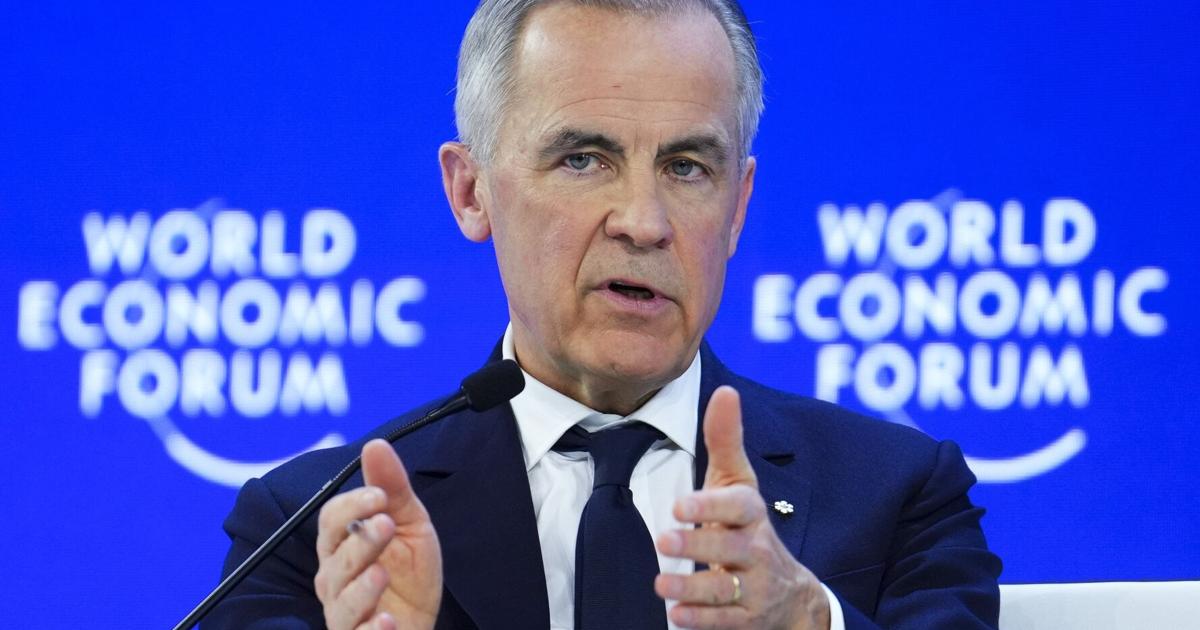
It’s been 18 months since Mark Carney was sworn in as prime minister, but the week ahead will be his real coming out.
With his much-touted investment summit in Toronto and his planned speech to the European Parliament in Strasbourg, it will be the moment when much of what the prime minister has been preaching and promising since he took power is put into practice.
Think of the investment summit as the grand opening of a heavily advertised new store.
The Carney government first created the Major Projects Office to develop and evaluate a series of big-ticket energy, infrastructure and mining projects seen as capable of boosting a Canadian economy under threat from Donald Trump’s tariffs.
They include a new oil pipeline out to the B.C. coast, a high-speed rail line from Toronto to Quebec and a deep-water port upgrade in northern Manitoba.
On Monday and Tuesday, they will be among the 167 projects the Carney government puts on the shelves, creating a shopping experience for some of the world’s deepest-pocketed investors.
Think of it as an epic ”Dragons’ Den” episode meant to turbocharge the Canadian economy.
We know from an abundance of opinion polling that the Canadian public trusts Carney to run the country at this fraught moment. The investment summit could tell us if the world of global finance has the same level of confidence in the pitches that will be made.
The prime minister has set a goal of attracting $1 trillion in foreign investment from the summit over five years.
But with days to go before the summit convenes, there are questions about the projected costs of some of these projects, and about the strength of the business case if Canada no longer holds the promise of tariff-free access to American markets.
Carney pushed back on the latter suggestion on Thursday, saying: “Canada is about so much more than being next to the United States.”
He touted Canada’s natural resources, energy and critical minerals, but also its stability and reliability, respect for the rule of law and the education and talents of the population.
“The individuals and organizations that are coming to that summit … are coming because of Canada. If they wanted to go to the United States, they would go to the United States.”
The next week will also test the power of Carney’s political persuasion.
We refer to it too often, perhaps, but the prime minister inspired his fellow world leaders to think about the world in a new way with his January Davos speech to the World Economic Forum.
He spoke about middle-power nations banding together to insulate themselves from the impact and influence of superpower bullies like the U.S. and China.
His challenge as he heads to the European Parliament on Wednesday and Thursday of next week, where he will be a guest of honour at the annual State of the Union address and then give a speech to European lawmakers, is to demonstrate that he is able to craft something more than just an inspiring political speech.
Officials in both Ottawa and Brussels have promised details about how they intend to take the economic and security relationship to a new level. The challenge is to come up with measures more substantial and tangible than the raft of bilateral agreements, strategic partnerships and memoranda of understanding that currently exist.
If Canada is to meet the Carney government’s goal of doubling trade to non-U.S. markets, the high-level transatlantic love-in needs to become concrete and reach a point at which Canadians naturally shift their gazes east to Europe rather than south to the U.S. — not just in protest of or in reaction to American tariffs.
In a paper released this week, the European Council on Foreign Relations urged deeper integration in transatlantic defence ties, including joint military exercises, co-operation in the Arctic and — perhaps most daringly — an agreement to jointly defend against threats to territorial sovereignty, whether it is challenged along the 49th parallel dividing Canada from the U.S., or in Greenland.
The paper’s author, Anand Sundar, warned that Ottawa and Brussels “should expect increasing pushback if they embark on this joint course.”
That’s a reference to the other potential bump in the path that Carney is leading the country along: the wrath of Donald Trump’s America.
The Trump administration has already signalled that it is keeping a close eye on Carney’s ambitions.
In May, a senior U.S. Defense Department official, Elbridge Colby, announced the suspension of a joint Canada-U.S. defence forum, saying there were “gaps between rhetoric and reality” on Canada’s defence spending and urging Ottawa to begin “recognizing our shared geography.”
In July, he followed it up with a social media post referring to the middle powers strategy credited to Carney as “a great deal of hubbub.”
“We are not concerned that this is a serious possibility. Rather, we are more concerned that a few allies and partners will think it is and waste valuable time, money, and political capital on a distraction.”
That is a clear warning — one that suggests Carney’s coming out next week could be seen in some quarters less as a celebratory grand opening, more as the opening round of a boxing match.
And that will put the Prime Minister up against the maxim of the seasoned former heavyweight slugger, Mike Tyson: that everyone has a plan until they get hit.