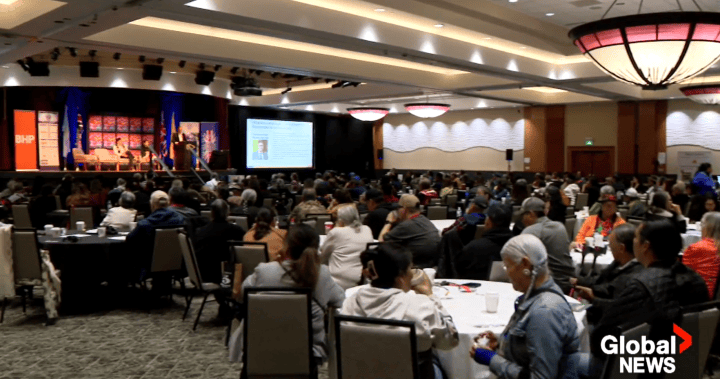
The Cree language is more than just a means to communicate. It represents culture, spirituality, and identity, something stripped away from hundreds of Indigenous peoples during their time at residential schools. Nevertheless, work is still being done to ensure the next generation knows how to speak their language.
One way is through the hard work and efforts of elders and Indigenous leaders, passing language, stories and the significance of using your native tongue. Events like the Keep Our Language Alive (KOLA) conference allows for everyone to workshop these ideals under the same roof.
“The people are lost, those people have lost their way, (and) they’ve lost their cultural identity,” shares Milton Tootoosis, the founder of the KOLA convention.
This year, the convention was completely sold out.
“It’s absolutely dynamic, very inspiring because I spend most of my time engulfed in the mainstream dominant culture which is the English language here in Saskatchewan of course,” says Tootoosis.
A big theme highlighted by the speakers this year was focusing on delivering the language to the youth. With talks on how to further incorporate Cree in institutions, school and technology.

Get daily National news
Get daily Canada news delivered to your inbox so you’ll never miss the day’s top stories.
“Teach our children the value of learning Cree or the value of learning Dene. The most important thing is that (we) keep language alive,” adds Buckley Belanger, Secretary of State for Rural Development and KOLA Speaker.
With modern day technology at our fingertips, learning a new language is easier than ever. This, inspiring one Cree teacher to create an app to teach his students how to say phrases in Cree.
“They are saying, ‘can we go to the gym?’ and they have asked in Cree. And I said, ‘well if you ask me in Cree, I’ll say yes’,” explains Vernon Lewis, creator of the How do you say this in Cree app.
The app, inspired by Lewis’ granddaughter is simple to use. Just type in a word or phrase and it will show how to say it in Cree. Lewis added the use of phrases, so users actually learn how to use the language, not just random words.
“I wanted to make sure that it wasn’t a dictionary. You can go online anywhere and look up the word dog,” explains Lewis. “But now that you know the word, the word for dog, how do you use that word in a phrase? ‘Do you see that dog?’ is the phrase that would be more common or ‘don’t go close to that dog’.”
The work to restore the Cree and Dene language to the not end here. There is a push to encourage more politicians and government officials to learn the language. With elders sharing no matter who you are or where you come from, you are more than welcome to ask them more about the Cree language.
“We learn a lot from the language about our identity, our purpose and our spirituality. I think if other people want to join our spirituality and our efforts to promote good humanity, (then) they are more than welcome,” adds Sturgeon Lake elder Willie Ermine.
Watch the video above to see footage from the KOLA convention.
© 2026 Global News, a division of Corus Entertainment Inc.