

Outside Wake’a Boo Breakfast Bar in Bloor West Village, an intimate brunch spot bathed in the pink light of neon signs spelling out phrases like “coffee first” and “this is my jam,” Anna Mattiuzzo carries a takeout container with the remnants of a weekday brunch.
Yes, she’s heard about the fate of the restaurant.
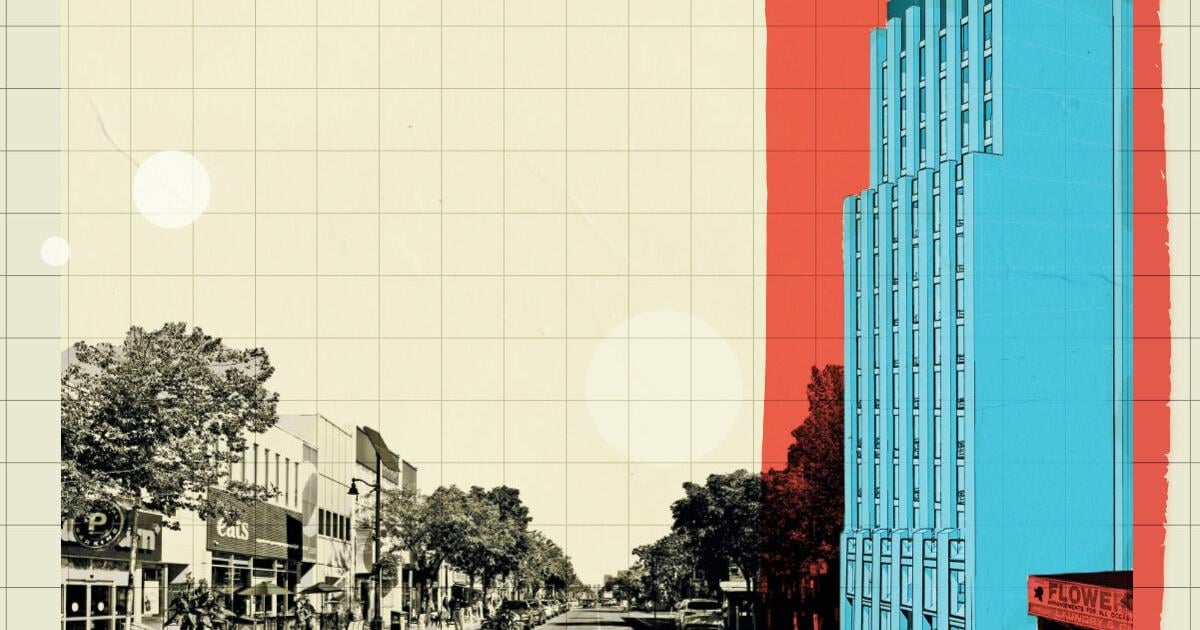
It’s slated to be demolished for a 15-storey rental tower on the strip of mostly two-storey storefronts on Bloor Street, roughly between Jane Street and Ellis Park Road.
“I’m opposed to it,” Mattiuzzo said.
“How are we going to accommodate the volume of cars onto, as we can see,” she gestures at passing traffic, “an already congested street?”
Like the Danforth and Little Italy, Bloor West Village is one of the neighbourhoods that Toronto is known for, stocked with unique and walkable small businesses. It’s also along a major street, in an area marked for growth because it’s so close to the subway.
The tower will replace the restaurant and two other small businesses, along with the rental apartments above them, according to the city, which has already approved the project.
The owner listed on the city planning documents did not respond to the Star’s multiple requests for comment.
The plans have brought out fears about parking, long shadows and the loss of charm and small businesses the area is known for.
It’s a story that’s playing out in similar neighbourhoods across the city, highlighting the challenge of increasing density and adding urgently needed housing, without losing the character that makes them destinations.
In Bloor West Village, many residents aren’t confident it can be done.
The plan
Council approved a zoning bylaw amendment for the site in July 2026, said Dan Nicholson, manager for community planning with the city, in an email. The decision was not appealed “and is now in force,” Nicholson added.
The area falls within a “Protected Major Transit Station Area,” a zone within a 10-minute walk of a major transit station, where the province mandates higher density and growth.
About 60 residential units are planned along with retail on the ground floor, and some office space, according to the city website.
Mattiuzzo fears the impact on the village. Retail in new developments tends to be big box retailers.
“If you want a city to be interesting it cannot be a row of Starbucks in perpetuity,” Mattiuzzo said. “It cannot be Shoppers Drug Mart as far as the eye can see. It needs to be diverse mom and pops.”
Too much, too tall?
There is a Shoppers in Bloor West Village, but it’s in the old red-brick 1920s-era Runnymede Theatre and has retained some of the architectural details inside. There’s a Starbucks too, a few banks, and some chains like Popeyes and Bulk Barn.
But there are also independent drug stores, quirky gift shops selling sachets of dried lavender, a place to get a watch battery replaced, a Ukrainian credit union and a Catholic Church, flanked by a line of yellowing trees.
The strip is busy on a sunny fall day. Residents dipping in and out of small grocers and running errands used words like “horrifying” and “inappropriate” to describe the tower plans.
One passerby outside the future tower site said her thoughts depend on what type of housing will be built, as more affordable units are badly needed.
Michael Younder, chair of the Bloor West Village Residents Association, opposes the development. He summed up the association’s concerns in a recent blog post.
They include parking — there won’t be any but there will be 62 bike parking spots, according to the architectural plans — and waste management.
It’s about the “proportion,” Younder said. “This building that not only is higher than the other buildings, but markedly so.”
Residents are also concerned about the shadow or “valley of doom” it would cast on the north side of Bloor, and the impact that could have on the shopping experience, he added.
Younder, who has lived in the village since he bought his first house in 1995 and raised his kids there, thinks what happens may have repercussions for other neighbourhoods in the city.
“I think this sort of sets a precedent,” he said.
“This isn’t really a not-in-my-backyard (NIMBY) situation. It’s more of a hey, is this the only place this building can go?”
More homes without height?
Leilani Farha, a housing advocate and 2026 CBC Massey Lecturer, said there are many cities around the world, such as Paris, that manage to be very dense without tall towers.
“Big buildings are kind of ugly often, and they lack character, ” she said.
While it’s clear there is a need for more rental housing in the city, it needs to be affordable, she added. Otherwise people already living there will be priced out.
“And so the question is, what’s being built here?”
Usually, these towers have one anchor tenant, a large multinational corporation that can absorb the risk.
But she believes developers should be more creative, embracing ideas like incubator spaces for small businesses. They could start by asking the community what they need.
Governments are already offering the struggling building industry breaks on property taxes and development fees, and this could be a way to incentivize developers to look outside the box.
“If there’s public money, then they should be wresting something from it,” she said.
In defence of towers
Naama Blonder, an architect, urban planner and the co-author of a new book called “Building Charm,” about the difficulty of creating new neighbourhoods, has a different view.
“We obviously need the density. We need the homes,” she said. “We’re talking about 15 storeys, not 75.”
Because the new building will be incorporated into the existing streetscape, she added, pedestrians will still enjoy the small businesses around it. And a well-designed tower can be more interesting to look at than a bulky midrise building.
She said the tension between density and neighbourhood character is a familiar one, but as the condo market has cooled, communities haven’t been having this conversation as often.
However, there are clear government policies to direct density around transit, she added.
She doesn’t blame developers for wanting big box tenants because they are less risky.
“No one wants empty storefronts,” Blonder added.
Good vibes only
Most of the existing buildings, according to the Bloor West Village Residents Association’s website, are from the 1920s and ‘30s, and protecting small businesses has long been a point of importance for the community.
Under threat from underground retail that came along with the extended subway and malls such as Cloverdale, owners formed the world’s first Business Improvement Association in 1970, the website states.
The neighbourhood was dry from the early 1900s until 1997, with no booze allowed to be sold, according to the residents association. Today there are several small pubs and restaurants where drinks flow, including Wake’a Boo Breakfast Bar. One of the neon signs there reads, “Alcohol you later.”
A small TV displays a sun setting over the ocean, while Wake’a Boo owner Irena Sacirovic serves up brunch classics as well as Middle Eastern and Balkan specialties.
“We are very sad because we need to leave,” Sacirovic said.
She said it will be difficult to find another spot in the neighbourhood. Rents have gone up since they opened three years ago.
Her customers meanwhile are “mad and disappointed,” she added.
“It will ruin the whole vibe of the village.”
Error! Sorry, there was an error processing your request.
There was a problem with the recaptcha. Please try again.
You may unsubscribe at any time. By signing up, you agree to our terms of use and privacy policy. This site is protected by reCAPTCHA and the Google privacy policy and terms of service apply.
Want more of the latest from us? Sign up for more at our newsletter page.

