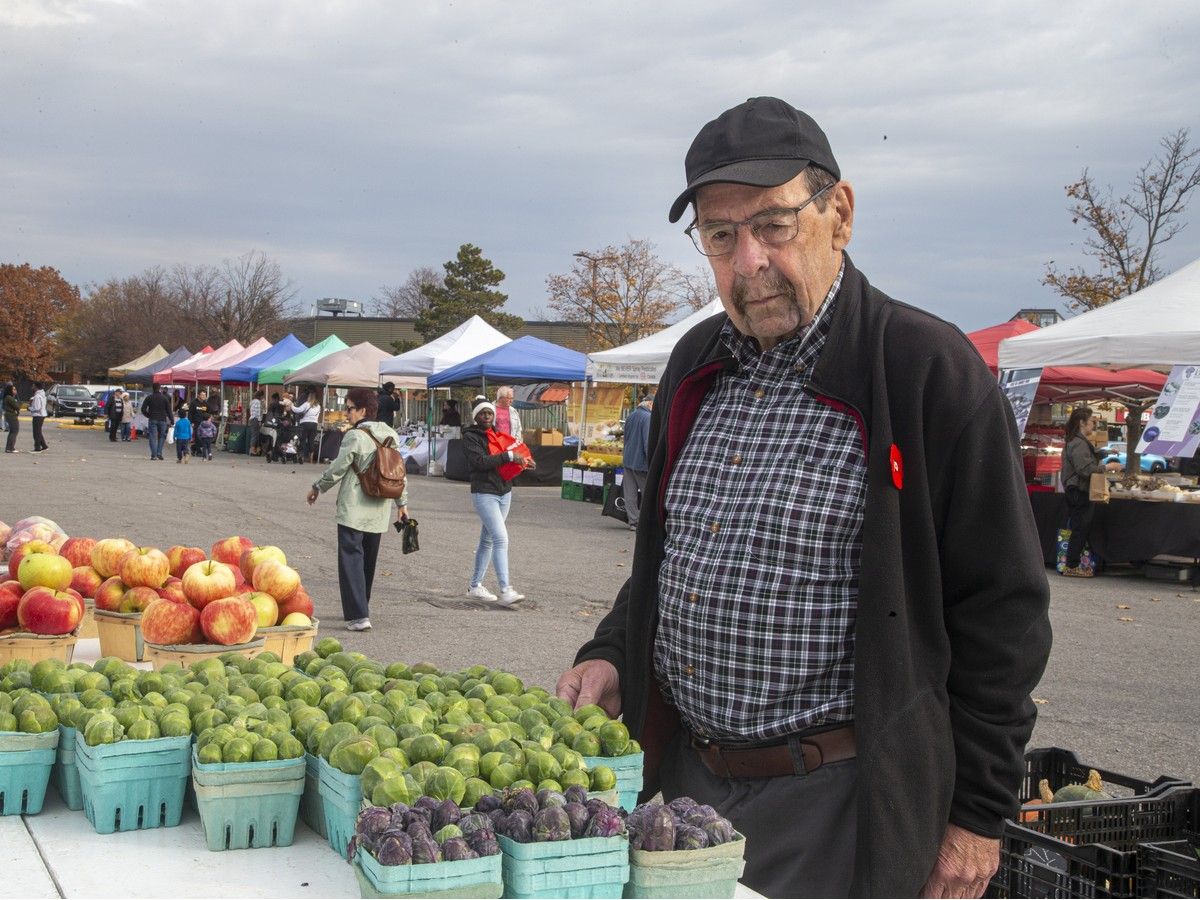
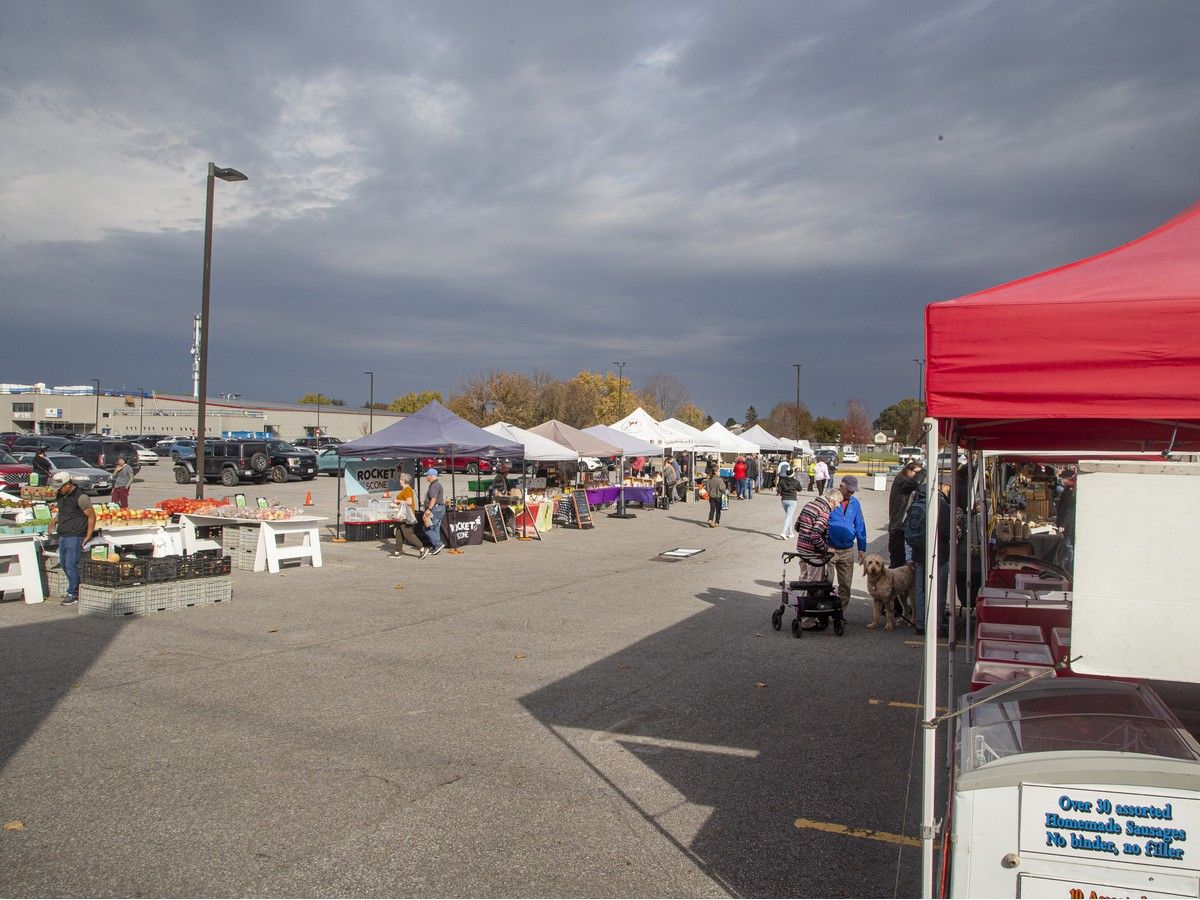
The Orléans Farmers’ Market occupies a parking lot that is not very attractive, even by parking-lot standards.
It’s just a broad expanse of asphalt that does what it’s supposed to: provide people somewhere to leave their cars while they take part in activities at the Ray Friel Recreation Complex on Tenth Line Road.
But on Thursdays during the growing season, dozens of local farmers and other producers set up their tents in the southwest corner of the lot, arrange their wares, and wait for customers.
And despite the absence of any historic architecture or picturesque cobblestone courtyards to admire, customers come.
They come for tomatoes. And carrots. And potatoes, garlic, honey, beans, meat, baked goods, maple syrup, hot sauces, coffee, soap, bee balm and all the other things you’d expect to find at a farmers’ market.
“I love everything about it,” said Gerry Labelle, an Orléans resident who shops there every week.
He shrugged when I mentioned the location’s starkness.
“But you have parking,” he replied. “Business is business.”
Which raises a question I’ve been thinking about lately. How is it that farmers’ markets can flourish in parking lots, on berms and at other unremarkable spaces across Ottawa, while the city’s most famous market — the one actually named after a market — can hardly attract a farmer?
Is there any point in trying to bring them back? And what would it take?
Many people I’ve spoken with believe the ByWard Market needs farmers back as part of its rejuvenation and salvation. Markets animate spaces. They make people want to be there.
Others, however, say the produce stalls that once defined the area are simply another part of Ottawa’s history that has come to an end.
So I spent a couple of Thursdays at the Orléans Farmers’ Market asking the people who actually do the growing, producing and selling what they thought.
One thing quickly became clear: the ByWard Market of old, where vendors arrived before dawn and stayed until dark, six or seven days a week, isn’t coming back. None of the farmers I spoke with seemed interested in resurrecting that model.
And they certainly don’t want to return to the days when they competed with resellers — merchants who bought produce wholesale and sold it alongside farmers who had actually grown theirs.
Farmers, after all, take all the risks associated with growing food, paying for land, labour, equipment, seed and all the other costs. Resellers can simply buy what they need, often at wholesale markets in Montreal or Toronto, and sell it at prices local growers can’t match.
For a time, the Market used green, red and yellow signs to help shoppers differentiate between farmers, resellers and hybrid vendors, but farmers say the system didn’t work well. It was sort of like having Loblaws set up a stall amid local farmers.
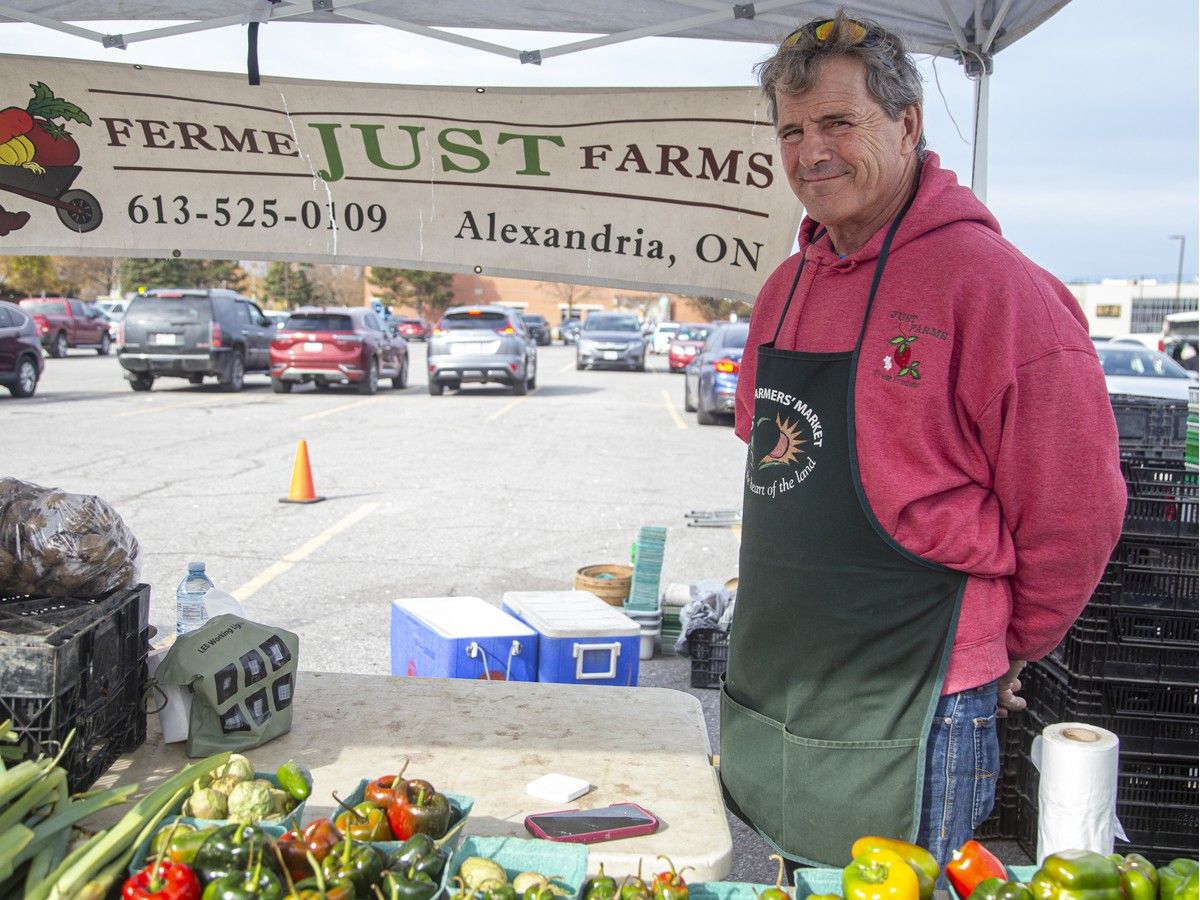
Marc Just, who operates Just Farms in Alexandria and once sold at the ByWard Market, remembers those resellers well. He says you could identify them by their suntans: one arm was darker than the other from all the driving they did to Montreal and back to buy produce.
It’s a funny description, but the consequences for farmers were nothing to laugh about.
And it’s hardly a new complaint. A federal Department of Agriculture report published way back in 1940 found that one of the most common suggestions from ByWard Market farmers was to get rid of the resellers, then known as “hucksters.” The only more popular suggestion was to put a roof over the market.

Ann Marie Rochon, whose family sold produce in the ByWard Market for generations, has no interest in returning.
“I think it’s dead,” she said. “I think it’s had its time … The ByWard Market has changed. I think it is more of an entertainment district now.”

Linda Bergeron, who sold in the ByWard Market for more than 30 years and whose mother sold there for 55 years, remembers the long hours, inadequate facilities and a sense that the people running the market didn’t appreciate what the farmers needed, noting that resellers were allowed larger stalls than growers.
“They had their mind done,” she said of the administration, “so whatever they had in mind … that was pretty much it.”
She’s not interested in going back, either.
But it’s not like farmers’ markets are dead. Far from it.
In fact, one of the consequences of the ByWard Market’s decline was the creation of Ottawa Farmers’ Market, an organization established by producers who wanted a different way of doing business.
OFM, the ranks of which include more than 100 area producers, operates five markets — at Lansdowne, Westboro, Main Street, Orléans and Barrhaven — where farmers and other local producers sell directly to customers, without having to compete with resellers.
The OFM markets generally operate for a few hours on one day of the week, rather than requiring farmers to spend most of their waking hours downtown selling.
And judging by the customers who turn out, the model is working.
Just, who’s been farming for decades, says his farmers’ market business keeps getting better.
So the problem doesn’t appear to be that people have stopped going to farmers’ markets; they simply stopped going to the ByWard Market.
It’s understandable. Orléans residents can buy their vegetables in Orléans. If you live near Westboro, you can shop there. There’s less reason to drive downtown, find a parking spot and haul your groceries back to your car.
But even if the ByWard Market will never again be like the days of yesteryear, drawing customers from every part of the city for produce, that shouldn’t necessarily be the death knell of its market.
Just as farmers’ markets have found success serving individual Ottawa neighbourhoods, why couldn’t the ByWard Market have one of its own?
It is a growing residential neighbourhood with condos and apartment buildings sprouting like a bumper crop of corn. Why shouldn’t they have the same sort of market that residents of Westboro, Orléans and Old Ottawa East enjoy?
For all the talk lately about keeping our elbows up and buying Canadian, it’s hard to imagine a better way of supporting local producers than buying food from the people who actually grow it.
Just said he would consider selling in the ByWard Market again, provided it was a genuine producer-only market with a manageable schedule.
Kodie Gills, of Horizon Hog Farm, said he’d be open to the idea, though he wondered whether downtown condo residents would buy the quantities of meat to make it worthwhile.
In 2021 and ’22, the ByWard Market tried a producers-only market on York Street, but it didn’t last. Of course, the timing was less than ideal, coming during the pandemic.
Dain Burrell was one of the farmers there. He recalls a promising start, followed by declining sales, while the demands of attending other markets led him to drop ByWard. He hasn’t given up on the idea of returning, though, with the same caveats that Just proposed. Burrell believes that a weekly market gives customers something to anticipate.
“If you go one day a week, people get hungry,” he said. “They wait for you.”
Would he return to the ByWard Market if OFM established a market there?
“Oh, yeah, for sure,” he said. “One hundred per cent.”
Steph Kittmer is the general manager of Ottawa Farmers’ Market. Their markets, she says, are different. Orléans, for example, is a grab-and-go market, where customers come primarily to buy their groceries. Westboro and Lansdowne, on the other hand, are more integrated into the social life of their neighbourhoods. But all of their markets have something in common: “We thrive in environments where people, the customer base, wants us there.”
That doesn’t mean every location is a guaranteed success. OFM tried operating a market in Riverside South, without much luck, before moving it to Barrhaven, where Kittmer says it’s doing well.
I asked her whether OFM might consider operating a weekly market in the ByWard Market. It would seem to me the exact sort of legacy the city and ByWard Market should commit to for ByWard’s 200th anniversary next year.
Kittmer couldn’t commit to anything — she answers to a board of directors — but said she was open to discussing the possibility.
It would make sense. Farmers’ markets are the only thing that OFM does. The ByWard Market District Authority, which oversees operations in that area, has the much more complicated task of balancing the interests of businesses, restaurants, residents, tourists and others. It might welcome the farmers’ input.
But when I reached out to the BMDA, the response was less illuminating. My request to speak with Michelle Groulx, its interim CEO, was declined. Her office instead provided a statement:
“One of the first things I heard when I joined the BMDA was how much people want to see local farmers and producers return to the ByWard Market,” it read in part. “As we approach the Market’s 200th anniversary in 2027, we’re looking at how markets can once again play a central role in the ByWard experience.”
Then, later, “The interest, collaboration, and momentum are already there.”
Perhaps, but collaboration with whom?
The organization that already operates five successful farmers’ markets throughout Ottawa hasn’t heard from the BMDA, according to its manager.
Perhaps this is where City Hall, including the mayor’s office, should take a more active role.
Rather than simply hoping the farmers will find their way back, why not invite Ottawa Farmers’ Market and its producers to the table? And this time, make sure the arrangement works for the farmers, rather than expecting the farmers to work around the arrangement.
If farmers’ markets can flourish in bleak parking lots, it’s worth finding out whether one can succeed in the ByWard Market.
Related
Take control of your search results. Make the Ottawa Citizen a preferred source on Google and see verified local reporting first.