

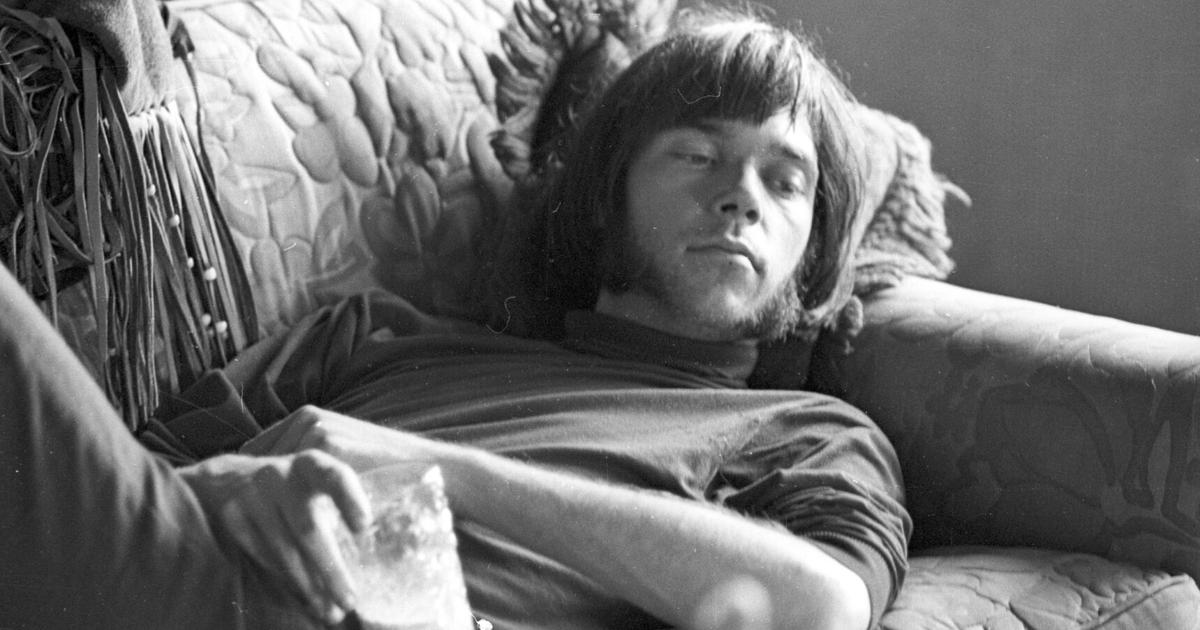
The lustre of Toronto’s now-tony Yorkville has its origins in the music scene (centred on the famed Riverboat Coffee House) that burgeoned there in the mid-‘60s, where hordes of young people flocked to hear local stars, touring acts and a young, bound-for-glory Joni Mitchell. However, an even bigger name than hers struggled to find his place in that scene, and he soon moved on. From “Yorkville: How a 1960s Coffeehouse Scene Rewrote Popular Music” by Mike Daley.
After his parents divorced, Neil Young and his mother moved from Toronto to Winnipeg. Neil became obsessed with the guitar in high school and put together a disciplined instrumental band called the Squires. With a burning desire to make it as a musician, he brought the band to Toronto on a whim in July 1965. At first he lived with his father, journalist Scott Young, and then in a series of crash pads from 88 Isabella St. to folk singer Vicky Taylor’s flat above the Night Owl coffee house at 102 Avenue Rd.
Neil connected with local manager Martin Onrot, who took on the Squires and renamed them Four to Go.
Neil Young: The Yorkville scene. I’d never seen anything like it. Music was everywhere … The Riverboat was an upscale thing — people who played there were really making a living … We didn’t succeed in taking Toronto by storm. It was a tough time. We were small fish in a big pond, had no reputation, and really there was nothing special about us in the big city. We were out of our league.
Four to Go broke up without ever getting a local gig. Neil, who was soaking up Yorkville folk music, tried his hand for a while as a solo folk singer and songwriter but met little success. He does not seem to have played even one advertised gig under his own name during his months in Toronto. The only exception he remembers is a last-minute fill-in for a sick performer.
The only way Neil was going to play the Riverboat was by auditioning for the Monday night hootenanny. This was no open stage, but a multi-performer night with a small amount of pay and an audition for Estelle Klein (founder of the Folk Guild, the musicians’ collective which ran the event) to get a slot. Neil auditioned and did appear at least two times.
In a photograph from the winter of 1965-66, Neil sings at a Riverboat hoot, his overgrown Beatle haircut poking out from under a leather fisherman’s cap. The microphone stand is too short for his lanky frame, and he is leaning over to sing, strumming a borrowed guitar.
The Folk Guild hoot was one thing, but an actual gig at the Riverboat would have been preferable. Neil asked Riverboat manager Burnie Fiedler for one, but was turned down.
Vicky Taylor: One night they got into an argument and Burnie said that Neil howled like a dog and told him to take his horrible voice and never come in his club again. Neil said, “You know what, Burnie, some day you’re going to beg me to play here.”
Adam Mitchell: (At the Riverboat) one night I walked in and this guy Neil Young was up on the stage. I remember standing there hearing that voice. He’s playing (affects nasal, shaky voice) “Oh to live on Sugar Mountain.” I remember thinking, “Oh dude, don’t give up your day job.” You know, dreadful.
Not all of the feedback was negative. A few folkies on the scene believed in his talent.
Neil Young: One night after hearing me at a hootenanny, Chick Roberts of the Dirty Shames told me he really liked my song “Sugar Mountain” — that made me feel like I was somebody.
For a while, Neil lived with Vicky Taylor in her apartment above the Night Owl.
Neil Young: I was at the bottom, kinda like the new guy. I wasn’t that good, y’know. My songs were pretty dumb … they were what they were. Vicky Taylor was just a good friend. She had an apartment above the Night Owl — I lived there a little while. She was a little bit crazy. She would get real sad about things … but not for long. She was a real party girl. Had a little bit of money, liked to have a good time. Let me sleep on her floor.
Vicky Taylor: I was the only one with an actual job; I was making $50 ($500 in 2025) a week. So I rented this apartment over the Night Owl club on Avenue Road. And it was just one huge room. It had a bathroom, but no kitchen. And it had a bedroom in that. That was my private space. But when I came out in the morning, I never knew how many bodies would be there or who they would be. The door was never locked. I was the mama. I took care of everybody and I fed everybody with this concoction that my mother taught me called guck, which is sort of like chili without the chili in it. I would just make a huge pot of this stuff. And then when it was gone, I would make more, but there were times when it was Kraft Dinner, and boy, I have never been able to eat Kraft Dinner since. There was a whole bunch of instruments in there and everything, people’s belongings, and nothing was ever taken.
There was only one chair in the place, a big green chair in the corner and (Neil) would be curled up in there writing his songs. I remember when he wrote “Nowadays Clancy Can’t Even Sing,” and that song really impressed me. I saw genius in that boy, that’s for sure. Not that I had much power to do anything for anybody, but, you know, I tried to do whatever I could.
Salvation came in the form of Bruce Palmer, Mynah Bird bassist, who met Neil precisely at the moment that the band was desperate for a new lead guitarist.
Bruce Palmer: I ran into Neil on Yorkville Avenue. He was carrying an amplifier on his head. You didn’t see many people carrying that around back then. He was looking for people to play music with, so I asked him to join my group.
Neil moved into an apartment on Isabella Street with Ricky James Matthews; this flat was later commemorated by Neil along with other Toronto locations, including the Riverboat, in his 1972 song “Ambulance Blues.”
Rick James: Neil and I had just started writing together, and while our songs were good, I was sure that in a few more weeks they’d be great. Neil had this machine-gun style on the guitar that inspired melodies and lyrics out of me.
After the breakup of Four to Go, Neil had traded in his electric guitar for an acoustic 12-string with a pickup mounted in the soundhole, which lent the Mynah Birds a folk-rock patina. Soon Eaton’s retail empire scion and Mynah Birds benefactor John Craig Eaton bought Neil a Rickenbacker electric to use. Neil played only a handful of gigs with the Mynah Birds before they travelled to Detroit to record at Motown.
There, in addition to recording their own album, the Mynah Birds found themselves being used as studio musicians for other acts, in line with the company’s assembly-line approach to record production.
Rickman Mason (drummer): Twenty-four seven, day and night until we dropped. They would take us into the studio individually — I bet you I did maybe 30 tracks by myself. I still listen to Motown songs and wonder if that’s me playing on them.
Neil Young: It was a very cool time and place. We even went to choreography school to learn how to move, and I’m sure we flunked, but they treated us well. They fitted us for clothes. We were on our way to the big time!
A single, “It’s My Time”/“Go On and Cry” was prepared for release on Motown’s V.I.P. imprint. Co-written by Ricky, Neil and R. Dean Taylor, “It’s My Time” offers a glimpse of what might have been. Ricky sings the tightly written, dramatic soul-rock song with a confident swagger and a compelling, gravelly voice. Neil plays a memorable 12-string acoustic guitar line that floats ethereally on top of the mix.
With the album in the can, the rest of the band went back to Toronto. Ricky was waiting for his share of the $25,000 ($233,000 in 2025) royalty advance from Motown. When the band’s handler Morley Shelman couldn’t produce it, the two got into a physical altercation. As revenge, Shelman told Motown that Ricky was a Navy deserter. Motown brass, uneasy about this situation, convinced Ricky to give himself up to the authorities. Reportedly the very day that the “It’s My Time” single was to be issued, Motown cancelled the release.
Back in Toronto, Ricky broke the news to Neil Young and Bruce Palmer before returning to Buffalo, where he gave himself up to the FBI. He was sentenced to five months of hard labour, escaped, then turned himself in and spent more time in prison.
With their frontman in the Navy brig, Neil and Bruce quit the Mynah Birds. The rest of the group soldiered on with replacements, still backed by John Craig Eaton, and closed up shop in the early summer of 1967.
At loose ends, Neil and Bruce hung out at the Cellar (a venerable Yorkville coffee house) at 169 Avenue Road. The club was still open but its founders, Steve Ciotlos and Sam Shirose, were no longer at the helm.
In September 1965, Ciotlos had rented the Cellar to Scotty Mair, a former Toronto Telegram reporter, and two Yorkville waitresses, Jeanine Hollingshead and Bev Davies.
Jeanine Hollingshead: We had taken over the Cellar and we were keeping it open as an all-night café. Neil played in there and Daisy DeBolt played in there. The jug bands played in there. This was in the days when the Telegram was out on strike. Scotty was one of those reporters that got displaced during the strike, and he was very active around Yorkville. He said, “Look, let’s just do this. Let’s just have an after-hours club.” I think we were practically living in it.
Around the corner at 182 Dupont (still standing in 2025), Ciotlos opened a second Cellar, which he called the Cellar Jazz Club (as opposed to just “the Cellar”) on New Year’s Eve 1965. This was a much bigger space than the tiny Avenue Road location — 250 seats — and Ciotlos was thinking bigger with his bookings as well. The public was confused, and no doubt a few jazz fans showed up at the old Avenue Road location to find a skinny longhair named Neil strumming an acoustic guitar in a corner.
Neil Young: I was in Toronto, in the middle of the night, sitting in a funky after-hours dive called the Cellar. I was with Bruce Palmer … The group had just broken up, Bruce and I were just sitting there, probably pretty stoned, and I asked Bruce if he wanted to go down to L.A … He said yes, so we sold all the band’s equipment (even though it had been purchased for the Mynah Birds by John Craig Eaton) to buy a ’53 Pontiac hearse. We loaded it up with three girls and another guy, all from Yorkville Village.
On Tuesday, March 22, 1966, Neil and Bruce headed to Los Angeles with Jeanine, folk singer Tannis Neiman, Judy Mack and Mike Gallagher. Somewhere along the way, Jeanine, Mike, and Tannis peeled off from the group, which arrived in Los Angeles on April 1. What follows is the stuff of rock legend, as Neil and Bruce found themselves stuck in L.A. traffic when they were spotted by Stephen Stills, an acquaintance of Neil’s. This led to the formation of Buffalo Springfield, the innovative group that launched Neil, Bruce, and Stephen into the big time.
Back in Toronto, the Avenue Road location of the Cellar was closed, abandoned by its young proprietors. Around the corner at the Dupont location, Steve Ciotlos was losing money on his new high-profile jazz bookings. He vented to jazz promoter and journalist Dave Caplan about the reception of his ambitious new club. “Where are all those so-called jazz fans who are endlessly screaming for more jazz around town? When I give it to them they don’t show up.” Just over six months after opening, the Cellar Jazz Club on Dupont was shuttered.
Excerpted from “Yorkville: How a 1960s Coffeehouse Scene Rewrote Popular Music” by Mike Daley. Copyright © 2026 Mike Daley. Published by Sutherland House Books. Reproduced by arrangement with the Publisher. All rights reserved.

