Last fall, the Toronto Police Service released a trove of data for the first time, offering a glimpse at the extent of domestic violence across the city. The numbers were sobering: Each year over the past decade, there have been between 17,000 and 19,000 reported incidents of intimate partner or family violence in Toronto. And that figure has not budged.
We know, of course, that this is only the tip of the iceberg. According to a Statistics Canada report from 2019, roughly 80 per cent of domestic violence cases go unreported.
The issue with our response to this epidemic, I believe, is that we often only look at domestic violence through statistics like these. The raw data, no doubt, is important. It helps guide public policy and social advocacy. But when we only look at domestic violence from a statistical lens, we lose sight of the very human toll — and very human stories — behind each of those numbers.
Theatre can offer a different way of seeing that human toll. In recent years, we’ve seen more playwrights tackle themes of domestic violence in their shows. We’re also seeing more companies programming these works into their seasons. I’m thinking of shows like “Girls & Boys,”“Blackbird,”“Enormity, Girl, and Her Earthquake in the Lungs” and, now, “Pre-Existing Condition,” Marin Ireland’s shattering drama that’s currently receiving its Canadian premiere at the Coal Mine Theatre.
All these shows deal with domestic or intimate partner violence. All demonstrate the theatre’s capacity to be a social catalyst. But all are also unique in their own ways. And Ireland’s play may be the most delicate of the bunch.
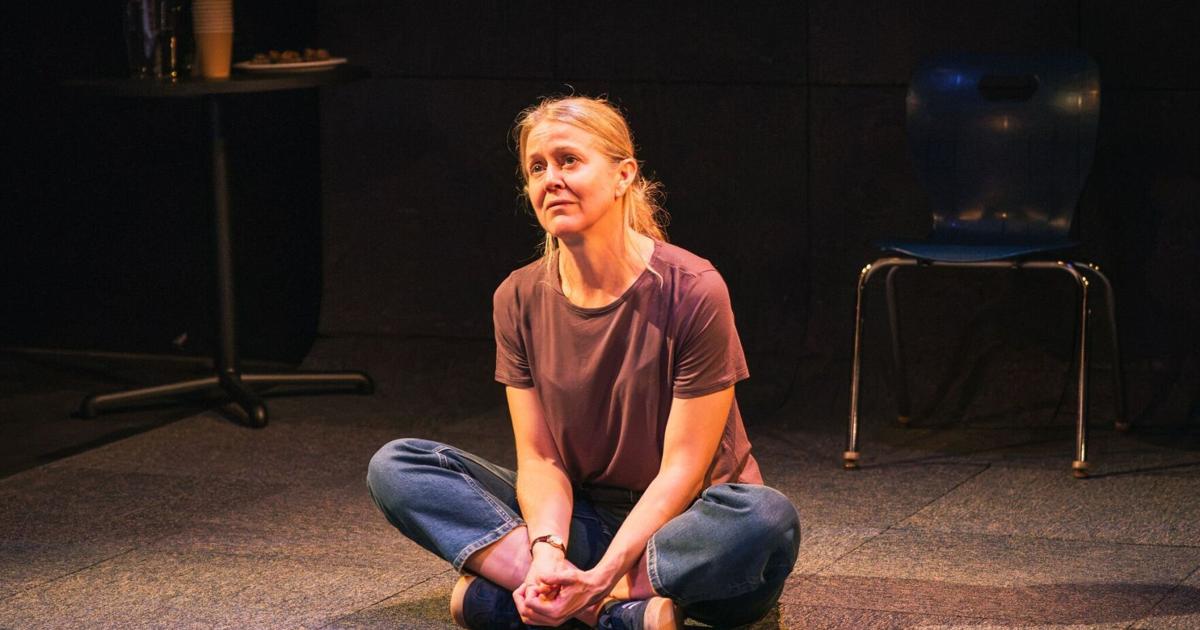
Loosely inspired by Ireland’s own experience with intimate partner violence, “Pre-Existing Condition” examines what it means to rebuild one’s life after escaping an abusive relationship. It’s a story presented through the eyes of an unnamed woman, simply known as “A” (portrayed by Amy Rutherford).
Like a Picasso portrait, her world is distorted and fragmented. So too is the structure of Ireland’s 75-minute play, which to sit through feels like walking through a hall of mirrors.
Scenes and characters are elided, enjambed like disparate thoughts loosely connected by ellipses. Three supporting characters, known only as “B,” “C” and “D” (and played, respectively, by Lindsay Leese, Diana Bentley and Philip Riccio), portray everyone from the protagonist’s gossipy mother and unhelpful friends, to her prying dates and pair of awkward yet well-meaning group therapy facilitators.
These roles are all blurred together. Riccio, for instance, plays the main character’s mother in one scene, only to return in the next as her close friend, all without changing his costume or modulating his voice.
Shifts like these are confusing. But they’re also intentional. And what Ireland ends up capturing, so astutely, is the whirlwind, jagged nature of trauma and recovery, and what it means for a survivor to pick up the pieces after leaving an abusive relationship.
For “A,” it’s not just the world around her that’s swirling about, but also what’s happening inside. She’s constantly in her own head, questioning her choices and blaming herself for what happened.
Rutherford, never leaving the stage, offers a quiet yet probing performance as the unnamed central character. She speaks as much with her gaze as with her voice — her eyes, at times, dart about, expressing fear, curiosity, confusion.
Director Linda Kash does a fine job of staging this fragile story. It all plays out on a purposefully drab, grey set (designed by Michelle Tracey), with three chairs and two round tables. Louise Guinand’s lighting does much of the heavy lifting, with quick cues marking a change of scene.
I think this abstract production design, this deliberate choice to avoid placing the story in a clearly identifiable setting, is meant to emphasize the universality of Ireland’s story. What happens to “A” can happen to anyone, anywhere, at any time. And it does.
Where “Pre-Existing Condition” perhaps falters is in its ending, in which “A” breaks the fourth wall for the first time, and speaks directly to the audience. It’s a final cadence that feels a bit too neat and tidy for a show that’s anything but. And it’s here where the story Ireland tries to tell clashes against the traditional confines and parameters of the stage.
A play needs to end. It needs a form of closure of some sort. But for so many survivors of domestic violence, there really is no formal closure, no clean ending. It’s a pain that lingers on, and on, and on.
Error! Sorry, there was an error processing your request.
There was a problem with the recaptcha. Please try again.
You may unsubscribe at any time. By signing up, you agree to our terms of use and privacy policy. This site is protected by reCAPTCHA and the Google privacy policy and terms of service apply.
Want more of the latest from us? Sign up for more at our newsletter page.