There exists in 2026 a great delicacy in explaining affinity for the band that played Massey Hall on Thursday night. No one can doubt their resumé — a decade of hit songs, including “Ventura Highway” and “A Horse with No Name,” and a multi-platinum record — but their name carries with it some unfortunate weight.
“I like America” just doesn’t sound quite right in today’s world. Such a statement must be immediately followed by a caveat along the lines of, “the band, not the country.”
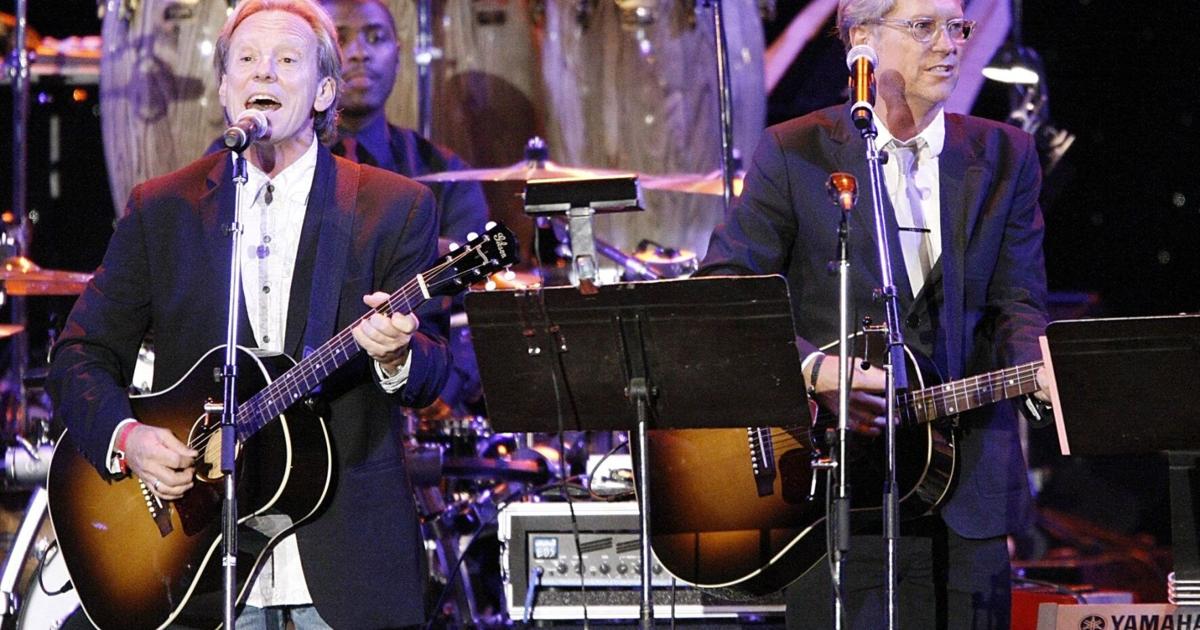
The more than 2,000 fans who showed up Thursday for the latest stop in the Happy Trails tour by the 1970s group — or what’s left of it — got a breezy, contemplative and nostalgic show, one that ran through the hits and then some.
By now — 56 years after forming as teenagers near London, England in 1970 — America has been reduced to only one original member. Dan Peek, the singer-songwriter turned contemporary Christian artist, left the group in 1977. Gerry Beckley retired from touring in 2024. That leaves Dewey Bunnell to lead the charge, accompanied by supporting artists Andy Barr, Steve Fekete, Richard Campbell and Ryland Steen.
The band’s music is by nature nostalgic, and it lent itself well to a setting where nostalgia was the chief emotion. The show began with a montage of America’s greatest hits and their appearances in pop culture — on “Saturday Night Live,” in the Grand Theft Auto video game series, during break dancing at the 2024 Paris Olympics and in “The Sopranos.” (The latter generated the biggest cheer.)
Then Bunnell, 74, bounded on stage and the time travel began. First, “Tin Man” — an enigmatic song in a catalogue full of them, a song that in a single verse references “The Wizard of Oz” and the Arthurian knight Sir Galahad. “Smoke glass stain bright colour,” Bunnell sings. “Soapsuds green like bubbles.” Parse that.
Laid out in that song, an appropriate tone setter for the night, is the magic of America. The music washes over you with impressionistic lyrics, more feeling and instinct than literal interpretation. The overwhelming vibe — for this listener, at least — is one of yearning for something lost. After 56 years, that works better than ever.
Bunnell’s voice is not as strong as it used to be; he traded off a handful of songs to Barr, who had some of the night’s best moments, including remarkably tender renditions of “I Need You” and “Daisy Jane.” But to hear Bunnell sing some of his more melancholic lyrics brings new meaning to old songs. The words to “Here” — “Within the time we’ve spent, wonderin’ what we meant, by living all those years” — mean something entirely new when sung by a 74-year-old.
And the wonderful three-part melodies key to America’s sound still work, even if two of the original voices are gone.
The emotional climax of the night came during “Lonely People,” a song on finding love, written by Peek, who died in 2011. Midsong, the stage lights dimmed and focus turned to the backdrop, where a video of Peek singing the verse played, mixed perfectly with the live band.
But that same backdrop also brought some of the night’s worst moments, too. For nearly the entire show, the projections were merely a distraction — a flashing screensaver of stock photos and, on three occasions, seemingly AI-generated montages. When Bunnell sang the “Sandman” lyric, “All the planes have been grounded,” a pixelated photo of a plane flashed on screen. The visuals were unnecessary at best, embarrassing at worst.
The show ended with a powerful two-part punch: the Vietnam War time capsule “Sandman” and the bittersweet questions of “Sister Golden Hair.” Then, for an encore, Bunnell played America’s most recognizable — and bewildering — song, “A Horse with No Name.”
Its lyrics are perhaps the most cryptic of any of the band’s ballads. In introducing it, Burnell joked even he doesn’t know what it means. But in performing, understanding or not, it brought about all the same feelings — of wistfulness, regret and yearning.
Even after 56 years, America’s music still does its job.