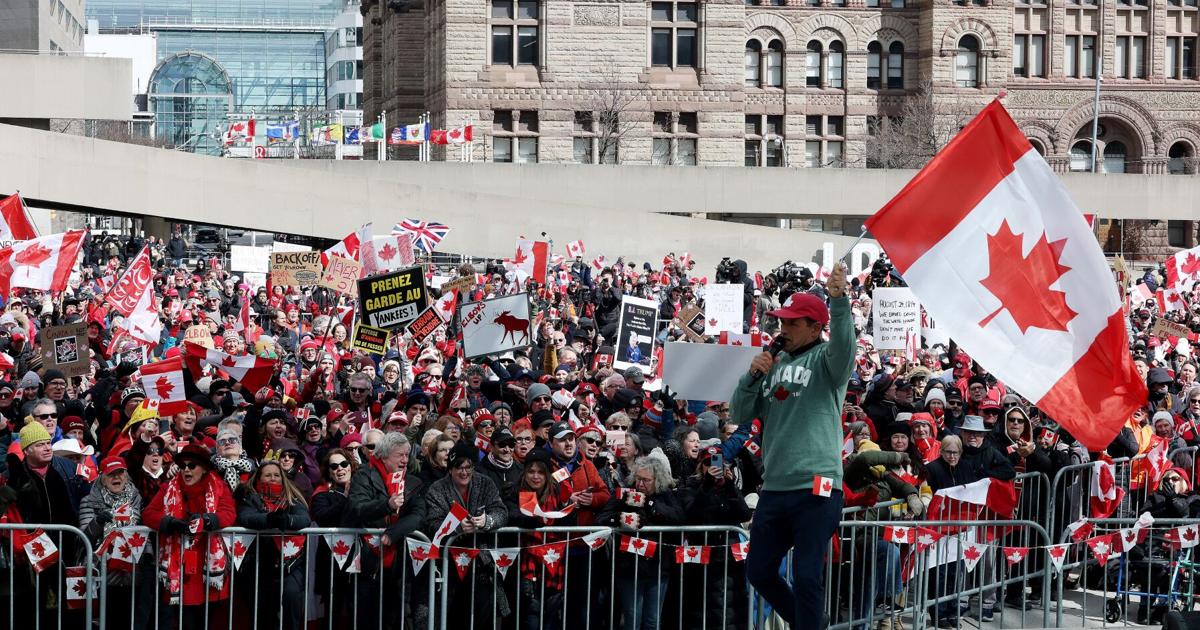
Crowds furiously waving Canadian flags. Boycotts of U.S. booze and beach vacations. And a pledge to “Buy Canadian.”
It’s been more than a year and a half since those protests and rallying cries were a common sight across Canada, when Scarborough-born comedian Mike Myers put his elbows sky high during an appearance on Saturday Night Live following sweeping tariffs and annexation threats from U.S. President Donald Trump.
Despite fraught tariff talks and the president’s recent jabs at how “nasty” Canada’s leadership is, it appears the momentum has waned, and the movement behind having Canadians go “Elbows Up!” — a riff on a defensive hockey move — seems less like the one that dominated the national consciousness during the early 2025 election cycle.
Official Elbows Up organizations say they’ve disbanded due to dwindling turnouts, and there’s a hint of a possibility that American booze may be coming back to Canadian shelves.
So, are Canadians’ elbows still up? As Canada enters a trade war with the U.S., some say the on-again, off-again threats have changed their sense of pride for good and that the damage by the Trump administration has already been felt.
In that sense, many argue the fighting spirit continues to thrive.
“That’s what good movements do: they instil pride and sustain itself,” former steering member of Elbows Up Toronto Anne Marie Aikins told the Star, suggesting support is more on a personal level now.
The signs are still there: There might’ve been more travel to the U.S. in June than the same time last year (up five per cent), but the numbers are still well below pre-second administration Trump levels (down 25 per cent compared to June 2024), according to the latest data from Statistics Canada.
Additionally, a recent poll from Pollara Strategic Insights suggested roughly four in five Canadians back the prohibition of American booze. The Buy Canadian forum on Reddit also saw a 163,000 spike in page views in the week following Trump’s July announcement that he would impose tariffs on $28 billion in Canadian goods and flag makers continue to report high sales.
The end of Elbows Up! in Toronto
Elbows Up was the grassroots, non-partisan group that hosted a thousand-person rally in Ottawa before spreading to other cities such as Toronto, which drew a crowd of about 1,500 at a rally in March 2025.
Aikins, previously a spokesperson for the Toronto Public Library and Metrolinx, joined a collection of local activists and professionals to form the Toronto chapter, which hosted meetings to discuss challenges facing the country.
“Canadians were very frightened … when you talk about your fears, you collectively feel better,” Aikins said.
Aikins says the attendance really waned by fall 2025 as Canadians moved on to other issues: “People have to go on with their lives, and they learned their own ways to cope with that, and trust that our leaders were doing something about it.”
The organization quietly decided to disband in October after deciding it had served its purpose. It was never meant to be permanent anyway, according to Aikins.
“You don’t need a group to continue the pride.”
Boycotts and ‘Buy Canadian’
Calls to “Buy Canadian” erupted from the initial wave of tariffs.
Data on consumer habits is largely self-reported, but a larger study of about 10,000 households from the Bank of Canada found that money spent on Canadian food peaked in July 2025 when those studied spent about two per cent more (to 76 per cent of all spending at the grocery store) on homegrown and locally produced products compared to July 2024.
Gary Sands, the vice-president of the Canadian Federation of Independent Grocers, said that focus has since shifted as “affordability still trumps Trump” in the minds of average Canadians fighting against the rising cost of living, but the label consciousness from last year has been imprinted on people.
It’s something Tracey Arts, a director with the Ontario Federation of Agriculture, echoed.
“People still want to know where their food came from; that question was never being asked before,” Arts said.
Sands said it also forced action from the government, like the National Food Security Strategy’s announcement in July aimed at reducing the sector’s reliance on other countries.
“When we look back at this period, we’ll ask, ‘Was (the Buy Canadian push) the most meaningful thing that occurred?’” Sands said.
While U.S. booze may be coming back to shelves, 42 per cent of respondents to Pollara’s poll said they would boycott American wine and spirits, something Pollara’s chief strategy officer Dan Arnold said “is cross-partisan, cross-demographic” and “unites both heavy drinkers and non-drinkers.”
The ‘new normal’
Greg Inwood, a professor at Toronto Metropolitan University studying Canada-U.S. relations, says that our current relationship with the Americans represents a “new normal” for Canadians, at least for the next couple of years.
“The Elbows Up sentiment at the (public) level is close to being as strong as it was when this all started,” Inwood argued, citing travel to the U.S., widespread polling numbers about attitudes toward Americans and Trump.
Inwood says the big test for Canadian nationalism will come once Trump leaves office.
He added that this collective support is comparable to a wave of pride the country felt in the 1970s and early 1980s as the nation was shaping its own cultural identity, though he argues it was later dampened by the 1988 Free Trade Agreement between Canada and the U.S.
He says the deal drew the countries too close together and made Canada too reliant on America, both economically and culturally.
He said that every new tariff revives some of that Elbows Up momentum, and he hopes that Canadians will be able to show pride in nonreactionary ways.
“The underlying feelings are still there.”