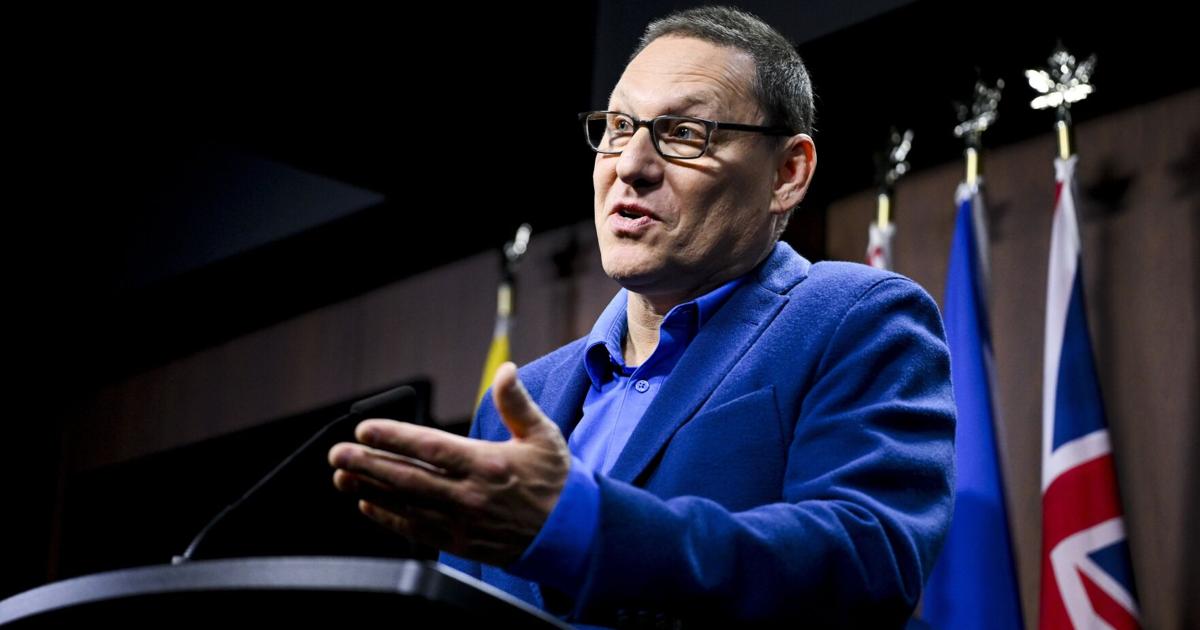
Much has been said since March about how Avi Lewis has finally and fully landed in the family business, following in the footsteps of his father, Stephen, and his grandfather, David, who also were leaders for the New Democrats.
But Lewis has always been in a family business. His mother, Michele Landsberg, wrote for this paper for more than 25 years, and journalism runs in Lewis’s blood as much as politics. It was his first career and many people still know him from his broadcasting days, hosting the CBC TV show Counterspin and farther back, on City TV in Toronto.
So when the new NDP leader joined me for lunch this week, fresh from a press conference on Parliament Hill, he was thinking about journalism and how it had prepared him for the job he now holds.
“It’s in many ways my primary identity,” when I ask how he’s managing the transition. Journalists see the world in stories, Lewis adds, and his mission in politics is to change the dominant political narrative.
“We’re stuck in a bunch of stories,” he says, citing the new fixation on pipelines and oil as an example of a story he thinks needs to change. “The repetition of these narrative frames is how we stay stuck in the stories. And so as a former journalist, I think that journalists have the best opportunity of anyone in society to change the stories and start asking the questions of, why?”
It is true in these early days of his leadership that Lewis often seems to be dipping a toe in both worlds when he’s doing media interviews, peppering his replies with suggestions or even challenges to those asking him the questions.
At the press conference he’d just completed on Thursday, which had been focused on mental-health support, Lewis told reporters gathered: “If I were back among you, in my role as a journalist, I would want this brought up in every single press conference.”
I ask Lewis whether progressive journalism stands a chance in a world dominated by the narrative of Donald Trump, which in essence is a backlash against progressivism, whether that’s on climate or the economy or all things the MAGA movement has deemed “woke.”
“I think it’s all the more important in a world dominated by Donald Trump,” he said. It creates the opportunity, he believes, for “a new story about what government is for, about what society is about, who matters, about what are the priorities for Canada.”
Yet while Canada isn’t in the midst of that same scale of backlash in the U.S., it’s also true that the last few years have been tough on the legacy of Justin Trudeau and the deal he made with the NDP to have stable government.
I also note to Lewis, as I’ve written previously, that I see some common threads between him and Trudeau, circa 2015 — both having to rebuild parties at historic lows, by tapping into progressive protest movements, such as the Occupy demonstrations, inspired in part by Lewis’s wife, Naomi Klein. Both men also hail from party dynasties, yet they entered the job determined to shake up the old establishment of their parties and certainly not to rely on them.
Lewis, who calls himself unapologetically socialist, doesn’t see Trudeau as all that progressive. “I don’t want to be uncharitable, but (it was) more the performance of progressivism or the rhetoric or the symbolic moves.”
As for the deal between the NDP and the Liberals, Lewis does appear to agree — gently — that it did help land the party where it is today, languishing with just five seats in the Commons.
Working with Trudeau meant that Jagmeet Singh’s party was “maybe over focused on the inside game — because it was so high stakes.”
His goal for rebuilding the NDP revolves around doing growth from the outside in, reviving it with a network of activism and volunteers at the grassroots. “That culture can exist independently from central control and from the inside game here on the Hill, and I think that’s where we need to get.”
It’s why Lewis has said repeatedly he’s not in a huge rush to get a seat in the Commons, and he’s rejected the idea of running in either of the two vacancies created this week — North Vancouver, which was held by Jonathan Wilkinson, announced this week as the new ambassador to the European Union, and in Rosemont, Quebec, now empty after the departure of NDP MP Alexandre Boulerice to provincial politics.
In the latter case, Lewis running in Quebec would be seen as a stretch, given that he’s still working to become fully functional in French. Lewis will be doing a three-week immersion course in Quebec in the months ahead, and it’s a goal keenly in his sights.
There’s another story that Lewis needs to change too, and that’s the one that’s seen the NDP shut out of Toronto’s 416 area code since 2011, and most of the surrounding 905 as well, though it did keep a toehold in Hamilton in the years after 2011.
“The rebuilding has got to start there,” he says. “We need star candidates in Toronto. And I will say that in the leadership campaign, we had the biggest crowds in the country in Toronto … I spent the first, what, 35 years of my life there, and my whole first career there, I feel at home in Toronto, and I felt a surge in Toronto around the leadership campaign.”
He notes that in the recent byelection in University—Rosedale, the NDP’s support nearly doubled over what it was in the bleak 2025 general election campaign, from 9.9 to 18.9 per cent.
“I think it was directly connected to the momentum from the leadership campaign,” he says. “We had regional chapters as part of our organizing philosophy. Our Toronto chapter was the biggest in the country.”
So it seems Toronto voters may be seeing a lot of Lewis in the months and years ahead, even if it’s unlikely he’ll run in the byelection that will open up when Beaches—East York MP Nate Erskine-Smith resigns to seek the provincial Liberal leadership.
He may well be there as often as he is in Ottawa. Despite his worry about being too focused on the Ottawa bubble, he’s comfortable in this city, recognized by many patrons in the Metropolitain restaurant where we’re dining, and approached by many of them to congratulate him or wish him well. Many also offered condolences on the recent death of his father.
After our lunch, Lewis was headed to do more to get security clearance for Parliament Hill, where for now he will be designated as a “volunteer.”
He did indeed volunteer for this challenge, and while he radiates enthusiasm, he’s under no illusions about the mammoth tasks ahead of him, especially when it comes to the party’s finances and resources.
As lunch winds down and he’s running late for his next appointment, I ask how leadership has changed him and whether he feels he may need to rub some of the edges off his politics to be more acceptable mainstream. He says he’s working on tone, slowing down his speaking style, for instance.
But what about principles? Will he have to rub some edges off there? “Never,” Lewis says.
Error! Sorry, there was an error processing your request.
There was a problem with the recaptcha. Please try again.
You may unsubscribe at any time. By signing up, you agree to our terms of use and privacy policy. This site is protected by reCAPTCHA and the Google privacy policy and terms of service apply.
Want more of the latest from us? Sign up for more at our newsletter page.