

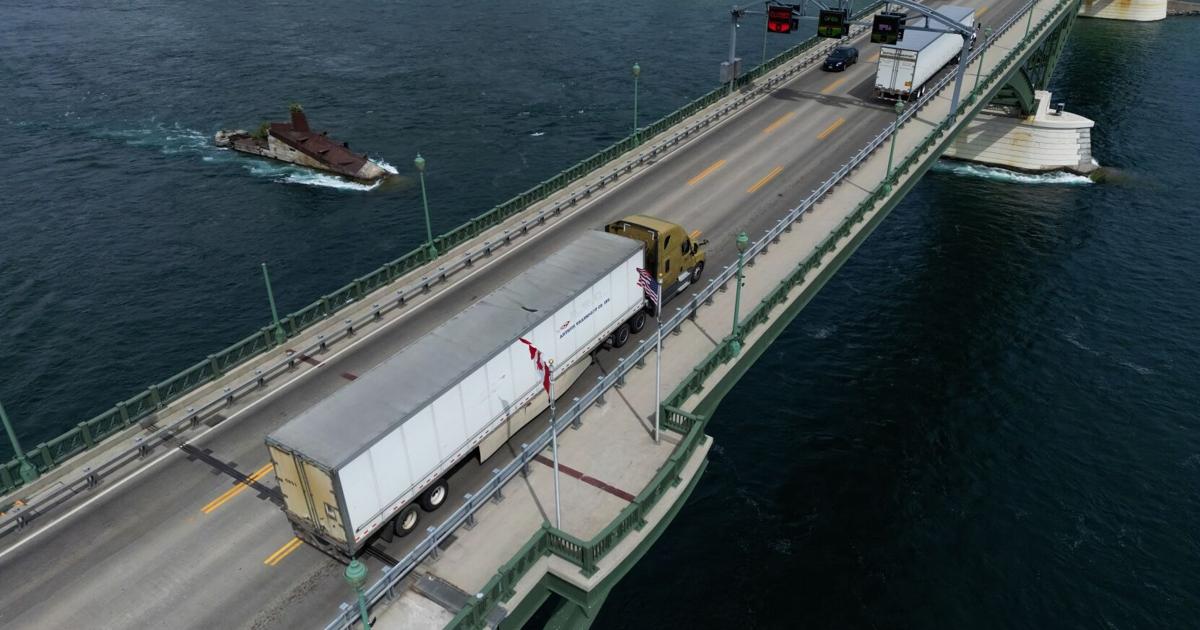
Business organizations on both sides of the border reacted with a mixture of concern and disappointment after Canada and the U.S. failed to reach a trade deal late Friday night and a new 50 per cent tariff kicked in on a wide range of Canadian exports.
They also warned the Canadian government needs to be careful with retaliatory measures to make sure it doesn’t cause even more economic damage.
Dan Kelly, head of the Canadian Federation of Independent Business, said the new tariff will be a death knell for many small Canadian exporters.
“This is deeply troubling for thousands of small Canadian exporters. A full 40 per cent of small exporters sell items on the new … list of items facing 50 per cent tariffs,” Kelly wrote on X. “Many CFIB members have said this will end their U.S. sales and some have reported this will kill their businesses.
In an interview, Kelly urged the Canadian government to be careful with its retaliatory measures, so they don’t end up hurting small Canadian businesses even more.
“I do want to remind everybody that retaliatory tariffs are their own hell,” said Kelly.
Talks collapsed late Friday after Prime Minister Mark Carney blamed “last-minute changes” made by the U.S. to its proposed terms, saying they were “unfair, uneconomic, and called into question the reliability of any deal.”
Candace Laing, the CEO of the Canadian Chamber of Commerce, called on the Canadian government to be decisive but precise in its retaliation.
“If Canada responds, it should do so with a strong hand — surgically, strategically and in close consultation with business. We should be careful not to inflict more economic damage on ourselves in the process,” said Laing.
The U.S. Chamber of Commerce called on the two sides to get back to the bargaining table.
“We urge U.S. and Canadian negotiators to return to the table and finish the job — a trade deal that address U.S. tariffs and Canadian retaliation. The alternative is an escalating cycle of tariffs that will raise costs and impede economic growth,” said Neil Herrington, a senior vice president at the U.S. Chamber of Commerce.
Added pain for the alcohol industry, lumber, agriculture and more
For Canadian spirits producers now subject to a 50 per cent U.S. tariff, the collapse of the talks came as a bitter disappointment.
“Canada’s spirits industry produces $2 billion in spirits a year, and a billion of that is sold in the U.S.,” said Cal Bricker, CEO of Spirits Canada. “We employ 48,000 people in this country who will be impacted by these actions.”
Bricker argued the federal and provincial governments should lower alcohol taxes to help cushion the blow for producers.
American booze producers, who had been hoping a deal would get provincial liquor monopolies to start restocking their products, decried the breakdown.
“It is unfortunate that the Canadian provinces’ continued refusal to return U.S. spirits products to store shelves over the past year and a half has contributed to this outcome,” said Chris Swonger, presidaent of the Distilled Spirits Council of the U.S. “We encourage policymakers on both sides of the border to pursue a negotiated solution.”
The Ontario Chamber of Commerce backed Carney’s decision to call Canadian negotiators home.
“Either way, Friday was destined to be a bad day for North American businesses. Behind one door, we had the high costs of permanent tariffs, making a mockery of CUSMA, and a truce that would only last until the U.S. president’s next tantrum. Behind the other, we had the madness of a continuing trade war,” said OCC CEO Daniel Tisch.
Canada’s lumber industry now faces a 50 per cent tariff on several products, as well as an existing 10 per cent duty across the board, and ongoing U.S. legal challenges.
“While the outcome was not surprising, it remains deeply concerning,” said Ian Dunn, CEO of the Ontario Forest Industries Association. “The North American forest product sector continues to struggle against fierce competition from China, Central and South America, and other international jurisdictions. Applying tariff after tariff on a highly integrated North American industry will only accelerate capital flight and deter regional investment.”
The Canadian Federation of Agriculture said the escalating trade dispute will have a devastating impact on both countries’ farmers and food supply.
“The breakdown in negotiations and escalation of new tariffs create uncertainty at a time when farmers are already facing significant challenges, including rising input costs, market volatility, and increasingly unpredictable weather,” said CFA president Keith Currie.
The U.S.-based Computer and Communication Industry Association, which had lobbied U.S. negotiators to help get rid of Canada’s Online Streaming Act and Online News Act, called on both countries to return to the table.
“We are disappointed that the United States and Canada were unable to reach an agreement before the deadline. Additional tariffs risk imposing significant costs on businesses and consumers on both sides of the border, underscoring the need for both governments to return to the negotiating table,” said CCIA vice president Jonathan McHale.
While Canada had reportedly agreed to either change or eliminate the Online Streaming and Online News Act, the head of the association representing TV, Film and online production companies praised the federal government’s decision to walk away.
“The federal government stood up for Canada by refusing to agree to an inequitable trade deal. We look forward to working with the government to ensure that, whatever happens next, the Online Streaming Act, a key pillar of Canadian cultural and digital sovereignty, is defended,” said Reynolds Martin, CEO of the Canadian Media Producers Association.

