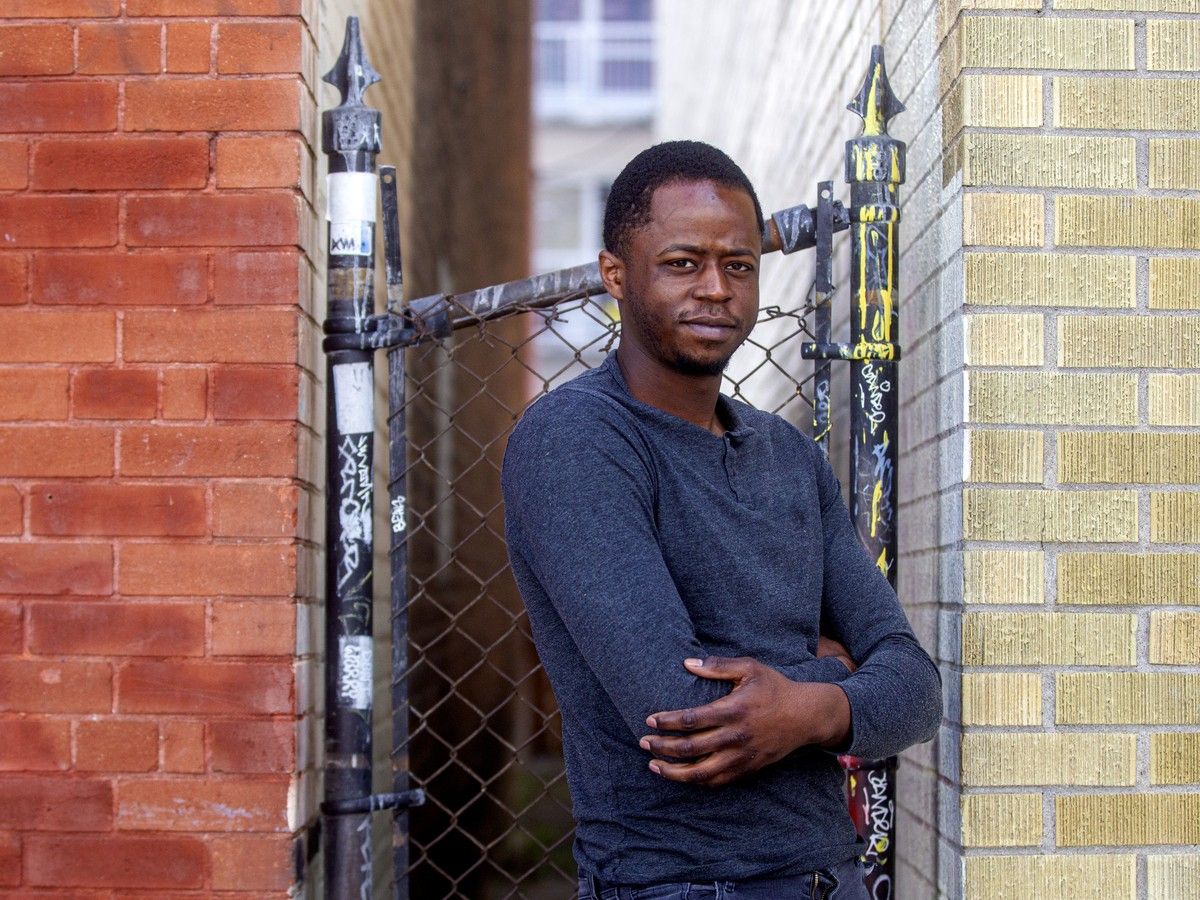
A change in how agencies deal with youth homelessness — and a greater emphasis on prevention — is at the heart of how to end it.
Many of the young people who show up at the Youth Services Bureau of Ottawa’s Besserer Street centre arrive carrying backpacks or hockey bags stuffed with clothes. Some have been sleeping on couches for months, moving between friends’ and relatives’ homes. Some have spent nights in cars, tents or church basements. Others are fleeing violence or other destabilizing trauma at home. Some have simply run out of options.

And yet, says Kenya Fithe, YSB’s shelter diversion program manager, most of them don’t see themselves as homeless.

The Evening Citizen
“Not at first,” she says. “A lot of the time they don’t actually know exactly what they need. They just know they have a problem, and the problem right now is they don’t have a place to stay. Usually, they’re just looking for somewhere to sleep tonight.”
Fithe recalls one young person she worked with who had spent seven months living out of his car after being kicked out of home. Even then, he didn’t consider himself homeless.
“I stayed in my car,” he told Fithe, “so I wasn’t homeless.”
That empty space between not having adequate housing and not seeing yourself as homeless lies at the heart of a growing shift in how Ottawa’s youth homelessness sector views and is responding to the problem. Increasingly, agencies such as YSB are focusing not just on helping young people survive homelessness, but on intervening before homelessness occurs or, if it’s already happened, keeping it brief enough that it isn’t baked into how they look at themselves.
That growing change in response from crisis management to prevention has a lot of people in the youth homelessness sector hopeful that the situation on the street will improve. In the meantime, though, that empty space underlines the difficulty that the capital-C City of Ottawa will face as it attempts to end youth homelessness by 2030, an initiative announced last September by Mayor Mark Sutcliffe.
After all, exactly how many youths are homeless in the first place? When I asked John Heckbert, executive director of Operation Come Home (OCH), for an estimate, he replied: “If you find that number, let me know.”
***
Reuben Khaemba’s housing instability arrived in pieces — gradually enough at first that it barely registered as homelessness.
“It starts in the home,” he says. “It starts with conflict with family, that sense of not belonging.”
Now 23, Khaemba never had a close relationship with his mother. When he was two, she sent him from Ottawa to Kenya, where he spent a decade being raised by his grandparents before returning to Canada.
“It was like coming back to a stranger,” he recalls. “She wasn’t nurturing. I can count on one hand the times she hugged me, and even then it was more like a pat on the back. If something happened in school or I felt sad, I didn’t feel I could go to my mom. It was a toxic relationship — every day was an argument.”
She booted him out of their Mechanicsville home when he was 18 or 19, he says.
He bounced between temporary housing situations, roommates, shelters and other precarious arrangements. He slept under a bridge at Lebreton Flats for a couple of nights before finding shelter at The Mission.
Khaemba didn’t consider himself homeless then, he says. He was just in a bad situation from which he had to find a way to extricate himself.
He eventually found work delivering appliances, allowing him to move into a house off Preston Street.
There, however, he fell under the influence of older roommates and was soon deeply involved with sports betting, drugs and alcohol.
The house, meanwhile, was damaged and the rent often left unpaid. Before long, Khaemba was back at The Mission. When we spoke, he was still there, but waiting to hear back about an apartment he’d applied for.
His return to The Mission, he says, was when he began identifying as homeless. “When I go there, I want to hide my face. I don’t want to be seen by other people.
“You’re in such a low spot, your self-esteem and demeanour changes — it drops. And that happened to me — that low vibration just kind of gets to you.”
That shift, when homelessness stops feeling temporary, is a critical turning point.
“The more time you spend in homelessness or in shelter, the more that becomes part of your identity,” says Nina Gorka, YSB’s CEO. “It’s not just your own self-identification. It’s how the world sees you. It’s how services see you.”
That identity can form quickly. Young people who enter shelters or begin spending time on the street often find not only danger, but community — people who share food, survival strategies and companionship in isolating circumstances.
“The homeless population has community,” says Gorka. “Make no mistake about it — they take care of each other.”
That can be a good thing, but that sense of belonging can also pull youths deeper into street life as they become disconnected from the routines that once anchored them.
When youths are in the homeless stream or on the street, they’re often easy prey for others to take advantage of, either by design — drug dealers or sex traffickers looking for vulnerable people not yet known to police, for example — or simply by chance.
Khaemba recalls witnessing some of that transformation when he was at The Mission.
“Everyone there smokes meth,” he says. “I had a lighter one time and I gave it to someone, and they offered me some to smoke. It’s just that easy.”
He resisted, but understands the appeal.
“You can easily get pulled in if you really want to give up,” he says.
***
Getting a clear snapshot of the situation is difficult. Data on youth homelessness is collected in various ways, including an annual Point-in-Time Count and the Homeless Individuals and Families Information System (HIFIS). But gaps exist.
Additionally, as data collection improves through greater coordination between agencies, the numbers may appear to worsen.
Meanwhile, although Heckbert and others may not have exact tallies of homeless youths, they do know how things look. Over the past five years, for example, the number of youths seeking help from Operation Come Home has more than doubled, from 356 in 2021 to 752 last year.
According to United Way East Ontario, between 1,200 and 1,400 youths in Ottawa experience homelessness each year.
Whatever the number, it’s more than the current system can handle. Shelters designed for short-term emergencies have increasingly become long-term spaces, creating a bottleneck. In Ottawa, there aren’t many emergency beds dedicated to homeless youths to begin with: YSB has two shelters, one with 32 beds for young men, the other with 32 for young women. About half of those beds are designated as more transitional spaces where youths can stay longer while stabilizing and arranging housing.
The only other emergency shelter for homeless youths in Ottawa is a small overnight one run out of the First Baptist Church downtown through Restoring Hope Ministries. Operating for the past 13 years, it serves 16- to 24-year-olds and can accommodate up to 20 youths — half on beds, the other half on mats — on a first-come, first-served basis. It also offers a meal, counselling and drop-in services.
Meanwhile, even defining “youth” isn’t clear-cut. OCH generally uses 16 to 25 as its age range, while YSB uses 16 to 20. Adult shelters, meanwhile, such as the Shepherds of Good Hope, accommodate those 18 and older, which includes youths.
The city’s 10-year housing and homelessness plan puts an upper cap of 24 on the definition of youth. According to Kale Brown, Ottawa’s director of Housing and Homelessness services, its focus on achieving functional zero youth homelessness — making it rare, brief and non-recurring — by 2030 will concentrate on the nearly 165 youths from 16 to 20 who last year accessed a city-funded shelter.
But many young people who are effectively homeless never enter shelters at all. They are the hidden homeless, moving between couches, cars, temporary arrangements and unsafe housing situations that too often remain invisible to official counts.
That concern — that temporary instability can gradually harden into chronic homelessness — has helped drive the growing use of a potential solution known as diversion.
The approach, which has gained traction in the homelessness sector across Canada over the past decade, aims to keep young people from entering shelters altogether when safe alternatives exist, or, barring that, moving them back out and into safe housing as quickly as possible. Rather than wait until a youth becomes entrenched in homelessness, diversion workers like YSB’s Fithe intervene at the point of crisis and try to stabilize situations while connections to family, school and community still exist.
The concept is simple: keep young people from entering a shelter if there is any safe alternative. In practice, it can involve frantic phone calls to estranged parents, negotiating temporary stays with relatives, arranging emergency rent payments or travel expenses, finding culturally appropriate housing, mediating family conflicts or simply helping a frightened teenager imagine that another path still exists.
Every case is different. Sometimes, Fithe says, the issue isn’t housing itself, but a relationship that has fractured just enough to send someone spiralling toward instability.
“Often there’s just a lack of communication and understanding that can be solved with a 30-minute conversation.”
Other times, there is no safe home to return to. Youths may be escaping abuse, violence, exploitation or homophobia. Some have already spent years moving through foster or group homes. Some are already carrying trauma, addiction or severe mental-health struggles by the time they arrive at a shelter door.
“But the longer somebody stays homeless,” Fithe says, “the harder it becomes.”
****
Mike Lethby thought graduating high school was the key piece to keep youth from becoming homeless.
As executive director of The Raft, a shelter in St. Catharines, Ont., his team launched a program called Youth Reconnect in 2008, which aimed to help vulnerable youths stay in school and remain in their home communities. The program was initially extremely successful at reducing youth homelessness, but after several years and a flat-lining of their success, they realized that something else was happening.
“We didn’t actually associate the success to the family and natural supports piece,” he says.
What was working were the ancillary benefits of keeping students in school — working with parents, grandparents, siblings, friends and other trusted adults to stabilize housing situations and repair relationships before they collapsed completely.
It would take another decade — and the introduction of shelter diversion — before workers fully realized what they had stumbled onto.
Diversion, which asks whether safe alternatives to shelter exist before assigning a bed, produced a significant finding: more than half the youths arriving at The Raft’s shelter could be diverted elsewhere, but the success rates varied dramatically depending on whether a young person had been homeless before. Among youths who had never stayed in a shelter before, diversion succeeded between 70 and 90 per cent of the time. For youths with previous shelter histories, the success rate dropped to between 30 and 40 per cent.
The difference, says Lethby, wasn’t simply housing. It was relationships. Young people experiencing homelessness for the first time were often still connected to family members and friends. Their conflicts were often fresh and their support networks, though strained, hadn’t yet disappeared.
As a result, workers could often simply slow the crisis down long enough for loved ones to hear one another and come up with less drastic solutions.
“The biggest indicator of homelessness — the biggest reason for youth homelessness — is family breakdown,” says YSB’s Gorka. Heckbert estimates that 40 per cent of youth homelessness results from issues at home.
Meanwhile, when workers in St. Catherines looked at the youths who repeatedly cycled through shelters, they discovered something else: “Every single person who was repeatedly using our shelter was profoundly isolated from their social network,” says Lethby.
The realization led The Raft to create a formal Family and Natural Supports program that focused on relationships. Combined with their diversion and connections programs, the results there have been profound: an 80 per cent reduction in shelter use by youths and a roughly 70 per cent reduction in youth homelessness. Between 80 and 90 per cent are staying in their home communities and in school.
Lethby has subsequently helped agencies in Ottawa, including YSB and the Shepherds of Good Hope, develop similar programs — first diversion and now prevention.
“Cities — communities —can actually move homeless intervention upstream,” says Kaite Burkholder Harris, executive director of the Alliance to End Homelessness Ottawa. “We can do that.”
The challenge, she says, is that homelessness systems have historically been designed to respond to crises rather than prevent them. More shelters, more beds, and never enough of either.
She points to The Raft as evidence that upstream intervention can work: In a region half the size of Ottawa, she notes, eight workers who were focused specifically on family and natural supports drastically reduced the number of youths entering shelter.
The goal wasn’t family reunification. For some youths, returning home is neither possible or safe. Instead, workers identified whatever healthy relationships already existed and tried to build on those.
“Homelessness,” explains Lethby, “is fundamentally a condition someone finds themselves in when they cannot leverage a social relationship for housing.”
***
Ottawa’s homelessness agencies are hoping the philosophical change will produce similar results here. Operation Come Home has already begun experimenting with that approach. Through a pilot project funded by the Peter Gilgan Foundation, prevention support worker Rylie Hillier works with youths and families before homelessness occurs.
Some are referred through schools, others through OCH’s drop-in services. Hillier’s role can involve everything from helping with practical matters such as education applications to addressing family conflicts.
“The goal is to never have them walk in through the door,” she says.
Right now, Heckbert says he’d like four more workers like Hillier, whose roster of 11 youths and two parents keeps her busy.
Ottawa’s plan rests on the insight that The Raft arrived at after years of trial and error — that youth homelessness is often easier to prevent than solve. The effort brings together agencies that have historically worked alongside one another but not always in concert. Burkholder Harris and Brown co-chair that steering group, known as the Housing and Homelessness Leadership Table.
Sutcliffe, meanwhile, recently announced the creation of the Youth Homelessness Champions Table, a coalition of civic, business and community leaders that will similarly keep different groups pulling in the same direction.
The ultimate goal, says Burkholder Harris, “is a shelter system that actually has vacancy, so that kids can get it if they need it, but that the length of stay is as short as humanly possible.”
****
For Idris Isse, the difference between homelessness and stability isn’t measured solely by the nights with a roof over his head, but in what it frees him up for.
When I first met him just over a year ago, he had recently moved into a small basement apartment in Vanier after months relying on a bed at The Mission.
“If I did not have this,” he told me then, “I’d be dead in a ditch.”
A year later, he still worries about money, work and what comes next, but when he talks about having a place to live, it’s not about the apartment itself, but what it gives him emotional space for.
“I can sleep properly,” he says. “I can think properly. I’m not stressed all the time.”
It may not sound like much, but it reinforces what workers in Ottawa’s homelessness sector repeatedly say: when each day is consumed by finding somewhere to stay, somewhere to shower, charge a phone or keep your belongings, there’s little room for anything else. School, work, relationships and future plans all become harder.
The shift in Isse’s mindset — from focusing on survival to thinking about the future — is what people like Heckbert, Gorka and Burkholder Harris are trying to protect. Much of Ottawa’s new approach is built on the belief that the earlier instability can be interrupted, the less likely it is to become entrenched, and the sooner that young people can reconnect with family, school, community or housing, the less likely it is that homelessness becomes an identity.
Still, even as prevention, diversion and family supports are embraced, the forces that drive homelessness continue. Affordable housing is scarce. Family stress is increasing, as are mental health needs.
And as things stand, the demand for shelter is relentless. During the six-month pilot phase of YSB’s diversion pilot project, the agency turned away roughly 200 people because they had no room. Even while successfully diverting many young people away from shelter — their success rate was about 30 per cent — others continued arriving at their door.
“Even when we divert somebody — which is great — there’s always another kid ready to fill that bed,” says Gorka.
What struck me most over the homeless or formerly homeless youths I spoke with was how, to a person, each told me how their being homeless was not a choice.
Some made bad decisions, committed crimes, did drugs and dropped out of school. But I didn’t meet anyone who set out to become homeless. Instead, each had been navigating instability since childhood.
William Jacobs, for example, described self-harming at the age of six, and reaching the conclusion when he was 10 that his only viable options were running away from home or killing his father. He found a third course of action — he asked a schoolteacher to call youth protection authorities on his behalf — but even then he cycled through group homes, struggled with drugs and crime, and found himself homeless.
Yet when I spoke with him, he wasn’t resigned to that life. He and the others I met were all trying to build something better.
Ending youth homelessness does not mean ensuring that no young person ever experiences a housing crisis. Family relationships will still fracture. Young people will still be forced to flee violence, abuse and unsafe homes. Emergency shelters will still be needed.
Now, though, workers talk about functional zero youth homelessness as an actual possibility, rather than purely aspirational.
The obstacles are daunting. The city faces a shortage of affordable housing, while many of the youths most at risk remain largely invisible. Maintaining the emerging level of cooperation among governments, agencies, schools, funders and businesses, meanwhile, will require a Herculean effort.
Yet all the sector players I’ve spoken to are effusively hopeful that the sector-wide coordination, along with a focus on diversion and earlier prevention, may actually turn the problem around. YSB’s diversion success rate is currently at about 30 per cent, and that’s with only one diversion position and few resources. Other regions, such as Niagara, have achieved diversion success rates of almost 70 per cent, but only with fully resourced, system-wide teams.
If the city is serious about ending youth homelessness by 2030, it doesn’t need to invent a new approach. The sector already knows much of what works: diversion, prevention, family supports and earlier intervention. Stable housing and greater manpower resources. The city needs to support that and get out of their way so they can do the work.
After all, Reuben Khaemba’s homelessness didn’t begin at The Mission or under a LeBreton Flats bridge. It began years earlier, with conflict at home and the growing sense that he didn’t belong. How might things have been different if a teacher, counsellor, coach or relative stepped in before he made his bed under a bridge?
Heckbert compares it to saving people who are drowning.
“We got really good at pulling people out of the river,” he says. “Now we have to go upstream. We can’t keep pulling them out. We have to find out why people are falling in the river and prevent that from happening.”
The Citizen newsroom is proud to report important stories like this one. If you would like to support our work and help our team continue to tell longform, deeply-reported journalism, please consider purchasing a digital subscription. ottawacitizen.com/subscribe