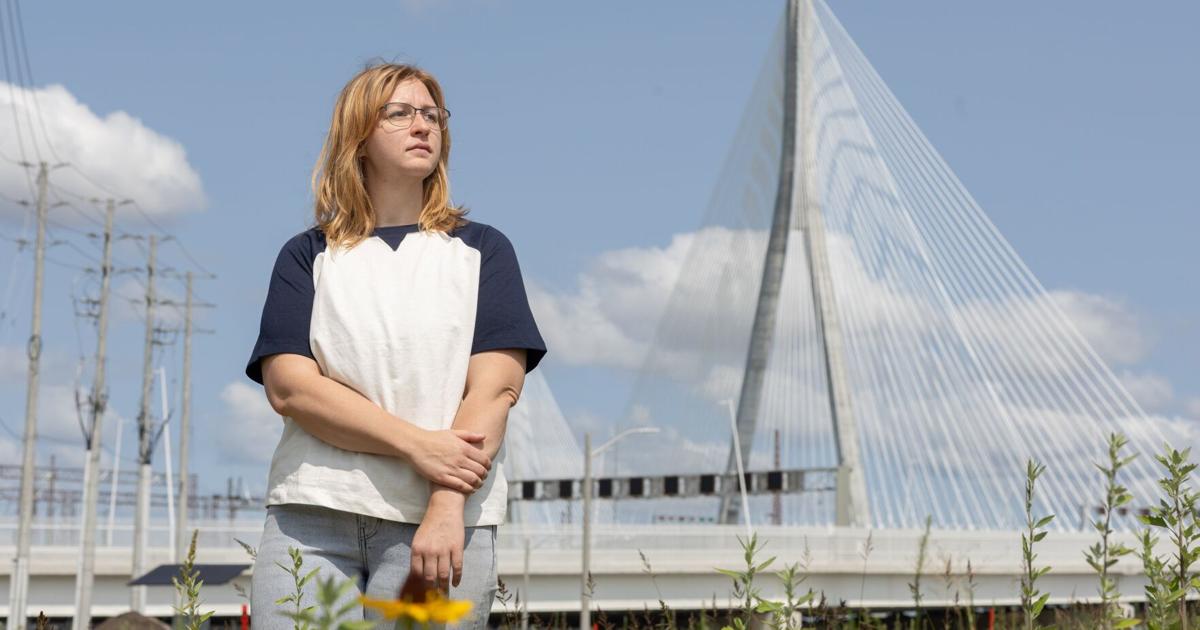
WINDSOR, ONT.—The wind gusted. Safety ropes clanged against scaffolds. And high atop the growing spire she helped build, Sean O’Keefe gazed across the Detroit River at the skeleton of the new bridge reaching over from the American side.
A general labourer who grew up within sight of the project, O’Keefe worked for two years on the Gordie Howe International Bridge. She was proud, excited, happy to recount her “part of history,” even if — as she put it over coffee at a nearby Tim Hortons this week — it was just a small one.
Now that the bridge is finished, that feeling of pride abides, but so does a certain ambivalence. For this isn’t just any border city. The closeness of Detroit’s towers across the water, the thrum of traffic below and above it, the webs of kinship that stretch into Michigan and beyond — it is as though the two sides are enmeshed, blurred frontiers of each country that commingle and coincide.
So it stings for many locals, from the mayor to the guys that drink at the Dominion House Tavern, to see the Gordie Howe fall under the shadow of Donald Trump’s trade war.
The bridge now stands gleaming grey and white in a great curve over the river, a tangible symbol of connection and mutual prosperity between Canada and the United States. It is also a goliath of steel and concrete redolent of another time, when free trade was a shared mantra, and the idea of a U.S. president idly musing about annexing Canada was as preposterous as it was unthinkable.
But times have changed. In the months leading up to this moment, Trump wrenched what he could from a Canadian government that already bankrolled the entire $6.4-billion cost of the crossing. To get it open, Ottawa had to sweeten the deal, changing its terms to give some proceeds from the bridge tolls to the U.S. before Canada’s construction costs are covered.
Then, with days to go before a shared ceremony to celebrate the bridge, the White House threatened more tariffs. Canadian officials responded by cancelling that event, then held their own on Friday on the Windsor side of the new link — without anyone from the U.S. present.
Not far from that spot, O’Keefe sat with her coffee and thought about what it all means. One way to look at it is to see a protracted tale of American greed, American power, and the uniquely Canadian predicament — present from the earliest days of the Dominion — of trying to profit from proximity without falling prey to the pitfalls of dependence.
But to O’Keefe, it is much simpler.
“We’re neighbours,” she said. “Neighbours are supposed to be there for each other.”
Connected communities
There’s a story the popular historian Pierre Berton tells in his book about the War of 1812. During the battle for Fort Detroit, the man who fired the first cannonball across the river from the Canadian side turned out to have killed his best friend. Berton reports this as “legend, possibly, but perfectly plausible,” so connected were the two communities.
And so they are still.
Windsor Mayor Drew Dilkens studied at Wayne State University in Detroit. His brother married an American and has lived in the U.S. for more than 30 years. By his count, some 6,000 Canadians — nurses, doctors, bankers and more — cross into Detroit for work and come home every day.
On a recent morning in a wood-panelled conference room in an industrial strip of the Windsor suburbs, Steven Kozma — a born-and-raised Windsorite — recounted how he and his wife got married in Tennessee’s Great Smoky Mountains.
“We don’t really go over there anymore,” he said, alluding to the obvious reason: “One man,” he calls it.
Even so, Kozma sees the approaching opening of the Gordie Howe as a “breath of fresh air.” With more than 30 years in the trucking sector, Kozma is business development manager of Morrice Transportation, a local company with a fleet of 115 semi-trailers. He sees the promise of the new bridge in dollars on his bottom line.
For 97 years, the only way for a sizable truck to drive from Windsor to Detroit has been over the Ambassador Bridge. (A tunnel below the river can’t handle large transports.) Opened in 1929, the Ambassador was deemed the longest suspension bridge in the world, a marvel for the dawning automobile era in a region famous for the American car giants that came to define it. After self-described “Freedom Convoy” protesters blockaded the bridge in 2022, the federal government cited data showing the Ambassador handles $390 million in trade per day, along with 26 per cent of Canada’s exports by road.
Call it a quirk of history or a historic mistake, but when it was built, Canada and the U.S. allowed this new piece of international infrastructure to be privately owned. By 1979, the bridge was in the hands of a single family and its billionaire patriarch, the shipping tycoon Manuel “Matty” Moroun.
The Ambassador Bridge owners did not respond to requests to interview Matthew Moroun, who has headed the business since his father’s death in 2020.
In 2018, the Detroit Free Press described the elder Moroun, then 90, as a shipping magnate who said his only defeat in life was failing to “stop the clock.” He was born two weeks before construction of the Ambassador started in 1927, and his family moved to Detroit after their home in Windsor was expropriated and torn down to make room for the bridge, the newspaper reported.
“I knew the Teamsters pretty well,” Moroun told the Free Press, referring to the truckers’ union. “I was close with (one-time Teamsters president) Jimmy Hoffa, since he used to buy gas from my father’s station.”
‘We were basically at their mercy’
Years later, Kozma’s company is among those that have had to pay stiff, monopoly prices to use the bridge — a $20,000 monthly retainer, and $180 for a single semi-trailer to make a back-and-forth trip, he said. That adds up, considering the company’s fleet makes 30 to 55 crossings on an average day.
“We were basically at their mercy,” he said of the bridge owners. “It got to the point where it became ridiculously expensive.”
And that’s not even counting the traffic jams. Unlike the new Gordie Howe bridge, which connects one highway to another, the Ambassador empties onto Huron Church Road, a broad Windsor thoroughfare with traffic lights and busy cross streets.
“We’ve been caught many times in a lineup on Huron Church, waiting to get across that bridge,” Kozma said.
Avoiding that traffic jam via the new bridge will save a company like Kozma’s up to $100,000 a month worth of time, according to the Canadian Trucking Association.
The situation has been beneficial to the Morouns and their business, which has enjoyed a local monopoly on cross-border truck traffic for decades. Canadian officials once estimated the Moroun monopoly was worth $60 million per year, said Roy Norton, a former diplomat who was closely involved in years of effort to build a new bridge.
The terrorist attacks of Sept. 11, 2001 sharpened the minds in political backrooms that this was indeed necessary, Norton recalled.
“Traffic at the Ambassador Bridge was essentially shut down for a week,” he said, remembering the security concerns at the time. “People began to reflect on the fact … the Ambassador Bridge was a little bit more than 70 years old. It opened in 1929, theoretically with a 50-year lifespan, so people were becoming alert to worst-case scenarios.”
The Morouns, meanwhile, began to advocate for a solution of their own: construction of a twin bridge, right beside the Ambassador, that they would own as well. Their company bought properties on the Windsor side of the river that were allowed to fall into disrepair; local leaders saw that as a tactic to get demolition permits to clear the way for more bridge infrastructure.
“We knew what they were trying to do … so we passed an interim control law that prevented the demolition of these homes,” said Eddie Francis, who was Windsor’s mayor at the time.
The bridge owners sued Francis and the city over the move, prompting years of legal battles.
Stephen Harper makes a deal
Their efforts intensified in 2012, when — after years of contemplation in Ottawa and at Queen’s Park — prime minister Stephen Harper inked a deal with then-Michigan governor Rick Snyder: Canada and Michigan would jointly own a new bridge across the Detroit River, construction of which would be financed entirely by Canada, with toll revenues split equally once Ottawa had made enough money to pay off its construction costs.
Norton recalled the Morouns financing an advertising campaign to denounce the proposed bridge, while promoting an effort to change Michigan law so the governor could not approve it without a vote in the state legislature.
Talks continued to ensure construction went forward, while the Morouns tried through the courts and a failed attempt to get an arbitration under the North American Free Trade Agreement in 2011.
As Norton explained, the federal government saw the new bridge as a major priority. And the Americans knew it.
“From their point of view, we seem to want this project dearly, desperately,” Norton said. Before leaving office in 2016, president Barack Obama declined to seek funds from the U.S. Congress to pay for a large customs and inspection plaza on the American side of the Gordie Howe bridge. But he did provide the required presidential permit.
And so the Canadian government decided to cover the bill for construction of the U.S. plaza, as well as for ramps connecting it to Michigan’s I-75 highway. This delayed the project and added costs, Norton said, with shovels breaking ground finally in 2018, before further setbacks amid the COVID-19 pandemic.
Then Trump came back.
‘We don’t like Dad’
Leaning against the outside wall of the Dominion House Tavern, Adam Zardo puffed out smoke and tried to explain how he feels. The housepainter was among those knocking back a few drinks at the end of the day, enjoying an establishment that has persisted in Sandwich Town — the neighbourhood nestled near the foot of the Ambassador Bridge, on the Windsor side — since the 1870s. Friends gathered over pints and grub on the back patio. A game of beach volleyball played out on the nearby sand court.
Amid the revelry of the evening, news trickled in about Donald Trump’s latest dig against Canada. For the country’s “discrimination,” including Premier Doug Ford’s decision to pull American booze from LCBO shelves, the U.S. was planning a new round of steep, 50 per cent tariffs on a slew of Canadian goods.
Zardo shook his head.
“Things are so much more intense,” he said, gesturing to suggest the change is out there, in the air. There was a time when he used to cross over to Detroit all the time. A Tigers fan, he’d take in 50-odd baseball games each year, pinning each ticket stub on a board at his house until he lost count.
But not anymore. “I’ve turned the page on America,” he said. “What’s the best way to say it? The T-shirt doesn’t fit.”
Sitting at a picnic table outside, Stephen Hargreaves — who runs a marketing firm and is head of the local business improvement group — offered a different metaphor.
“The situation between Detroit and Windsor went from being a brotherhood to something that is a lot more … like the children of a divorce,” he said, adding, “We don’t like Dad.”
After supporting the Gordie Howe bridge plan during his first term in the White House, Trump threatened to block it in a characteristically rambling social media post in February. Democrats in the U.S., as well as local politicians in Windsor like Dilkens, saw the Morouns at work again. U.S. Federal Election Commission documents show Matthew Moroun donated US$ 1 million to Trump-supporting political action committee in January. The New York Times reported that, hours before Trump’s threat to block the bridge, Matthew Moroun met with U.S. Commerce Secretary Howard Lutnick.
“Almost always, all roads lead back to the Morouns,” said Dilkens.
For Norton, it is hard to tell what motivates Trump. But the result was the need for Canada to make a deal to at least showcase another win for the American side. The change that got it through was to share the “net” revenue from the bridge for the next 15 years with a regional development fund in the U.S., while preserving the longer term structure for Canada to keep all toll revenue after that until it pays off the debts from building the bridge.
“It’s sort of classic, gangsterlike behaviour; hard to distinguish this from the way in which the mafia operates,” Norton said.
‘The cost of doing business’
Brian Clow, who was a top adviser to prime minister Justin Trudeau, including on relations with the U.S., said this is simply “the cost of doing business” with the Trump administration.
“The alternative was leaving a finished bridge closed indefinitely,” said Clow, “which would have hurt Canadians far more than it hurt Washington.”
Just before he returned to the White House last year, Trump spoke about his desire to use “economic force” to annex Canada. Prime Minister Mark Carney — with his economist’s verbiage — said during last year’s election campaign that he viewed Trump’s strategy like this: “The U.S. is trying to put economic pressure on us to gain major concessions, to the extreme of a level of integration of our countries that would impinge our sovereignty.”
In response, Carney has made his prime ministership about reducing what he sees as the vulnerability that comes from Canada’s commercial dependence on the U.S. His government is pushing to double exports to other countries by 2035. It’s directing a massive influx of money to the military to bolster Canadian industry, thus spending a lower share with the American defence sector. Everything is on the table for retaliation, Carney said this week, if Trump follows through with more tariffs.
The question that looms now over the twin spires of the new bridge is whether the world it was built for is still the one we live in. Statistics from the Bridge and Tunnel Operators Association, which includes the operators of 13 crossings between Ontario and the U.S., show border traffic has fallen across the board. At the Ambassador, yearly truck crossings dropped almost 35 per cent from 2000 to 2024.
At his office in city hall, Dilkens said he still sees promise in the bridge finally — hopefully — opening to new traffic.
“All of our assumptions always are based on dealing with rational actors. You don’t have that in the United States right now,” he said, arguing that the free trade agreements from the 1980s to now have brought huge benefits to both countries.
“It will come back. There will be better days ahead.”
Over the river, in a park in downtown Detroit, Randy Williams looked up from his phone to talk about the new bridge. A maintenance worker between jobs, the 60-year-old loved heading to Canada to visit the Windsor Raceway. The venue is closed now, but the Gordie Howe will soon carry cars and even cyclist and pedestrian traffic over to near where it used to stand.
He said he hadn’t seen the new crossing yet, but his eyes softened into a smile when he heard about how it curves in gleaming white and grey across the river.
He promised to check it out.
Error! Sorry, there was an error processing your request.
There was a problem with the recaptcha. Please try again.
You may unsubscribe at any time. By signing up, you agree to our terms of use and privacy policy. This site is protected by reCAPTCHA and the Google privacy policy and terms of service apply.
Want more of the latest from us? Sign up for more at our newsletter page.