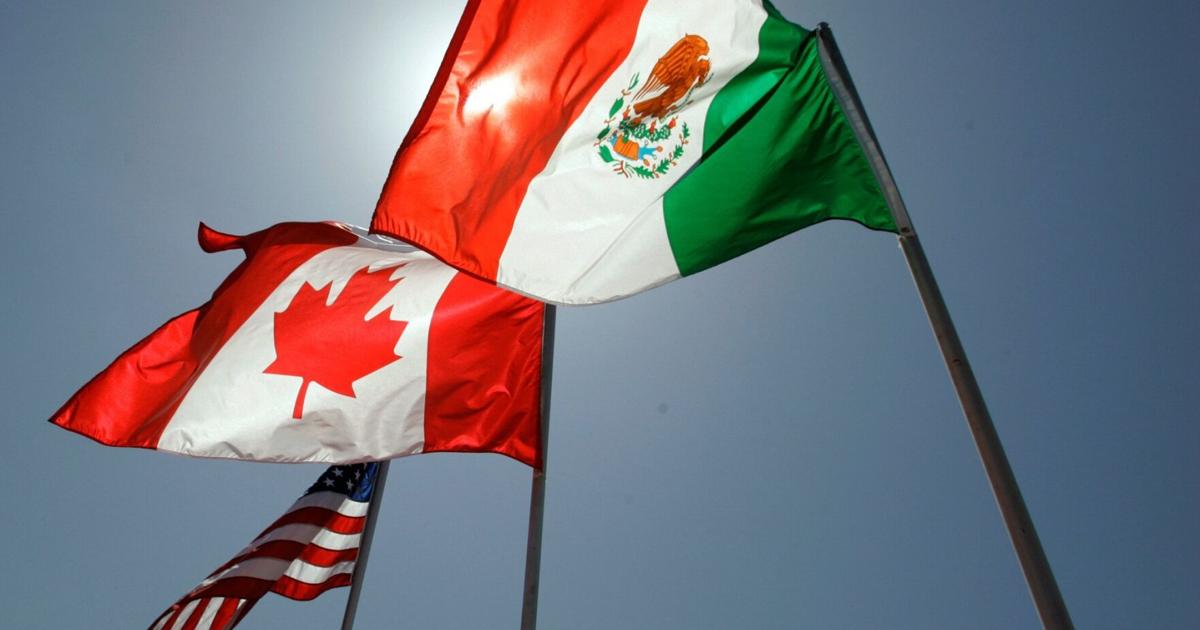
OTTAWA—Canada, the U.S. and Mexico will not extend the continental free trade pact for another 16-year term and instead will only secure the North American free trade market for the remaining decade while subjecting it to annual reviews.
The decision at the behest of the U.S. was confirmed during a virtual meeting between U.S. Trade Representative Jamieson Greer, Canada-U.S. Trade Minister Dominic LeBlanc and chief negotiator Janice Charette, and Mexico’s Secretary of the Economy Marcelo Ebrard, thousands of kilometres apart.
Greer’s office announced the outcome in a statement, saying the U.S. “did not agree to renew the USMCA in its current form. As a result, the USMCA is not renewed. The United States will continue to engage with Mexico and Canada to address the Agreement’s shortcomings and our trade deficits with these countries. However, the Agreement remains in force pending resolution of these issues or until the Agreement’s termination.”
The decision, later confirmed by the Canadian government, was not unexpected.
LeBlanc said in a statement that during the meeting he reaffirmed Canada’s “unwavering support for the CUSMA and its renewal” and noted that the deal remains fully in force until 2036 “and can be renewed at any time for another 16-year period.”
In the immediate term, Wednesday’s decision changes little. But it will contribute to ongoing investment and business uncertainty.
“The Americans have made it official,” said Brian Clow, a former top Canada-U.S. advisor to the Trudeau government. “They want more concessions from Canada and Mexico, and they want the trade uncertainty to continue before they’ll consider extending the agreement.
“The lack of surprise doesn’t make it any easier for the sectors in the Canadian economy that are suffering, like automobiles and steel,” he said.
Brian Kingston, head of the Canadian Vehicle Manufacturers Association, said the decision by the U.S. not to renew the deal “underlines the need for Canada, the U.S., and Mexico to negotiate a durable agreement that supports the integrated North American auto industry.”
“U.S. tariffs have made the auto industry uncompetitive compared to other jurisdictions around the world,” Kingston said. “An urgent resolution is required to eliminate tariffs and create certainty for long-term auto investments in the region.”
Flavio Volpe, of the Auto Parts Manufacturers Association, said his sector will continue to work with negotiating teams in all three capitals to restore market and investment certainty. But he took a glass-half-full perspective.
“The Americans could have chosen to formally declare they are leaving the agreement,” said Volpe. “Instead they have signalled they will continue to work with their partners on updating the terms that bind them as contemplated by the agreement.”
While the three national leaders were not in the meeting, U.S. President Donald Trump has long made clear he is uninterested in an extension of the existing agreement but wants fundamental change to it.
The Canada-U.S.-Mexico Agreement on continental free trade (CUSMA), which governs one of the world’s largest trading blocs, will continue to be in force and to shelter most Canadian exports from most American tariffs, but not shipments of autos, steel, aluminum, copper or lumber, for example.
Those products are subject to punishing surcharges, ranging from 25 per cent on autos up to 50 per cent on important metals, which Trump has levied against all global imports in his bid to “re-shore” American production and manufacturing.
Trump additionally slapped tailored border emergency tariffs, including on Canada and Mexico, which were struck down by the U.S. Supreme Court.
Trump reimposed a 10 per cent baseline tariff on global imports while his administration negotiates so-called reciprocal trade deals with other nations.
Prime Minister Mark Carney says all the American tariffs are in violation of the free trade agreement that the three countries reached in 2018 and that took effect on July 1, 2020.
Mark Carney’s pledge to ‘face the world’
At Canada Day celebrations in Ottawa, Carney did not directly address the trade talks but invoked a “united Canada” as a force to be reckoned with, saying Canadians must “face the world” with courage.
He said “in a world where traditional alliances are crumbling, Canada has chosen to reach out and build new partnerships. We offer partnership in a divided world” in security, trade and culture, as he announced Canada would participate in Eurovision and would host the 2028 Francophonie summit.
Heritage Minister Marc Miller, in his warm-up speech to Carney, said Canada kneels “for nobody.”
Carney had said a day earlier that trade negotiations and agreement on any “update” to the CUSMA deal will take a lot more time, and downplayed prospects of a whole “new deal” that Trump would be required to seek congressional approval to pass.
The USTR statement underscored that Mexico-U.S. talks will resume July 20, but made no mention of formalizing talks with Canada.
LeBlanc in his statement said the countries “agreed on the importance of continuing our discussions and identifying ways to ensure trade and investment frameworks between Canada, the United States and Mexico continue to support North American prosperity and competitiveness. For Canada, this includes substantive discussions with the United States on addressing sectoral tariffs on Canadian steel, aluminum, autos and lumber.
“Canada approaches these discussions from a position of strength and with the goal of preserving and strengthening one of the most successful trading relationships in the world,” LeBlanc said.
For leaders in the affected strategic metals sectors, the outcome was “expected.”
Jean Simard, head of the Aluminum Association of Canada, said Wednesday’s non-renewal of CUSMA was not a surprise, and declined further comment, noting only that Mexico and Canada are in different negotiating positions. “Mexico has a different balance sheet with the U.S. and a keen interest to play ball.”
Catherine Cobden, head of the Canadian Steel Producers Association, said “this outcome is aligned with our expectations. We encourage ongoing discussions particularly to relate the s. 232 tariffs on affected industries.”
Despite the cross-border tensions that Trump’s tariff war has inflamed, there was cross-border love for Canada from south of the border and beyond.
Canada Day wishes were posted to “X,” formerly Twitter, by the Buffalo Sabres, the NATO alliance including its air command, India, the British army and the Colorado Avalanche.
There was a statement from Trump’s envoy, U.S. Ambassador Pete Hoekstra, hailing the North American co-hosting of the World Cup.
Carney’s predecessor, Justin Trudeau, who signed the CUSMA after negotiating with Trump in his first term, attended the Ottawa Canada Day event, greeting Carney with a hug.
In a CBC interview beforehand, the former prime minister replied to a question about whether he feels the need to pick up the phone and yell at anybody. “I got to do that for 10 years. I’m now happy to take a step back,” Trudeau said, adding he’s happy to give advice “quietly” when asked.
“I look at the amazing folks who are working so hard to continue to build this country and I just wish them all the best and encourage them wherever I can,” Trudeau said.
What next for North American free trade?
Mexican President Claudia Sheinbaum and her team of negotiators led by Ebrard are already in formal rounds of negotiations with the U.S. and will have a third session later this month.
In a video message Tuesday, Carney leaned in on Canada’s energy sector and oil and gas production as a way to “help us become more independent of the United States.”
He said that although expansion plans — which include a new pipeline to the B.C. coast to reach Asian markets — will raise greenhouse gas emissions and blow past Canada’s targets to tackle global warming, it is critical to support global partners who need new sources or energy, and to national unity.
Trump said nothing about the decision before he departed Washington for North Dakota early Wednesday, and before the Wednesday meeting started. He was to speak at a dedication of the Theodore Roosevelt Presidential Library.
In her first Canada Day message as governor general, Louise Arbour said, “The world is watching the country that we are building together,” and later in a CBC television interview she said, “Today is not the time to worry about the world, it’s a time to celebrate.”
Error! Sorry, there was an error processing your request.
There was a problem with the recaptcha. Please try again.
You may unsubscribe at any time. By signing up, you agree to our terms of use and privacy policy. This site is protected by reCAPTCHA and the Google privacy policy and terms of service apply.
Want more of the latest from us? Sign up for more at our newsletter page.