

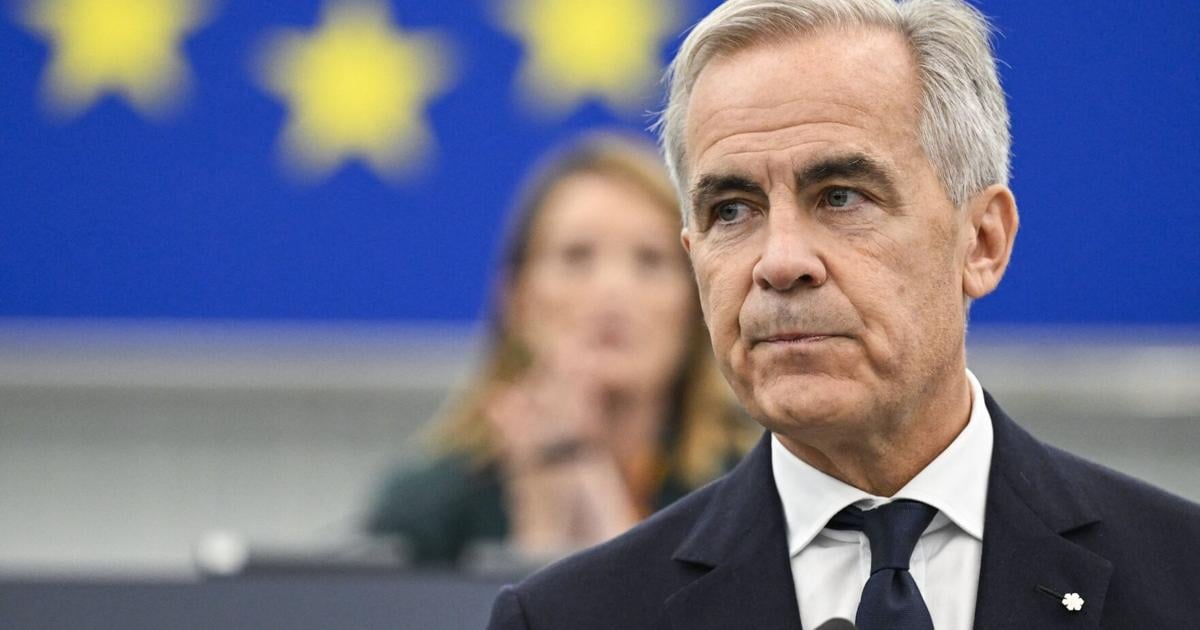
MONTREAL — For all the hype around this year’s 21st Canada-EU summit — and there’s a lot — most of the attention has been on what’s in a name. Not on what it means for Canadians in practical terms.
Debate raged for weeks over what to call Prime Minister Mark Carney’s and EU chief Ursula von der Leyen’s shared quest for a deeper partnership, ever since von der Leyen’s enthusiastic and unexpected label of “associate membership” as the goal.
Should their new deal — or deals — to come be called an “alliance” or should Canada become an “associate member” of the European Union? It would be the first country outside Europe’s continental territory to align in a formal-still-to-be-defined way with the 27 other states that make up the world’s largest single market and trading bloc.
Now that debate appears to be over, thanks to the objections of a handful of European countries who insisted words have meaning.
Until the new concept takes legal and actual shape, it won’t be called “associate membership” — which doesn’t exist in the legal treaties that underpin the EU.
Jonathan Wilkinson, Canada’s ambassador to the EU, told the Star on the eve of the summit that certain European states “would like to see a better definition of what it means … I think that’s the only issue.”
EU member states all support the concept of a deeper partnership with Canada, he added.
“I would say 27 out of 27 are enormously supportive of a closer relationship with Canada but I think some of them would like us to actually do the work before you actually put a specific label like membership” on the relationship, he said.
Two European sources confirmed that view Wednesday. So for now, “alliance for the future” it is.
Or as one senior European official put it this week: “the highest form of partnership imaginable.”
So cool that other, unnamed, countries already want to be part of it, he said.
But what does it mean in concrete benefits for Canadians?
A clear goal Carney identified when he set out his Euro-vision in a speech to the European Parliament at Strasbourg last month is more student mobility.
Carney aims to boost by a wide margin the number of Canadians who go abroad to Europe to study through Erasmus+, the EU’s study exchange program, where he believes they will make lifelong connections, expand their personal and professional networks — as he, an Oxford University graduate and a former London-based employee of Goldman Sachs and central Bank of England governor, did — to their and Canada’s future benefit.
Wilkinson said Canada and Europe are also looking to sign agreements to make it “simpler for people to do financial transactions, or perhaps less costly to do that,” and to increase greater exchange of “certain types of labour that can benefit both countries.” In plain terms, that means possible mutual recognition of credentials, such as Canada and Europe have done with architects, he said.
What it doesn’t mean, however, is widespread free movement of people across the Atlantic, Wilkinson said. Conservative Leader Pierre Poilievre charged in the Commons this week that “the prime minister is risking ceding our sovereignty to European policies which are costly when it comes to taxes, immigration and regulations.”
“People should be clear that this is not broad-scale immigration. This is not Europeans having control over Canada’s immigration system. This is not, you know, facilitating irregular migration,” said Wilkinson. “This is very specific. It’s about things like Erasmus, which is about enabling mobility for young people and students. ”
For Canadian university researchers, the hope is the talks secure a renewal of Canada’s participation in the Horizon Europe program, the world’s largest research and innovation funding program that is set to double its budget, spending 175 billion euros ($278 billion) between 2028 and 2034.
Meanwhile, workers on both sides of the Atlantic are both hopeful and skeptical of how tighter trade ties will work out for them.
In a joint statement Wednesday, the European Trade Union Confederation and the Canadian Labour Congress, which together represent close to 50 million workers, said they support a closer and deeper partnership at a time of tariffs and geopolitical instability, but they said trade unions “must be fully involved in shaping it.”
Stéphane Dion, a former Canadian ambassador to the EU and now diplomat-in-residence at the Université de Montréal, said what he wants to see most is success — “concrete results” — on all the areas set out in the Canada-EU 2025 strategic partnership agreement, and “at least they need to come with very, very specific deadlines for the year to come to be sure that we’ll not waste an additional year in 2027 at this next summit in Brussels.”
Certainly, Canadian and European officials who separately briefed reporters ahead of the summit promised “deliverables” — or announcements, many along the lines of an already leaked draft text.
The Canadians provided few details, saying they didn’t want to scoop Carney. The Europeans were clear.
Leaders will sign a digital trade agreement to ensure open rules-based digital trade; an agreement between Canada and the European Investment Bank to leverage capital for critical minerals projects in Canada; a EU-Canada competition co-operation agreement to tackle anti-competitive practices that affect interconnected economies; a modernized Euratom Canada nuclear co-operation agreement on uranium fuels; an agreement to open Europe’s supercomputing infrastructure to Canada to deepen research into areas like Alzheimer’s and artificial intelligence.
Other deals to come include Canada’s participation in European satellite programs — which the Canadian side says will boost sovereignty — and new joint efforts to combat foreign misinformation.
If it all works, both sides hope to accelerate trade in goods and services which, in less than a decade, has already grown by 80 per cent.
With U.S. President Donald Trump in office, the need to do more, faster is apparent, even though officials on both sides of the ocean say these moves are not targeted against any other government.
Wilkinson said it’s the follow-on to Carney’s Davos speech that implored like-minded middle powers to band together in the face of “hegemons.”
Error! Sorry, there was an error processing your request.
There was a problem with the recaptcha. Please try again.
You may unsubscribe at any time. By signing up, you agree to our terms of use and privacy policy. This site is protected by reCAPTCHA and the Google privacy policy and terms of service apply.
Want more of the latest from us? Sign up for more at our newsletter page.

