

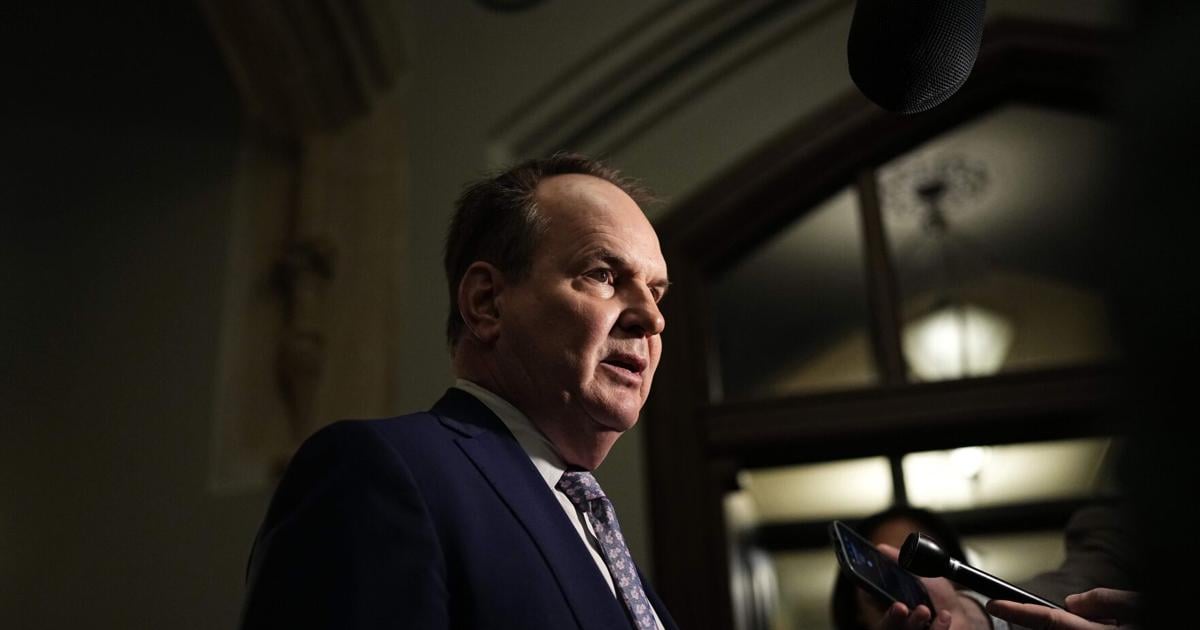
OTTAWA — Quebec is essential to the plan for Canada’s first high-speed rail line, Transport Minister Steven MacKinnon said Tuesday, as the federal government was forced to defend the costly megaproject after the province’s separatist party said it would reject the development if it takes power in this fall’s high-stakes election.
Asked if the proposal to build a 1,000-kilometre rail line from Toronto to Quebec City could proceed without the approval of the Quebec government, MacKinnon told reporters, “Let’s be clear, there is no Alto project without Quebec.”
His office later said MacKinnon was referring to the centrality of the rail line’s route through Quebec, and not the possible opposition of the provincial government.
But with polls showing the Parti Québécois is currently the favourite to win this fall’s provincial election, party leader Paul St-Pierre Plamondon—who is already vowing to hold a referendum on separation—promised Tuesday to reject the multibillion-dollar project if he becomes premier. Taking to social media, Plamondon called the proposal a “fiasco” that the province cannot afford, and said money from Quebec taxpayers would be better spent on schools, hospitals and other infrastructure in Quebec.
“I know this position will not necessarily be popular,” Plamondon wrote in French. “But as leader of a political party that aspires to form a responsible government, I cannot condone this waste to the detriment of vital projects for the population.”
First proposed as Justin Trudeau left office, the new rail line’s estimated cost is between $60 billion and $90 billion. It would have trains that travel at speeds up to 300 km/h, with stops in Toronto, Peterborough, Ottawa, Laval, Montreal, Trois-Rivières and Quebec City.
In an interview with the Star, the head of the federal Crown corporation in charge of the project stressed that neither Ontario nor Quebec would be on the hook for its costs.
Alto CEO Martin Imbleau said the train line would be funded by Ottawa and a conglomerate of Canadian and French companies that includes the Caisse de dépôt et placement du Québec, Air Canada and AtkinsRéalis.
“This is a federal infrastructure project,” with Alto owning the tracks and trains that run on them, Imbleau said.
“There is no provincial participation in Alto or any aspect of the project.”
At the same time, Tuesday’s new-found opposition from the Parti Québécois also renewed condemnation from Conservative Leader Pierre Poilievre, who described the project as a “white elephant” that will force farmers to lose their land.
In the House of Commons, Prime Minister Mark Carney insisted that Quebec voters who helped elect his Liberal government last year also cast ballots for the project that was part of his policy platform, and suggested the right-of-way for the rail line—which he said would be about 60 metres wide—was worth it for the scale of the development.
“We’re talking, at the same time, of the biggest infrastructure project in the history of the country,” Carney said in French. “It’s the moment to build a strong Quebec. It’s the moment to build Canada strong, and we will do it.”
Industry Minister Mélanie Joly said she believes Quebecers are tired of seeing how it has been possible to build high-speed rail in France but not in their province. France’s “TGV” system has existed for decades, and other countries in Europe and Asia have extensive high speed rail lines.
She added that the project is being funded by the federal government, and cited Alto’s projection that the development will support more than 50,000 jobs while adding about $24 billion to Canada’s economy.
“I think that in a modern Quebec, a modern Canada, we are capable of building big things, we are capable of having high speed rail, and we are capable of linking the four most important cities in Quebec via a high-speed train,” Joly said in French. “That will be the government’s objective.”
Earlier this year, the federal Conservatives came out against the project, with Poilievre predicting a ”$90-billion Liberal boondoggle” that would take land from farmers while serving major urban hubs.
The Bloc Québécois supports the project “in principle,” but is calling for further study and transparency about how much it will cost and how it will be built, BQ MP Patrick Bonin said Tuesday.
He added that there is “no social licence” for the development, noting concerns about the Carney government’s potential use of expropriation powers—expanded in an omnibus bill related to last year’s federal budget—to force landowners to sell so Alto can construct the new rail line.
“We’re not giving a blank cheque here,” Bonin said.
Error! Sorry, there was an error processing your request.
There was a problem with the recaptcha. Please try again.
You may unsubscribe at any time. By signing up, you agree to our terms of use and privacy policy. This site is protected by reCAPTCHA and the Google privacy policy and terms of service apply.
Want more of the latest from us? Sign up for more at our newsletter page.

