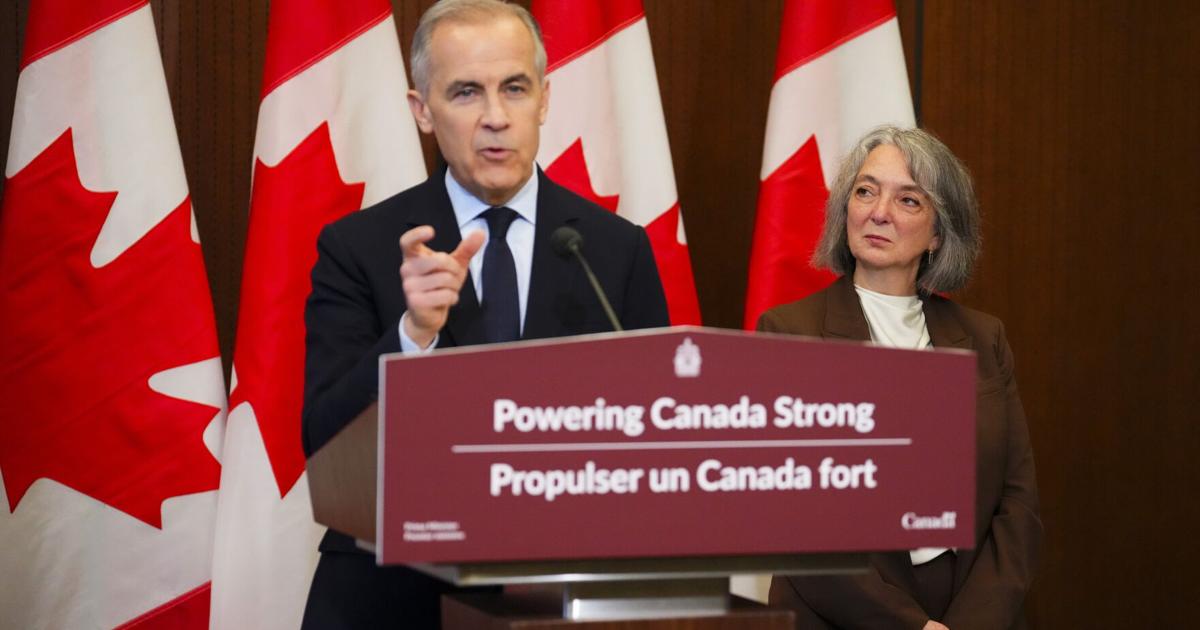
OTTAWA — The federal government has approved northern Ontario’s Crawford nickel mine, a major project that was under review for almost four years, as Prime Minister Mark Carney‘s Liberal administration tries to fast-track choice development projects and position Canada as a global leader in critical minerals used for advanced technology.
In a decision published Friday, Environment Minister Julie Dabrusin concluded that the open pit mine’s anticipated impacts on fish, migratory birds, local wetlands and Indigenous Peoples — in some cases deemed “significant” — are “justified in the public interest.”
The Crawford nickel project was reviewed under 2019’s Impact Assessment Act, beginning in August 2022. The Canada Nickel Company, which is behind the development, now has five years to start construction, Dabrusin’s decision said.
The mine north of Timmins, Ont. would include an open pit operation to extract nickel and cobalt, as well as an on-site metal mill, with the capacity for 240,000 tons of mine ore per day for about 41 years.
According to the federal government, the project is expected to “attract” $5 billion in investment and could create up to 4,000 jobs.
Dabrusin’s approval of the project comes with a set of conditions on Canada Nickel. These include consultation with local communities and Indigenous groups, protocols to “salvage and relocate fish” that lose their habitat because of the project, and steps to prevent chemicals from leaching into the surrounding environment.
The company also must work in a way that protects migratory birds and their nests, including through lighting controls.
The company said in a written statement Friday that it is aiming to make a “construction decision” next year, and that the mine should become the “Western world’s largest nickel sulphide operation,” as well as the only source of chromium — used in steel production, for instance — in North America.
The government and Canada Nickel said the mine will help provide critical minerals used in military industries, electric car batteries and advanced manufacturing, as Canada, the U.S. and other countries try to reduce their reliance on such material from China, the world’s leading producer.
Pierre Gratton, head of the Canadian Mining Association, applauded the news that the Crawford mine got a green light, and said he hopes the company will be in a position to raise enough money to build it.
“We’re now a relatively small producer of a very key critical mineral,” said Gratton, referring to how Canadian output has fallen over the past two decades.
Government data shows Canada produced 3.5 per cent of the world’s nickel in 2024, far behind the global leader of Indonesia, where Gratton said mining is fuelled by heavy Chinese investment.
“We haven’t been opening new mines and we’re depleting the ones that we have,” he said. “If we don’t start opening new mines like Crawford, we’re going to continue to decline.”
The approval also comes as the Carney government promises to bolster the Canadian economy amid the trade war with the United States, in part by fast-tracking the approval and construction of major projects like mines, oil and gas infrastructure, and electricity projects.
In May, the government said it wants to change federal rules for major project reviews so they move faster — with Ottawa-led assessments lasting no more than one year, and the potential creation of special zones where projects are considered pre-approved.
But the proposed changes have met criticism, since they come with new federal powers to adjust conditions on approved projects and overlook the “jeopardy test” that is meant to block projects if they would risk eliminating a species at risk.
Under Carney, the federal government has promised to make Canada the strongest economy in the G7, attract more investment from abroad, and double the country’s non-U.S. exports by 2035 to reduce dependence on the neighbour to the south.
The government also created a new “Major Projects Office” that is meant to shepherd through developments deemed to be eligible for fast-tracked approval in the “national interest.”
Error! Sorry, there was an error processing your request.
There was a problem with the recaptcha. Please try again.
You may unsubscribe at any time. By signing up, you agree to our terms of use and privacy policy. This site is protected by reCAPTCHA and the Google privacy policy and terms of service apply.
Want more of the latest from us? Sign up for more at our newsletter page.