

DUBLIN – Prime Minister Mark Carney is heading to a major summit of southeast Asian leaders as the ongoing Rohingya refugee crisis shows no sign of easing.
Randeep Sarai, Canada’s secretary of state for international development, said the federal government is not abandoning the nearly one million Rohingya people expelled from Myanmar into Bangladesh.
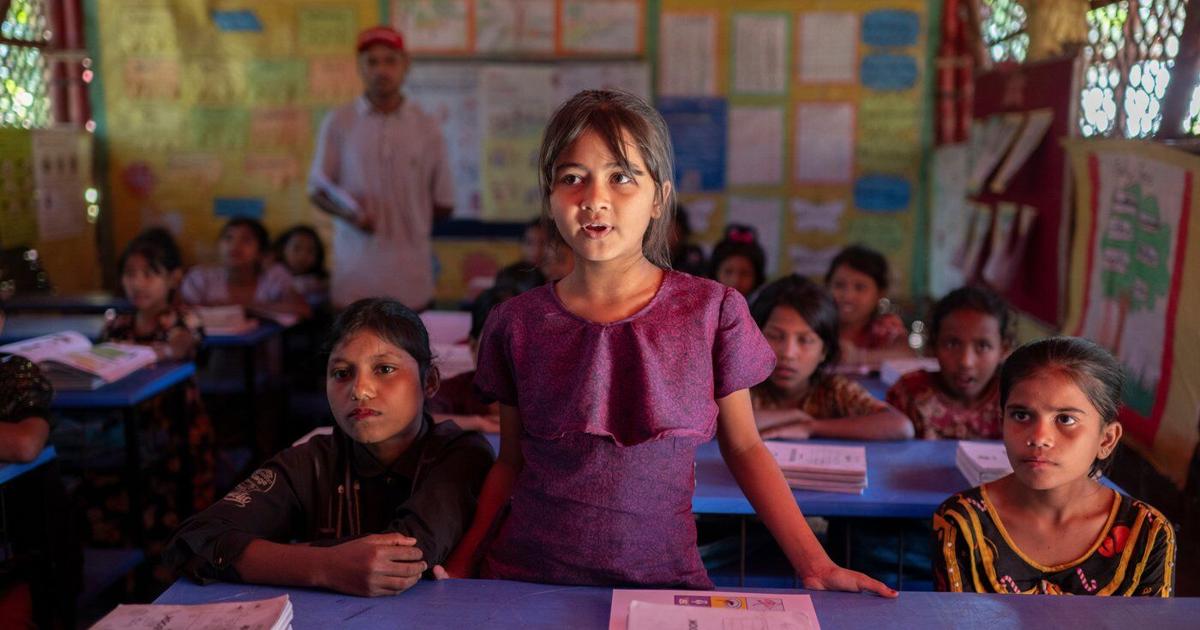
“They know that Canada is there for them,” said Sarai, who visited the world’s largest refugee camp in Bangladesh last month. He said he met Rohingya children there who were born in the camp nearly a decade ago.
“They’ve only seen one life, which is at a refugee camp.”
The Council on Foreign Relations says almost a decade ago, the government of Myanmar launched a military campaign that forced roughly 700,000 Rohingya to flee the country.
Rights groups suspect the government has committed genocide against the Rohingya, but officials deny the accusations.
Human rights groups say the country’s military killed and raped Rohingya civilians and burned down entire villages.
The crisis forced families to flee to neighbouring Bangladesh, where they still languish in an overcrowded camp in the town of Cox’s Bazar.
In 2021, a military junta overthrew Myanmar’s civilian government and intensified ethnic violence, often through airstrikes. Amnesty International reported in October that 150 to 700 new Rohingya refugees had been arriving weekly in Bangladesh.
The International Court of Justice is set to rule later this month on whether Myanmar has committed an act of genocide.
The instability is a major issue for the Association of Southeast Asian Nations, a bloc of 11 countries that includes Myanmar, previously known as Burma. Carney arrives Saturday in Manila for the ASEAN leaders’ summit, where he’s expected to pursue new trade arrangements with the region.
Former prime minister Justin Trudeau appointed Bob Rae as a special envoy to Myanmar to advocate for Rohingya people, a role he retained after Trudeau named him Canada’s ambassador to the United Nations.
Rae said the crisis is worse since then, as the world has shifted its attention to crises in Ukraine, Gaza and Iran and as Canada works to rebalance its trading relationships.
“It remains a challenge for the Canadian government to put it at a high enough level of priority, when the country’s facing a whole bunch of other crises,” he told The Canadian Press.
The instability has caused Rohingya and others to flee Myanmar to countries across Southeast Asia such as Malaysia, where 126,000 people live as undocumented migrants.
Meanwhile, scam centres in Myanmar have engaged in human trafficking by luring people from multiple countries into forced labour.
Rae said the spillover beyond Bangladesh is a source of deep concern for the entire region.
The ASEAN bloc agreed in 2021 to a five-point plan involving a ceasefire — which never happened — to be followed by negotiations, mediation, an influx of aid and a delegation to Myanmar.
“A lot of pressure is also on the ASEAN countries,” Sarai said. “We feel that they have a duty to work and put pressure, to make Myanmar bring [Rohingya refugees] back and give them a safe place.”
Rae argued pressure from ASEAN countries will only work if Canada and others put up enough aid money to help with the refugee crisis, and convince India and China to help more. Russia has helped to arm Myanmar, he noted.
Rae oversaw two plans for Canada’s response to the crisis; the last plan expired in early 2024. Ottawa folded its Rohingya programming into general aid programming that year.
“Our level of funding has gone down since the beginning of the crisis in 2017,” Rae said, arguing Canada needs to be vocal on the issue if it wants to be seen as a credible security partner for the region.
“The continuing issue is to make sure that it’s enough of a priority, that it’s seen as enough of priority for Canada, that we can continue to have strong credibility in our relationships with ASEAN.”
Rae said he regularly receives messages from desperate Rohingya pleading for funding for education initiatives.
The UN’s humanitarian head Tom Fletcher told The Canadian Press on a visit to Ottawa last month that he raises the Rohingya issue regularly with foreign ministers from ASEAN countries.
“It’s a really sustained, expensive, prolonged crisis,” he said.
Fletcher said the ultimate goal must be the voluntary return of Rohingya refugees to Myanmar under safe conditions.
“There has to be a horizon where we can see a pathway to that,” he said, adding that refugees “clearly don’t feel that it’s safe enough.”
Queen’s University professor Stéphanie Martel said the Rohingya issue is part of a broader Myanmar crisis that will be a “top priority” at this weekend’s summit, though she does not expect progress.
“I don’t think a lot of people actually have leverage when it comes to managing this awful, tragic situation,” she said, adding that lack of leverage is due in part to ASEAN’s format.
“This is an organization with a diverse set of regimes and that was built around this notion of non-interference in domestic affairs, and that everybody gets to do basically what they deem is right for their own regime and country,” she said.
Canada also has limited leverage, Martel added.
“I don’t think there’s a whole lot that Canada can do differently than what it’s already doing,” she said.
Sarai said Canada is committed to helping Rohingya gain skills they can use to support themselves within the camp and, ideally, after they return to Myanmar.
“Canada is one of the leading supporters of the Rohingyas. And when you talk to them, they’re … still very strong in their dream to go back home,” he said.
“It’s foolish for the Myanmar regime to not have them back, as I think as soon as they get back, they will be adding to their economy, they’ll be contributing.”
The refugee camp is not connected to Bangladesh’s power grid. Sarai said Rohingya refugees have taught themselves how to wire up the camp with solar power and to engage in commercial activities, such as making shoes and repairing motorcycle engines and bicycles.
Sarai said he also saw the effects in the camp of Canadian-funded programs that train women to start daycares and help teenagers learn how to preserve their language and culture.
This report by The Canadian Press was first published Nov. 13, 2026.

