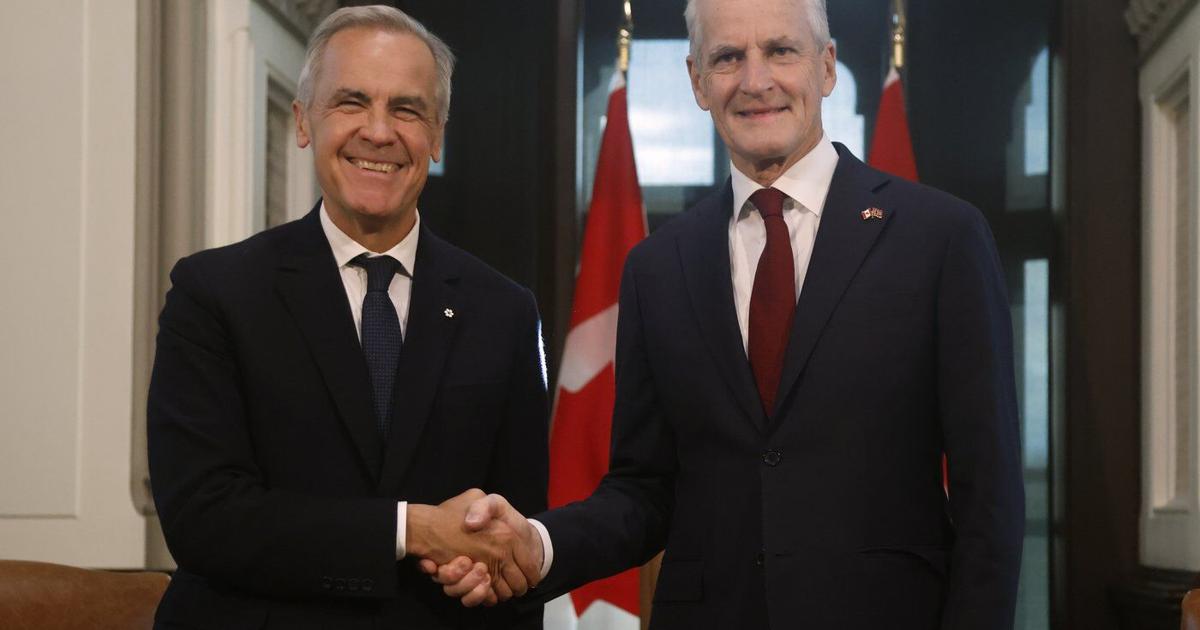
OTTAWA – Prime Minister Mark Carney says his focus on building international relationships, including with Norway, is part of the answer to renewed threats from Russia.
During a news conference with Norwegian Prime Minister Jonas Gahr Store in Ottawa, both leaders were asked about warnings from the Polish prime minister that Russia may be planning attacks on European countries that support Ukraine.
Store said those warnings should be taken seriously and that Norway’s intelligence has concluded there are “real threats coming from hybrid activity, ranging all the way to potential sabotage.’
Carney didn’t comment on the credibility of the threats, but said he agreed with Store’s statements.
“One of the advantages of this relationship and deepening across a broad range of relationships is, yes, greater intelligence sharing, greater perspective, greater capacities that are built together,” he said.
Carney said that includes having the “right partners” among Arctic nations working together. “The phrase that always sticks with me… is, ‘High North, low tension,’” he said.
He said the way to accomplish that includes submarine and space capacity.
In July, Carney chose to buy a dozen submarines from a European shipbuilder instead of a Korean firm, after a months-long, hotly contested bidding process. The chosen partnership involves a German company but partners with Norway, with the three nations collaborating to produce and maintain the submarines.
Carney said the “time spent whether it’s in the high north in Norway, a meeting with the French president who’s directly implicated in a number of these decisions, our meeting today and beyond, it’s all connected,” Carney said.
Before his meeting with Store in Ottawa, Carney travelled to Saint-Pierre and Miquelon to meet with French President Emmanuel Macron earlier in the day.
Store’s visit comes as Carney looks for closer ties with Europe, including potential “associate membership” in the EU.
Norway is not a member of the EU, but for three decades the country has had a deal with the EU that gives both sides free access to each other’s markets for goods and services — and gives Norway access to most EU programs.
Carney is courting deeper defence ties with the Norway, as well as investment from its massive, petroleum-based sovereign wealth fund.
Carney was in Norway in March — the first sitting prime minister since 1980 to visit the Nordic country.
During that visit, the two leaders pledged to advance collaboration in fields ranging from Arctic security to space, critical minerals and energy. Carney and Store also touted their reputations as low-risk global oil producers, amid supply shocks emanating from conflicts like U.S. President Donald Trump’s war on Iran.
Norwegian officials have often described Canada as a similar country, given that both seek to balance a large oil sector with a push for green energy and respect for Indigenous Peoples.
They both put an emphasis on using multilateral institutions to resolve disputes while identifying as strong proponents of NATO and deeply tied with the European Union, without being EU members.
Both countries have put support for Ukraine at the forefront of foreign policy, amid Russia’s 2014 and 2022 full-scale invasion.
Since late 2024, Canada has had an Arctic foreign policy that calls for more intense ties with Nordic countries in defence, strategic sectors and environmental issues.
This report by The Canadian Press was first published Sept. 20. 2026.
— With files from Dylan Robertson
Error! Sorry, there was an error processing your request.
There was a problem with the recaptcha. Please try again.
You may unsubscribe at any time. By signing up, you agree to our terms of use and privacy policy. This site is protected by reCAPTCHA and the Google privacy policy and terms of service apply.
Want more of the latest from us? Sign up for more at our newsletter page.