In 1972, two recent graduates from Hamilton’s McMaster University moved to Toronto and began renting an unassuming three-bedroom, red-brick house at 1063 Avenue Rd., just north of Eglinton Avenue.
Martin Short and Eugene Levy signed the lease with another housemate, John Yaffe, and under their tenancy, 1063 became a mecca for their many new friends in the city’s burgeoning musical-theatre and comedy scenes, all of whom treated the place as a kind of post-hippie update of the intellectual salons of 18th-century Paris.
In his foreword to my recent book, “John Candy: A Life in Comedy,” original “Saturday Night Live” cast member Dan Aykroyd wrote, “There should be a commemorative plaque on it … the pre-Hollywood parties there were massive fun fests. We’d have Paul Shaffer playing piano, Dave Thomas, Martin Short, Rick Moranis, Andrea Martin, Gilda Radner, Catherine O’Hara, Eugene Levy, Joe Flaherty, Brian Doyle-Murray, all the talented ‘Godspell’ performers and whoever with Second City was passing through, singing and trying out material.”
Over the ensuing years, the Avenue Road digs would become the home of various people associated with “Godspell,” the Second City Theatre, “SCTV,” “SNL” or in some cases, all of the above. By 1974, Levy and Short had moved on, and Sheldon Patinkin, who would produce “SCTV,” took over the lease until 1976, when John and Rose Candy moved in and stayed until 1980.
With 2026 marking the 50th anniversary of “SCTV”‘s television premiere and the series’ recent streaming debut (on Prime), the denizens of 1063 reflect on the house that helped invent postwar North American comedy and became the breeding ground for a generation of Canadian cultural exports in comedy, drama, musical theatre and film.
Theatre kids and weirdos
At the dawn of 1970s, Aykroyd and his performing partner, Valri Bromfield, had only recently relocated to Toronto from Ottawa, where the local TV sketch-comedy program they had created, “Change for a Quarter,” had so impressed future “SNL” mastermind Lorne Michaels, himself fresh from wrapping up his own CBC series, “The Hart and Lorne Terrific Hour” (with Hart Pomerantz), that he urged the duo to make the big move to Toronto. Once there, Bromfield and Aykroyd befriended the ragtag group of like-minded theatre kids and weirdos who lived, or frequently congregated, at 1063.
Dan Aykroyd “1063 Avenue Rd. was the hub for all of the comedy kids at that time and a lot of fun with many, many memorable nights and stage shows at Second City.”
Martin Short (in his 2014 memoir, “I Must Say”) “Tom Hanks thinks the name Avenue Road is hilarious and acutely Canadian. He brings it up whenever the subject arises: ‘Hey, Marty, when you were a kid in Toronto, did you ever wish you lived on Street Lane instead of Avenue Road?’”
Short, Levy, and fellow McMaster grad Dave Thomas had all joined the cast of the groundbreaking inaugural Toronto production of “Godspell,” a show composed by Stephen Schwartz, with a book by John-Michael Tebelak. The American version had opened at Manhattan’s Cherry Lane Theatre in May 1971 and yielded the hit single “Day by Day” in the summer of 1972, just as the Toronto production was opening to rave reviews at the Royal Alexandra Theatre, launching the careers of many of its cast and crew, including Thomas, Short and Levy, plus Victor Garber, Paul Shaffer, Howard Shore, Gerry Salsberg, Andrea Martin and Detroit expat Gilda Radner.
Eugene Levy (to Alex Simon in Venice magazine) “‘Godspell’ was the first legit job any of us had, and yeah, it was an amazing company. We signed for a year, got a check every single week … making about $145 a week. So that was our big foray into show business. We were just hanging out, living the life of Riley, partying. We were young!”
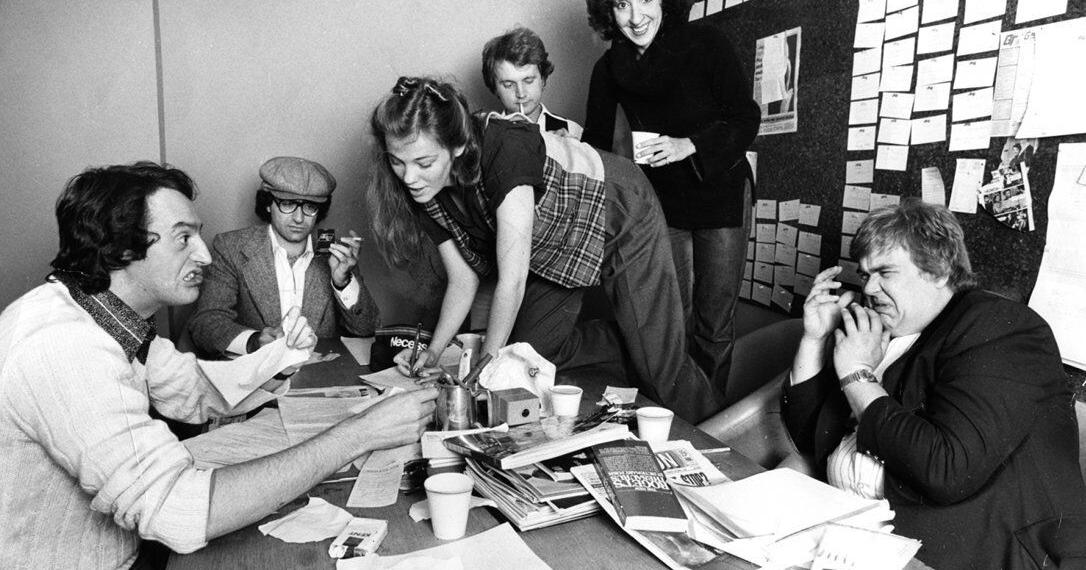
In the early days of “SCTV,” the house became the unofficial headquarters for the show’s writers, with parties attended by the likes of Shaffer, Aykroyd, Radner, Garber, Flaherty, O’Hara, the Murray brothers (Bill and Brian), even John Belushi.
Dave Thomas (in “SCTV: Behind the Scenes”) “Hundreds of pages of comedy have been written there. Eugene, Marty Short, Paul Shaffer and I had most of our infamous Friday Night Services at 1063 Avenue Rd. That little house has a real place in the history of comedy. In fact, Toronto in the mid-1970s was a remarkable place if you were at all interested in comedy.”
The Friday Night Services were weekly talent nights comprised of theatre games, songs, dances, improvisations, smoking and drinking, lots of drinking. Speaking to me for my Candy biography, Thomas elaborated.
Dave Thomas “It was a social scene, but it was all these people that had a similar sense of comedy that were connecting on their similar sense of comedy and making each other laugh. So there didn’t seem to be enough parties to celebrate that kind of common bond.”
Thomas and Levy, with Dave’s musician brother Ian, were writing a CBC Radio program called “The National Rockworks Company” when Andrea Martin entered 1063 in 1974.
Dave Thomas (in “SCTV: Behind the Scenes”) “She was ‘sort of’ dating Eugene at the time. They had co-starred the previous year in ‘Cannibal Girls,’ a schlocky no-budget horror movie directed by Ivan Reitman. Andrea just burst into the room with so much energy that all you could do was watch. She did an instant comedy routine with some bedsheets she had just washed. Her routines were often sexual and so explicit that you had to laugh as a way of handling the shock.”
When the friends weren’t cracking each other up at 1063, they could often be found at the Pilot Tavern at 22 Cumberland St. in Yorkville.
Martin Short (in “I Must Say”) “When we weren’t performing together, we were hanging out together. John Candy, with whom many of us fell into friendship at that time, joked that he hated hanging around with the ‘Godspell’ people because all they ever talked about was f—king ‘Godspell’ … (We were) impervious to fatigue because we were all so young.”
In his comprehensive history of sketch comedy, “Improv Nation,” Sam Wasson described the all-for-one, one-for-all ethos of 1063, which would later become an operating mantra for the close-knit Second City players in their future work on “SCTV,” “SNL,” the Christopher Guest ensemble comedies and, eventually, “Schitt’s Creek.”
Sam Wasson (in “Improv Nation”) “They dreamed in ridiculous parody, aping the outsize careers they wanted but couldn’t have, moving the coffee table out of the way and turning 1063 into an improv stage and laughing to life a living room carnival of their showbiz gods, their idols … the denizens of 1063 were already living their dreams. Jealousy and competition, therefore, did not exist.”
Dave Thomas “It was so much fun. And kind of scary, because there was always (a sense of), ‘Am I actually good enough to be in the company of these people? Because they’re really good.’ There was an album that came out at that time by Albert Brooks, ‘Comedy Minus One.’ (In) the album liner notes there were scripts, and you could do scenes with Albert and read (along). But what Albert Brooks did was, he changed the timing. He started the script out great, where you had plenty of time to do the lines. And then there was not enough time to do all those lines in the space provided. And then there was more than enough time and you’d have to ad lib. We were always looking for somebody who didn’t know the trick, and it created an opportunity for people to perform for each other. Because we didn’t have an audience to perform for, we were performing for each other.”
Catherine the outsider
Well-connected Toronto arts maven and bon vivant Marcus O’Hara’s little sister Catherine had already improvised with Radner at the O’Hara family dinner table, and in 1974 would become her understudy at The Second City.
Martin Short (in “I Must Say”) “I am told by Catherine O’Hara that the first time (she) and I met (at 1063) … I barely cast a glance in Catherine’s direction. She was a mere girl of eighteen, as was her school friend who tagged along, Robin Duke. (Robin would later, like me, perform in the casts of both ‘SCTV’ and ‘Saturday Night Live.’)”
When I spoke with O’Hara for my Candy book, she admitted that while she always felt welcomed into the Friday Night Services, it would be years before she felt like an insider.
Catherine O’Hara “I was there many times, but I wasn’t deep in the circle. We were all bonding and learning to improvise with each other … So it was a really ridiculously talented crowd, and really exciting to be around them and to watch them with each other. And they’re all lovely talented people. Paul Shaffer was in the ‘Godspell’ crowd, but also old friends and schoolmates with Eugene, Marty and Dave.”
O’Hara also recalled, with mild trepidation, her ritual hazing into the circle via the infamous Albert Brooks album.
Catherine O’Hara “Albert would leave a really long space for you to say two words, so your timing would be cut off. You’d have a big speech, then Albert gave you two seconds to read your line. It was funny to watch people be tortured to try to do it. So that was a way to initiate new people into the fold … but it really wasn’t a gang-up thing. It was just like, somebody would put on the album and go, ‘Hey, you. First time here. Why don’t you come on and try this album?’ Parlour games galore, from then ‘til now. I love the parlour games.”
Michael Short was already a gigging musician when his brother Marty invited him to be a part of the Friday Night Services. Interacting with comedic minds presented a detour in his career that would see him becoming not only one of the staff writers for “SCTV” but also prepare him for later roles as a writer and producer of “Schitt’s Creek.”
Michael Short “Marty and I used to make comedy tapes, and Marty would pull them out at the house on 1063 Avenue Rd. They’d all be smoking pot, and suddenly I became this comedic hero. I remember Eugene came up to me — he’d only met me once or twice — and he started doing a character that I had done on the tape. Marty told me, ‘Yeah, Eugene is obsessed with that character.’ My band wasn’t really making any money so Dave said, ‘You’re funny. You should come and try writing comedy for “SCTV.” Just do what you and Marty do and write it down. That’s what a sketch is.’ So suddenly, I’m shifting careers. It was weird, but I did a couple of writing things and it kind of worked out.”
When Jayne Eastwood, presently a member of the comedy troupe Women Fully Clothed — with Robin Duke, Kathryn Greenwood and Teresa Pavlinek — began hanging out at 1063, she was already, by her own description, “semifamous in Toronto” for having appeared Donald Shebib’s legendary Canadian indie film “Goin’ Down the Road” in 1970, before joining the cast of “Godspell” in 1972 and then the nascent Second City troupe the following year.
Jayne Eastwood “The best parties ever were at 1063 Avenue Rd. That’s where Eugene and Deb (Divine) first hooked up. We just partied there non-stop. Gilda fell in love with Victor, but for obvious reasons that didn’t quite work out, and then it was Marty and that didn’t work out. But I’ve never laughed so hard in my life. And then when we met John Candy, it got even funnier. Of course we became the new comedy renaissance. I don’t think we knew how famous some of us were going to become.”
High times at the 505
After some of the “Godspell” kids moved on to Second City, many began frequenting the 505, an unlicensed after-hours club run by Aykroyd and Marcus O’Hara at 505 Queen St. E., just a few blocks away from the Old Fire Hall, where Second City performed.
Valri Bromfield “The 505 was initially a storefront place that I rented. It was two doors down from a cafe where a guy made pies at four in the morning, and Marcus came and lived with me in that house. Then Danny took it over and turned it into an off-licence.”
Martin Short “When I started dating my wife Nancy Dolman, we would (still) hang out at the Avenue Road place, or we’d go to the 505.”
The 505 was also where Aykroyd first bonded with a visiting John Belushi, whom he had only just met the night before in an onstage improv set at the Old Fire Hall. In the wee hours of the morning, the two future stars dreamed up the prototype for their Blues Brothers routine after grooving to the Downchild Blues Band.
Dan Aykroyd (in “Improv Nation”) “We took one look at each other. It was love at first sight.”
Occasionally, Lorne Michaels could be seen hovering in the background at the 505. Perched in his favourite seat, an old barber chair rescued from a second-hand shop, Michaels assessed the talent pool as he plotted his comedy empire.
Inevitably, Michaels would draft many of them to join him in various “SNL” casts in New York City, and while the core “SCTV” comedians remained in Canada for as long as they could, the lure of wider show business success eventually saw most, if not all, of the key players look south to establish healthy careers in the U.S.
And yet, as Michaels told me a few years ago, it’s possible to retain one’s essential Canadian identity while broadening one’s comedic horizons for the sake of practicality.
Lorne Michaels “I think you have to go where the most talented people are, just to be able to challenge yourself, and though I don’t like to use the phrase ‘comfort zone,’ I think you have to get to a point, particularly if you’re going to be speaking to an American audience, where you’re not speaking exclusively as a Canadian voice. I don’t mean that you’re trying to pass; I just mean that you have some understanding of the USA.”
Short, O’Hara, Aykroyd, Levy, Thomas, Shaffer, Martin and others exported not only their unique comedic abilities, but they also demonstrated the specifically Canadian kind of team spirit that they grew and nurtured during those madcap Friday nights at 1063.
Martin Short “You have to remember, no one particularly thought they’d ever become successful outside of Toronto. It wasn’t like people were saying, ‘Someday we’re going to be in the movies,’ or something. It was just a tight-knit group, we were all buddies … And again, everyone was just happy to be out of university. They were happy that they were actually getting paid for doing something they adored to do. It was quite a unique experience.”