

Amid all the attention paid to her mildly salacious revelations about Justin Trudeau, Chrystia Freeland has been saying stuff that’s much more relevant to our current moment.
At every tour stop to promote her new book “Unreliable Boyfriend: An Insider’s View of Dealing with a Chaotic Superpower, Plutocrats, and Other Complicated People,” the former federal cabinet titan has been going out of her way to reiterate that she considers her longtime pal Mark Carney an excellent prime minister.
But she’s also been subtly offering warnings about the direction his government is going on foreign policy, and to some extent domestic economic policy as well.
And fitting as they do into her unique perspective about how we got to the dark times the world is currently living through and how we might get back toward something more optimistic and harmonious, which is really the thrust of the book augmented by the gossipy bits, they’re well worth taking seriously.
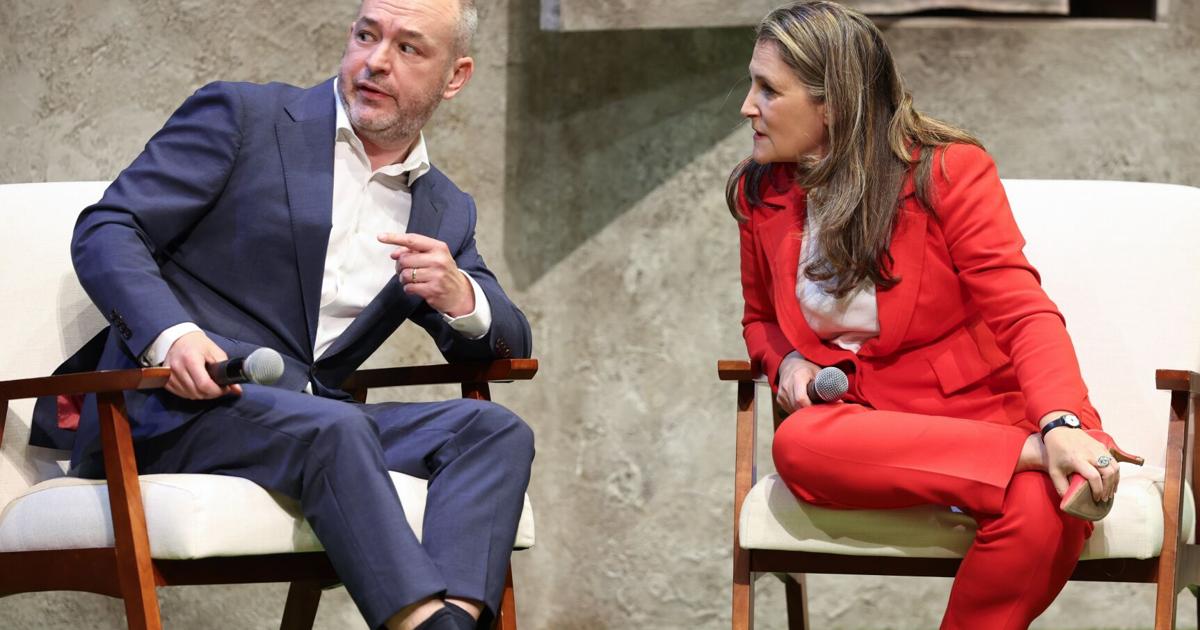
When I interviewed Freeland this week to launch a monthly series of Star events at Toronto’s Soulpepper Theatre, we discussed Trudeau and (even more so) her dealings as foreign minister with U.S. President Donald Trump. But what I was most eager to talk to her about was Unreliable Boyfriend’s final, more forward-looking section.
That’s where she lays out her argument for how we should learn from the mistakes of the globalization push that peaked in the 1990s and early 2000s, and hopefully make a post-Trump push back toward free trade and international alliances that doesn’t cause the same sort of backlash that helped bring him to power.
Much of that case revolves around her view that last time around, liberal democracies were too willing to set aside their principles while focusing almost exclusively on closer economic ties with countries (especially China and Russia) which Western leaders mistakenly believed would play by our rules the more we brought them into the fold — only to suffer from how they distorted markets and wielded their clout.
What Freeland is essentially arguing is that we should now instead prioritize closer economic ties with relatively like-minded nations, and make things like human rights, security, and labour and environmental standards part of the conversation when negotiating with more fraught ones.
And she cautions against the temptation to respond to current circumstances with a realism which holds that “hope is not a strategy” and “that we need to take the world as it is, not as we wish it to be.”
Those are some of the exact words that Carney has used to describe his government’s policy approach, although the book doesn’t directly attribute them to him. So I had to ask: At a time when Canada is re-engaging with China, treating Saudi Arabia as a friend and negotiating a trade deal with India while downplaying allegations it orchestrated an assassination on Canadian soil, is she worried that we’re tilting a little too hard toward realism and away from values?
Her answer, in a word and after a brief pause, was “Yes.” There followed a lengthy riff on why “realism” might not even be the right word to describe naively treating authoritarian regimes as trustworthy, before she characteristically drew off the examples of Russia and China over the past couple of decades.
Another lesson that her book draws is about needing to do better at ensuring that the benefits of global trade are spread across the population — including to people whose industries (like heavy manufacturing) can be losers from shifting trade balances — rather than allowing it to contribute to income inequality that spurs social unrest. Does that mean she’s concerned that, as a matter of competing in the Trump era and as a perceived correction to the Trudeau years, Ottawa is now so squarely focused on economic growth that it’s deprioritizing economic fairness?
That didn’t get as direct an affirmation during our discussion. But as she emphasized the need to pursue growth and fairness in tandem, cited programs like child care (which the current government seems lukewarm about further advancing) as fitting on a Venn diagram of those priorities, and warned about a corporate-tax race to the bottom (amid a push for Canada to do just that in next month’s budget), it wasn’t too hard to read between the lines.
None of these cautions are likely to stop Carney in his tracks in how he responds to geopolitical tumult either internationally or at home, nor should they.
Some of what Freeland is advocating for is difficult to square with the current need to decrease economic reliance on the U.S. (She acknowledged that, a bit, when I asked how much we can really afford to keep China at arm’s length.)
And all available evidence suggests that Canadians are currently on board with Carney’s relatively hard-eyed view of the world and his ambitions for Canada’s role in it, more than what was offered by the Trudeau government in which she served.
But there are very few people in Canada (or elsewhere) who both reported on the circumstances that brought us to an era of authoritarianism and mercantilism, and played a central role in government trying to respond to it, the way Freeland did.
That’s the history, not the details of her break with Trudeau, that’s most timely now.
And it makes her voice — her implicit and seemingly reluctant warnings about the balance being struck by her friend leading the country — an important counter-balance when it’s easy to dismiss even the most realistic values-based concerns as misplaced moralizing.

