

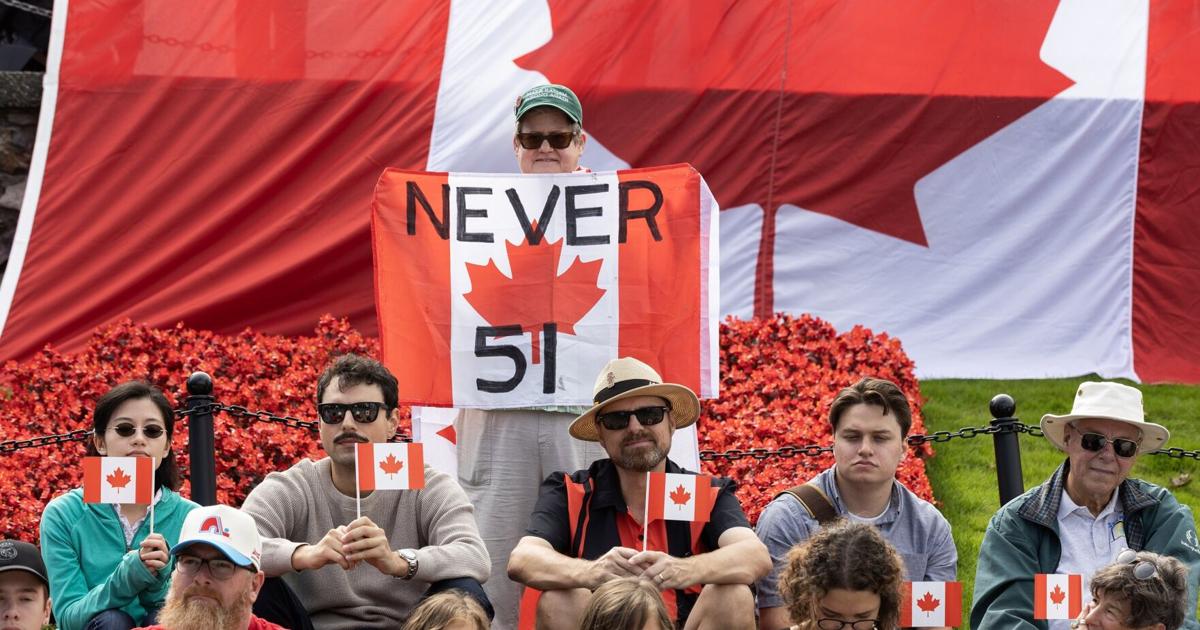
OTTAWA — U.S. President Donald Trump significantly ramped up his trade war Tuesday, responding to Canada’s tariff counterpunch by moving to ban imports of Canadian alcohol and dairy products, and dramatically increasing tariffs on a wide variety of other goods.
He also vowed to include steel, aluminum and automotive products — already facing steep import duties — in tariffs from which they had previously been excluded.
Taken together, the moves represent a dramatic escalation of the trade war, according to leading international trade lawyers who spoke to the Star.
In a statement on social media late Tuesday, Canada-U.S. Trade Minister Dominic LeBlanc said the federal government is assessing the latest U.S. measures after the president issued five proclamations in response to Canadian countertariffs that kicked in hours earlier.
LeBlanc said he is in contact with U.S. Trade Representative Jamieson Greer, and that “our government will work in good faith and constructively towards a more secure mutually beneficial trading relationship that fully respects Canadian sovereignty” when the Trump administration is “ready to engage.”
Trump’s new proclamations said 50-per-cent tariffs imposed after trade talks collapsed will extend as of Sept. 15 to a variety of other goods, from cheese, steel and golf carts to tanned furskins and motorboats.
Import bans, previously unseen in the trade war that began early last year, are set to hit a range of Canadian alcohol, dairy and whey products, and Canadian-made motorcycles on Sept. 29, the proclamations said.
“This is moving from retaliation to retribution. He wants Canada crawling back to the table and cowering,” said Barry Appleton, co-director of the Center for International Law at New York Law School, and a fellow at the University of Waterloo’s Balsillie School of International Affairs.
An outright ban on importing Canadian products is a major change in the trade war, said veteran trade lawyer John Boscariol.
“This brings things to a whole new dimension. That signals a very significant escalation,” said Boscariol, head of the trade law group at McCarthy Tétrault.
“To have not just tariffs but import prohibitions … that’s a massive sledgehammer.”
The head of the association representing Canadian distillers decried the import ban, which is slated to hit packaged beer, rye whiskey, vodka and more.
“Obviously this is very concerning for the Canadian spirits industry,” said Cal Bricker, CEO of Spirits Canada. “We urge both sides to return to the table as soon as possible to resolve the dispute so we can return to free trade in spirits in North America.”
Companies on both sides of the border will feel the effect of the escalation, said Flavio Volpe, CEO of Canada’s Automotive Parts Manufacturers’ Association, noting that the latest executive orders mean that industries already hit by sector-specific tariffs now face a second set of tariffs.
“While this proclamation does not directly impact automotive or parts production, Trump is banning small displacement motors that could be built for other uses,” said Volpe. “He is also allowing these new tariffs to stack on top of the Section 232 tariffs, reversing earlier guidance designed to ease the burden on American importers.”
Candace Laing, president of the Canadian Chamber of Commerce, added in a statement that the U.S. is trying to “make an example of Canada” after the Carney government walked away from trade talks and retaliated with countertariffs to U.S. import duties imposed in late August.
“The U.S. administration is punishing Canada — by punishing themselves — for the whole world to see,” Laing said.
The news came on the heels of Trump’s promise Monday to ban aerospace firm Bombardier from selling planes in the U.S., as well as a previous pledge to double existing tariffs on Canadian autos to 50 per cent on Jan. 1.
Earlier in the day, Trump also said his administration would bar Canadian products and companies from supplying U.S. government agencies.
In a social media post, Trump repeated his long-standing grievance about Canada’s decades-old protections for the dairy sector, and also took issue with government policies favouring domestic procurement in Ottawa and the provinces.
Under Prime Minister Mark Carney, the federal government has promised to use Ottawa’s spending power to favour Canadian companies in areas like defence in an effort to strengthen the economy.
“This is not reciprocity, it is a Canadian Trade Scam,” Trump wrote, before stating he is directing the U.S. General Services Administration to remove Canadian-origin products from its list of approved products for American government purchases “unless Canada restores full and fair reciprocity for American Farmers and Companies.”
Earlier Tuesday, Carney addressed Canadians about the escalating trade war in a video statement, accusing the Trump administration of trying to make Canadian industries dependent on the U.S. and forcing his government to abandon talks as the two sides approached a deal in late August.
The prime minister also touted his government’s plans to fast-track major projects, expand trade with other countries, and break what he described as Canada’s overreliance on the U.S. over the 40 years since the Canada-U.S. Free Trade Agreement in the 1980s.
Just after midnight Tuesday, the government imposed tariffs of up to 50 per cent on almost $28 billion worth of U.S. imports, matching the value of goods Trump slapped with 50 per cent duties after the trade talks collapsed last month.
In his video, Carney defended Canada’s response — which taxes goods entering the country from the U.S. — as necessary to match the hit of Trump’s tariffs on Canadian sales south of the border.
“I don’t believe in escalating the conflict. That’s not constructive,” he said. “But our tariffs are necessary to protect our workers, protect our companies, and our communities. We can’t let American goods into Canada tariff-free while they charge our companies to export them.”
Carney said his government is supporting workers and businesses impacted by the trade war, including through a recent commitment of $7.5 billion in loans and changes to make Employment Insurance more generous, citing a “harsh reality” that Trump’s tariffs will impact some Canadians more than others. “And that was by design,” he said.
Hearkening back to Canada’s founding under prime minister Sir John A. Macdonald, Carney described repeated attempts by the U.S. to weaken Canada’s economy and strive for annexation.
“That threat has flared up periodically throughout our 160-year relationship,” Carney said, referring to American protectionism in the late 19th century under president William McKinley, as well as his rhetoric during the Liberals’ victorious federal election campaign last year, when he repeatedly accused Trump of trying to “break us” so the U.S. “can own us.”
The U.S. president has repeatedly said that he’d like to annex Canada, and told reporters last year that he would try to do so through “economic force.”
“Our future won’t be decided in Washington, but right across Canada,” Carney said.
He went on to tally his plan since taking office last year to deepen trade with countries other than the U.S., strike stronger industrial ties with the European Union in areas like defence production, and to provide public funding and make regulatory changes to speed development of major projects like fossil fuel pipelines, ports and electricity grids.
“We have everything we need to pivot and prosper. That pivot will come at a cost,” he said. “There’s always a cost to action, but it doesn’t come close to the cost of standing still.”
Error! Sorry, there was an error processing your request.
There was a problem with the recaptcha. Please try again.
You may unsubscribe at any time. By signing up, you agree to our terms of use and privacy policy. This site is protected by reCAPTCHA and the Google privacy policy and terms of service apply.
Want more of the latest from us? Sign up for more at our newsletter page.

