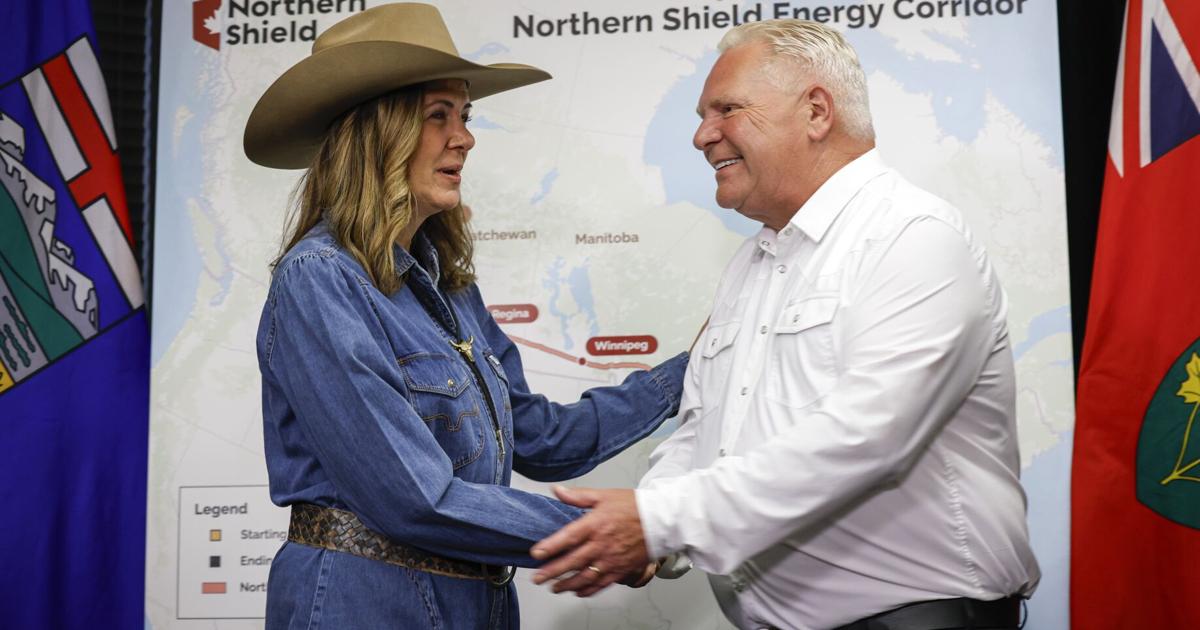
Touting national unity against the backdrop of a looming Alberta referendum on whether to pursue secession, Premier Doug Ford is pitching a 3,300-kilometre pipeline to ship Albertan oil east to refineries in Sarnia, Ont.
Ford was at the Calgary Stampede on Monday to ink a deal with Alberta Premier Danielle Smith to build the so-called Northern Shield Energy Corridor.
“The Northern Shield Energy Corridor is a critical next step in building a more united, more prosperous and more resilient Canada,” the premier said of a crude oil pipeline that could end up being bankrolled by Ontario taxpayers unless corporate proponents can be found.
“We’ll reach out to the private sector, but we won’t hesitate to do what the government of Canada and Alberta is doing,” he said, referring to the proposed publicly subsidized pipeline to the southern B.C. coast that Smith and Prime Minister Mark Carney unveiled last Thursday, which would ship one million barrels of oil daily.
Ottawa was noncommittal, with a spokesperson for federal Energy Minister Tim Hodgson noting “given the west coast pipeline proposal is sufficiently advanced to have been referred to the Major Projects Office due to its diversification and nation-building potential, that project is our priority at this time.
“We are taking a collaborative approach, and any next steps will be informed by additional project details, engagement with partners, and relevant approvals,” said Charlotte Power, Hodgson’s press secretary.
The Ontario premier said the planned pipeline would move between 500,000 and 800,000 barrels of oil a day and snake from Hardisty, Alberta, to Sarnia via Regina and Winnipeg.
But there is no timeline or price tag for a scheme that is currently the subject of a feasibility study being led by Infrastructure Ontario and includes consultations with 77 Indigenous communities.
In May, Ford blasted Smith’s decision to hold a referendum on whether Alberta should move toward secession from Canada, accusing her of trying to “protect her 30 per cent base” in the United Conservative Party and warning “it’d be a disaster for Alberta to split away from our country.”
“I would never do that,” he said at the time of her calling the October vote. “But then again, I’m not the premier of Alberta. That’s up to Premier Smith to decide, but I would never ever put that poll to Ontarians.”
On Monday, Ford shrugged off a reporter’s question about his earlier critical comments.
“I think the world of Premier Smith, first of all, and we’re focused on a pipeline,” he said, before launching a tirade against the way former prime minister Justin Trudeau dealt with Alberta’s energy sector.
“Let me cut to the chase here. The previous federal government — not this one, the previous federal government — treated Alberta like garbage, like terrible. I’ve never seen anything as bad as that. So I know that Premier Smith wants a proud, sovereign Alberta — part of Canada — and again, we’re there to support her. It’s Team Canada. I’ll do anything we can.”
Smith suggested the project would be good for national unity.
“Alberta is committed to working with provincial and federal partners to turn this opportunity into reality. A new west-east pipeline will connect Canadian energy with Canadian consumers while laying the foundation for future growth,” she said.
While Saskatchewan Premier Scott Moe backs the proposal, which he said would “generate the national wealth we need to invest in areas such as health care, education and community safety,” Manitoba Premier Wab Kinew is not yet sold.
To appease Kinew, who has been pushing a pipeline to tidewater in the Port of Churchill in northern Manitoba, the Ontario and Alberta premiers argued the eastbound project has potential benefits for Manitobans.
“I think the world of Premier Kinew, I’ve said it a hundred times, I think guy’s a champion,” said Ford, adding “the new route would also provide the government of Manitoba and the Manitoba-Crown Indigenous Corporation with the opportunity to explore the feasibility of a pipeline extension to the Port of Churchill.
“He has to consult a little more with his folks in Manitoba, but we’ll work something out, and I’m 100 per cent behind putting a pipeline up to Churchill and getting an icebreaker and start delivering it around the world,” he said.
Kinew’s spokesperson Amy Tuckett-McGimpsey emphasized “major nation-building projects have to be built the right way.”
“That’s why we’re continuing to work directly with northern communities, Indigenous nations, and the Manitoba Crown Indigenous Corporation as we advance discussions around Churchill’s future,” said Tuckett-McGimpsey.
“Those conversations will continue because lasting economic development is built in partnership.”
Keith Stewart, senior energy strategist for Greenpeace Canada, said the plan makes no sense economically or environmentally.
“Why don’t we cut out the middleman and just have Canadians send their tax dollars directly to ExxonMobil?” Stewart said of the U.S. oil giant.
“There is no private-sector proponent for these pipelines because there is no business case in a world where electric vehicles and heat pumps powered by wind and solar energy are cheaper, cleaner and faster to deploy than the fossil fuel megaprojects that are fuelling heat waves and wildfires.”
Emily Hunter, a senior program manager for Environmental Defence, warned “in Ontario, the proposed Northern Shield route would traverse the lake-rich Canadian Shield and could affect Muskoka, the Niagara Escarpment and Bruce Trail corridor, and productive southern Ontario farmland before reaching Sarnia.”
“Construction on this scale could involve extensive clearing, trenching and blasting in rocky areas, fragmenting habitat and creating long-term spill risks for lakes, rivers, wetlands, drinking-water sources and agricultural soils. This is not simply a line on a map — it could put the lands and waters Ontarians depend on at risk,” said Hunter.
The Canadian Taxpayers Federation, meanwhile, urged Ford and Smith to scrap existing carbon-pricing measures instead of subsidizing another pipeline.
“Governments are blocking pipelines with carbon taxes and red tape and then wasting taxpayers’ money trying to get projects built,” said Kris Sims, the CTF’s Alberta director.
“This is like the government dumping nails all over the road, popping your tires and then spending your money to buy new tires.”
With files from Ryan Tumilty
Error! Sorry, there was an error processing your request.
There was a problem with the recaptcha. Please try again.
You may unsubscribe at any time. By signing up, you agree to our terms of use and privacy policy. This site is protected by reCAPTCHA and the Google privacy policy and terms of service apply.
Want more of the latest from us? Sign up for more at our newsletter page.