What a difference a trade war makes.
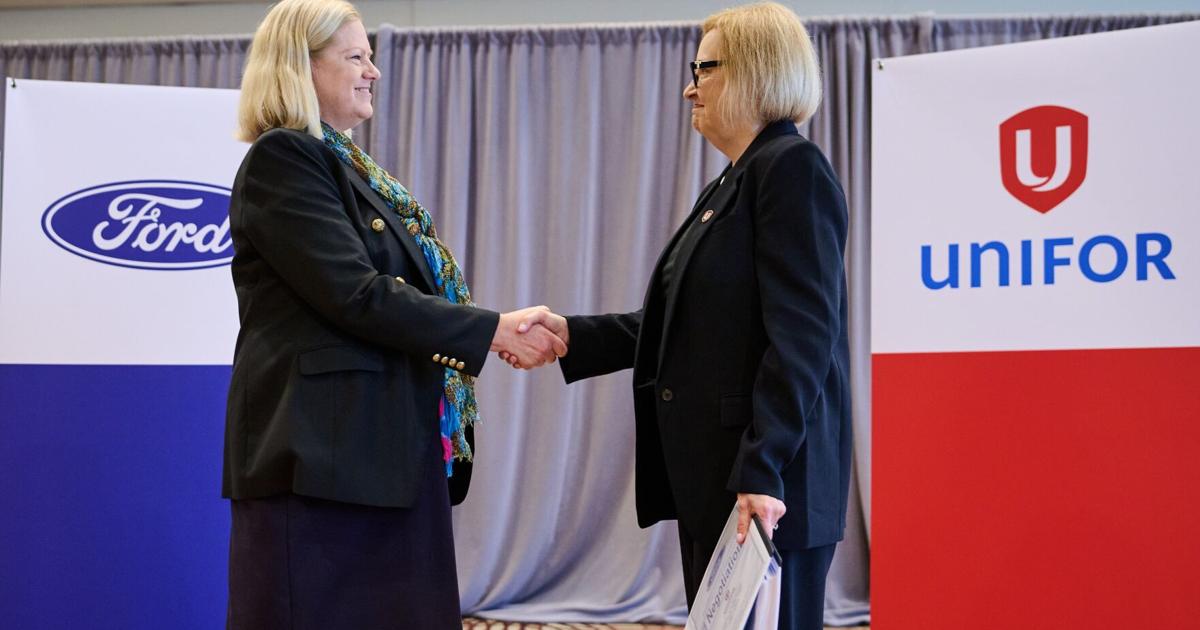
Over the weekend, workers at Ford Canada overwhelmingly approved a tentative contract agreement that likely would have been quickly shot down three years ago, and labour experts say their peers at GM and Stellantis are likely to back it too — assuming they can get those companies to agree to the same terms.
“I think they’re going to understand the context just the same way Ford workers do,” said Steven Tufts, a labour studies professor at York University. “It’s really hard to mobilize workers when they’re afraid for their jobs.”
The three-year deal between Ford and Unifor includes wage hikes of three per cent each year, a $10,000 signing bonus for full-time employees, as well as a pension improvement, a $1.2-billion investment by the company in its Canadian operations, and a side letter in which the company agreed not to sell or close any plants for the duration of the agreement.
Over the weekend, 74 per cent of Ford employees ratified the deal that was substantially less impressive than the deal that just 54 per cent of them backed in 2023. That 2023 deal included a wage hike of 10 per cent in the first year, and increases of two per cent in the second and three per cent in the third.
But that 2023 deal came on the heels of skyrocketing inflation, which has since cooled. And perhaps more importantly, there’s now a trade war prompted by tariffs from U.S. President Donald Trump, who has vowed repeatedly to lure more manufacturing jobs back to the U.S.
“Context matters,” said Brock University labour studies professor Larry Savage. “The politics of auto bargaining have shifted. Fear of job loss and production moving south now weighs more heavily in workers’ calculations than dissatisfaction with wages and benefits.”
Ford is the union’s first step in this year’s “pattern bargaining.” Typically in pattern bargaining, the first company is the one the union figures will negotiate the most worker-friendly contract, in hopes it sets a precedent for talks with the other two companies. (Unifor hasn’t said which company it’s targeting next).
While acknowledging that this year’s deal has doesn’t have the eye-popping wage gains of the 2023 agreement, Unifor national president Lana Payne insists it’s an “incredibly strong” agreement.
“It would be a strong agreement in good and normal times, and there’s nothing good or normal about these times right now for people working in tariff-impacted areas of the economy,” said Payne. “We are fighting for this entire industry in the face of some very, very challenging headwinds.”
Payne pointed toward Trump’s tariffs, and also said the federal government’s new auto industry policy announced earlier this year doesn’t do enough to support car companies who manufacture in this country. She also pointed to the growing competitive threat from Chinese automakers.
Despite the headwinds, Payne said, Unifor negotiators managed to secure good wage gains, along with a cost-of-living allowance (a quarterly payment to workers when inflation exceeds a set target).
“I don’t think anyone should dismiss a nine per cent wage increase over three years,” said Payne.
While the $1.2-billion investment guaranteed by Ford over the life of the agreement is substantially less than in some previous contracts, it’s still a clear sign that the company is committed to its Canadian manufacturing footprint, argued Rafael Gomez, director of the University of Toronto’s Centre for Industrial Relations and Human Resources.
“The company is protecting past investments, and the manufacturing footprint. That’s not something to sniff at,” said Gomez. “I think … that Unifor also understands that Ford is not the enemy this time around. They’re almost working in tandem.”
There’s still, however, a question of just how close the other two members of the Detroit Three — especially Stellantis — will stick to the “pattern” in such uncertain times, said Gomez.
“I think the weak link is Stellantis. GM isn’t doing too badly. Stellantis is so far apart from the rest of the two,” said Gomez. “I think they could absorb the wage hit. The other commitments? I don’t know.”
But union members and negotiators could also make a strategic decision to take a lesser deal now in the hopes of preserving some manufacturing footprint and then coming back harder next time, Gomez suggested.
“Are they prepared to accept a pattern-breaking deal if it means their jobs are saved?”