

Nearly two years after Haitham Abdelrehim began working as a food courier for delivery apps, he says his earnings have plummeted by half, despite working longer hours and travelling greater distances to make deliveries.
The 28-year-old international student from Egypt said he works across several delivery apps and at a coffee shop on weekends to make ends meet. Despite working nine-hour days, he earns about $600 a week on the apps.
“Delivery workers are treated like the worst people in the community,” Abdelrehim said adding that newcomers like himself are increasingly taking on delivery work out of financial necessity.
“When no one is around to do this work, it’ll be filled with international students and newcomers,” he said. “In the winter, it’s only delivery people who are out on the streets.”
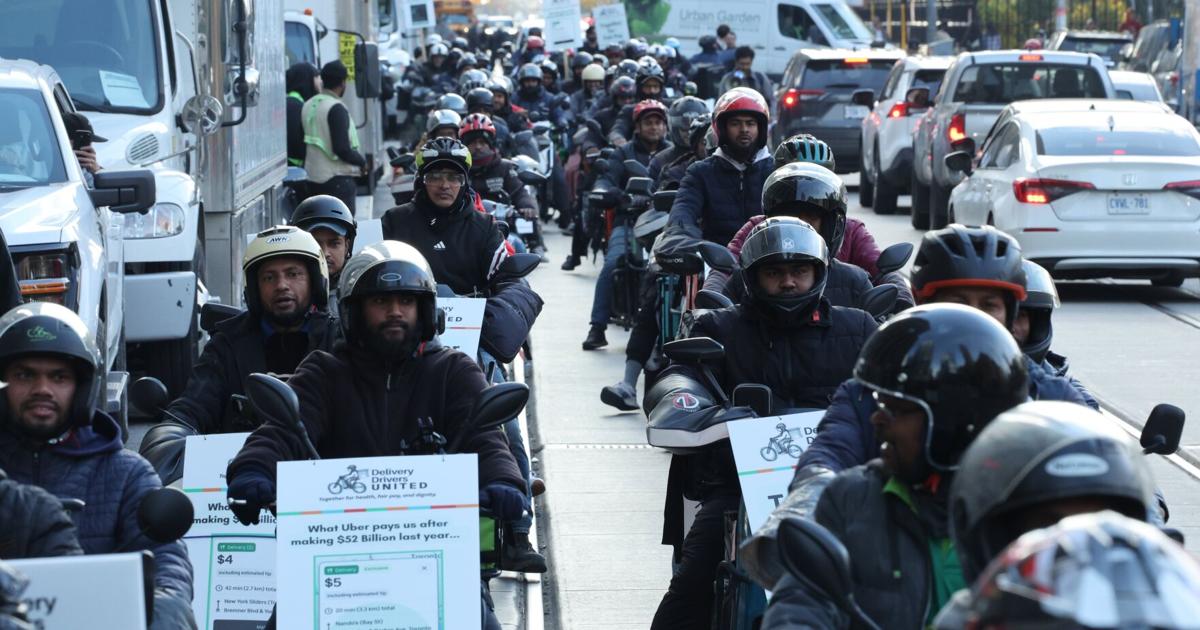
Abdelrehim is among more than 900 couriers across the GTA working for platforms such as Uber Eats, SkipTheDishes and DoorDash who have organized under a newly formed group, Delivery Drivers United. They’re calling for a living wage, more transparency around how base pay is calculated, and on how unexpected wait times are considered in the base pay.
Drivers are also seeking better health insurance coverage and compensation for accidents and injuries, fairer processes for challenging account deactivations and guaranteed access to washrooms while collecting orders.
When asked whether Uber will meet any of the demands, the company in an emailed statement said it is working with The United Food and Commercial Workers International Union to support delivery workers. “We have a common goal of transparency, safe working conditions, and respectful treatment for delivery people,” said spokesperson Isha Chaudhuri.
SkipTheDishes in an emailed statement said that company “fully complies with Ontario’s Digital Platform Workers’ Rights Act” and “champions a courier-first model rooted in transparency and autonomy.”
DoorDash did not respond to inquiries.
In a press release, the group said that for the past eight months, drivers have been quietly meeting in parking lots, apartment buildings and restaurants across Toronto.
“Delivery workers, who spend long hours keeping the city’s restaurants and other businesses running, deserve to be recognized as workers who keep this city running,” the group said.
More than 100 delivery drivers gathered to protest their working conditions Monday in Nathan Phillips Square. Delivery Drivers United has promised to organize more public demonstrations in the future.
“These corporations are making record profits,” said Avi Dhamija, a volunteer at the Centre for Worker Organizing. For example, Uber booked a net profit of $1.9 billion (U.S.) in 2023, compared with a loss of $9.1 billion in 2022.
“In comparison many drivers have shown us pay receipts of $2 or $3 for 30-minute trips,” Dhamija said.
Spurred by a pandemic surge in delivery app usage, the rideshare and food courier workforce has skyrocketed, made up largely of newcomers and precarious workers with few other job options.
Nearly 700,000 Canadians worked for digital platform apps such as Uber, Lyft and DoorDash in 2024, up from 468,000 people in 2023, according to data from Statistics Canada. The data also showed that immigrants who had arrived in the last five years were more than three times more likely to have done paid work through a digital platform compared with people born in Canada.
In July 2025, the province’s Digital Platform Workers’ Rights Act took effect, promising minimum wage standards for these gig workers, which drivers and advocates say have fallen short of ensuring fair wages and real protections for workers. Currently, the rules in Ontario guarantee a minimum wage of $17.20 an hour for “engaged time” — the hours drivers spend actively completing trips or deliveries — but ignore the time spent waiting for work, which many drivers say now makes up a large portion of their day.
A Star investigation detailed how Uber Eats delivery couriers’ pay and behaviour are governed by opaque algorithms that determine wages based on hidden criteria. Couriers can spend hours a day chasing work around the city with no guarantee they’ll be matched with a job.
Delivery Drivers United in a letter to Uber Canada said the group “exists to address these problems — to improve our livelihoods, protect our health and safety and the safety of everyone in Toronto, and to ensure we are treated with dignity.”
“We will no longer tolerate the way Uber and other app-based delivery companies exploit us,” the letter said.

