

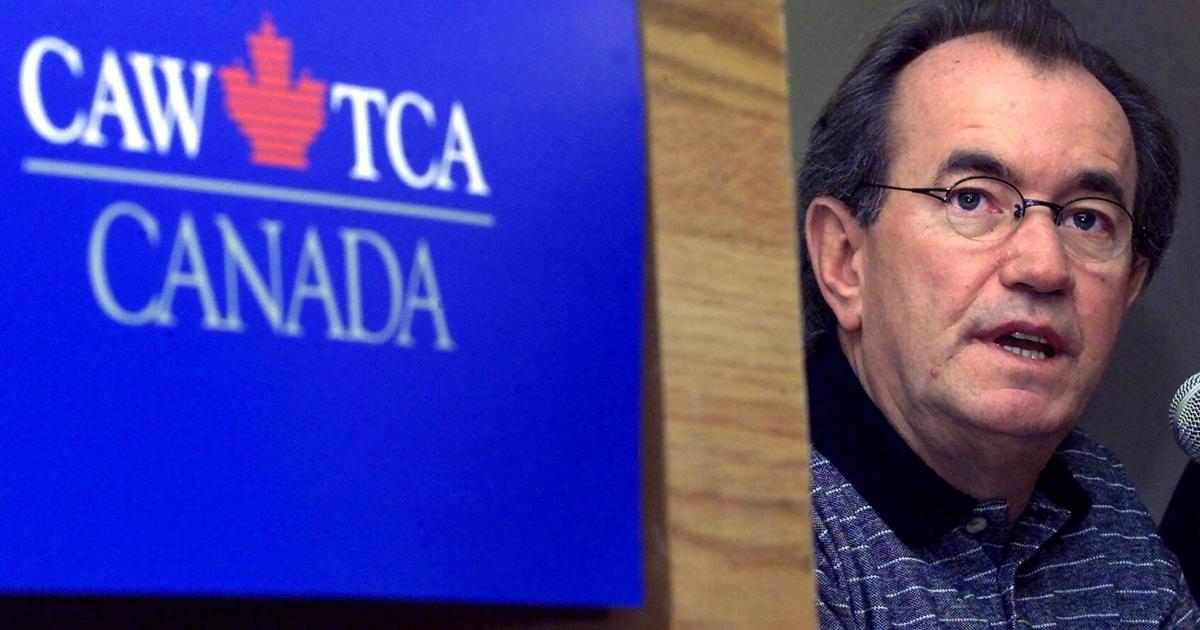
Buzz Hargrove certainly fielded some unlikely telephone calls in his time.
When Mike Harris was Premier of Ontario, Harris once phoned to wish the president of the Canadian Auto Workers (CAW) a Happy Easter. The two men didn’t usually exchange such cheery banter. In fact, Hargrove once described the premier as “an unmitigated disaster.”
For his part, Harris wasn’t nearly as phlegmatic in public, but his views on Hargrove probably fell into the category of: “Same to you, bub.”
Another politician who also got in touch with Hargrove was Jean Chrétien, the then Prime Minister.
He did so to congratulate the labour leader on the generous package he extracted from Ford Motor Co. of Canada. Beyond a generous three-year settlement, there were signing bonuses, pension enhancements and daycare subsidies. A bystander might be excused for asking the prime minister if such pay and perquisites could now become public policy.
When Hargrove tackled his next target, DaimlerChrysler Canada, he not only sought a contract to match the one with Ford but also demanded DaimlerChrysler’s help in getting the CAW into Magna International’s non-union plants. He didn’t achieve the latter request, but he got all else.
About the only key labour official with whom Hargrove never spoke was Jimmy Hoffa, the U.S. Teamsters boss who mysteriously disappeared in 1975 and was never heard from again. Yet even such a voice from beyond the grave would hardly teach much to Hargrove who single-handedly resurrected labour militancy in Canada.
From poverty to union power
To fully understand Basil Eldon Hargrove, to give him his full name, you need to know that he was born in 1944 in Bath, New Brunswick and was and raised deep in the New Brunswick bush, in a place called Holmesville, the sixth of ten children.
At night he shared a bed with two of his brothers; there was no central heating nor any indoor plumbing.
“I recall a lot more mealtimes than meals,” he wrote in his 1998 memoir, “Labour of Love: The Fight to Create A More Humane Canada.”
His father worked as a carpenter each summer, then spent winters cutting pulp and lumber.
“My dad was a hard-working guy, but he was a miserable son-of-a-bitch. He had the personality of a mud turtle.”
The family was relieved when the elder Hargrove left to work in the woods in the fall. Paycheques were sent directly to his wife so there was little need for contact.
In 1961 the elder Hargrove died of a heart attack at 53. There was no first-aid available in the woods, not even a speedy evacuation process for a stricken worker, only a horse and sleigh that would meet a pickup truck for the onward trek to a hospital.
“I often ask myself if my father would have lived had someone in the lumber camp been trained in cardiopulmonary resuscitation. Would it have been too much to ask, in the early 1960s, for companies to be required to have medical assistance or training for some of the staff in the lumber camps? It was years before unions were able to force companies to provide even the most rudimentary safety provisions for their employees.”
Building a movement from the shop floor
The full radicalization of Hargrove took time. He knocked about the country laying pipeline, among several other brute-force tasks. He permanently damaged his hearing working with a jackhammer. Wherever he landed, layoffs seemed to be more common than raises.
His earliest association with the automotive industry began in 1964 when he was hired to work on the shop floor by Chrysler in Windsor. Within a year, he had learned the system and was a union shop steward. He didn’t stop there. In 1992 he became CAW president, representing 215,000 workers in sectors as diverse as automotive, fisheries, airlines, mining and hospitality.
In addition to his impoverished boyhood, there’s another aspect of Hargrove’s life that is crucial to understanding his character and actions. His wayward and rebellious youth included gambling, drinking and womanizing.
For Buzz Hargrove, the union became something larger than life — a replacement family — as he took the CAW into ever more activist areas.
“It gave me a chance,” he has said, “to put into practice the values and lessons that life has taught me.”
There was yet more for him to do.
After retiring from CAW in 2008, he became executive director, Centre for Labour Management Relations, at what was then called Ryerson University in Toronto, now Toronto Metropolitan University. As Canada’s corporate leaders have since discovered, his reconciliation with others wasn’t always the next step. It wasn’t even the last.
Right up to the time of his death last year at 81, Hargrove remained, above all, a union activist.

