Imagine a friend calls you one day and says, “Pack your bags. We’re going on a trip.”
A trip to where? The friend’s not quite sure.
How will we get there? Eh, we’ll figure it out later.
What will it cost? Um, well, to be determined.
But don’t worry, the friend keeps saying: This trip will be really good for the economy.
That’s what the past few weeks have felt like as various proponents of expanding Billy Bishop Airport on Toronto Island have pushed forward despite having nothing even close to an actual plan for expanding the airport.
To call it half-baked would be an insult to baked goods.
The list of things we know for certain about the plan being pushed by Premier Doug Ford’s government, the federal agency the Toronto Port Authority (TPA) and Nieuport Aviation — the owners of the airport terminal building controlled by a U.S. investment group J.P. Morgan — is remarkably short. Short enough to fit on the back of a napkin, with room to spare.
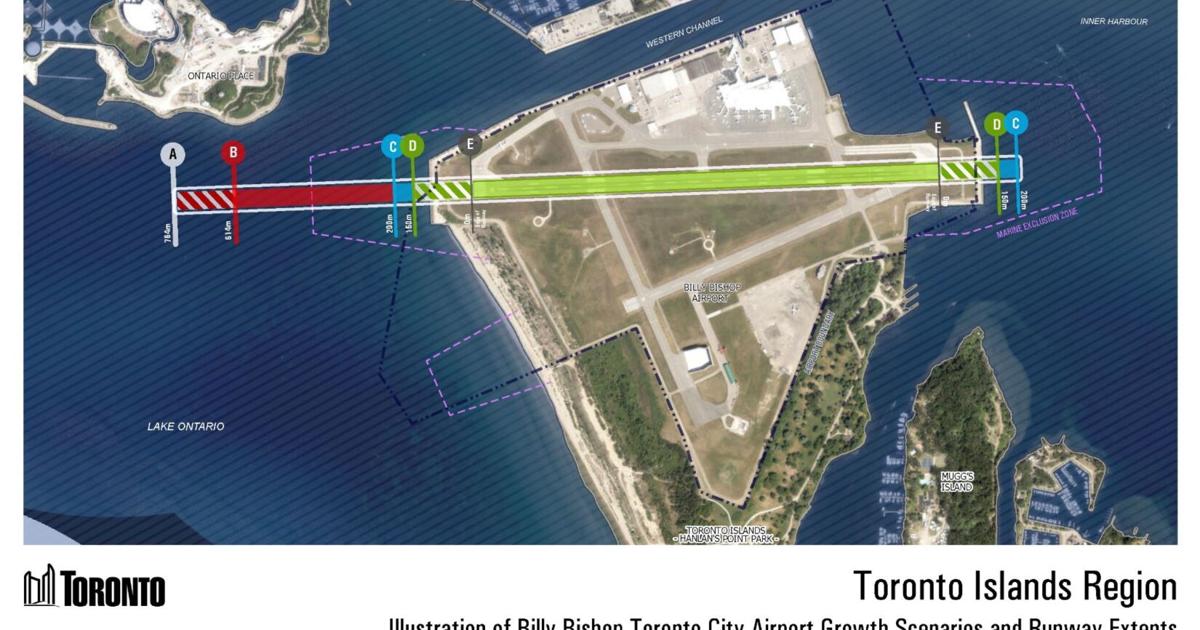
Ford’s government has offered a truly absurd passenger projection, suggesting that a tiny patch of land on an island served by a narrow road and a long tunnel can somehow handle 10 million annual passengers — more than the major airports in Edmonton, Winnipeg and Ottawa. They’ve also offered various very rosy job-creation and economic-impact numbers. And the TPA has acknowledged expansion requires a significant runway extension — maybe about 600 metres added to the current approximately 1,200-metre length.
Working with just those scraps of information, staff with Toronto’s planning department did their best to put together a report on the potential impacts ahead of a meeting of city hall’s planning committee last week. The report assumes the major runway extension will stick out from the west side of the island. A map included as an attachment shows it jutting out into the lake like a sore thumb.
The impacts are hard to quantify at this point, but they’re troubling nonetheless. Thousands of existing and planned housing units in the South Etobicoke area would find themselves under a flight path. The streets and streetcars serving the airport could be choked with airport traffic. And Ford’s grand vision for Ontario Place — a mega spa and associated parks and beaches — could be imperilled by a runway less than 150 metres away.
Chief planner Jason Thorne, speaking to reporters, including the Star’s Mahdis Habibinia, after last week’s committee meeting, expressed some concern with the city being cut out of the process so far, given that city hall has a ton of useful insight and analysis about development activity and traffic planning for the airport area.
“I think a plan done without that information, and especially done without the foresight of the amount of development activity that we foresee happening in the future, would be a significant weakness in any sort of plan that came forward,” Thorne said.
Maybe more specifics about the plan could ease these kinds of worries, but — whoops — TPA has confirmed we’ll be waiting a while. “We couldn’t even if we wanted to. We’re still working on a plan,” TPA vice-president Deborah Wilson said last week, when asked if the agency would release its plan soon.
Prime Minister Mark Carney’s federal government, which must sign off on any expansion plan, has barrelled forward with a public consultation process anyway. But the survey questions put together by the federal Ministry of Transportation and posted last week are as vague as the plan itself.
“Would you support changes to Billy Bishop Toronto City Airport?” reads one very broad question. I mean, sure, if by “changes” you mean the return of free snacks in the terminal, I’m on board. I’m more skeptical of change if it means quintupling passenger volumes.
“What mitigations would help address environmental impacts related to airport growth?” reads another, a question that’s impossible to answer without knowing first what the environmental impacts actually are.
But no one knows. Because it’s impossible to know the impacts of a plan that doesn’t yet exist. That’s the maddening situation Toronto finds itself in: debating a notion instead of a plan.
It’s not some NIMBY impulse to wonder if the central waterfront of Canada’s largest city is really the best place for a much busier airport. Most great cities around the world, in fact, have decided not to put big airports on their waterfronts and instead have opted for things such as public spaces and housing.
That’s been Toronto’s vision for the waterfront, too. Big money has been spent in recent years to try to deliver on it. Those championing airport expansion could change that direction, but they can’t say exactly where they want to go — or how they’ll get there. Instead, they’ve offered just a wing and a prayer. We need a lot more than that.
Error! Sorry, there was an error processing your request.
There was a problem with the recaptcha. Please try again.
You may unsubscribe at any time. By signing up, you agree to our terms of use and privacy policy. This site is protected by reCAPTCHA and the Google privacy policy and terms of service apply.
Want more of the latest from us? Sign up for more at our newsletter page.