

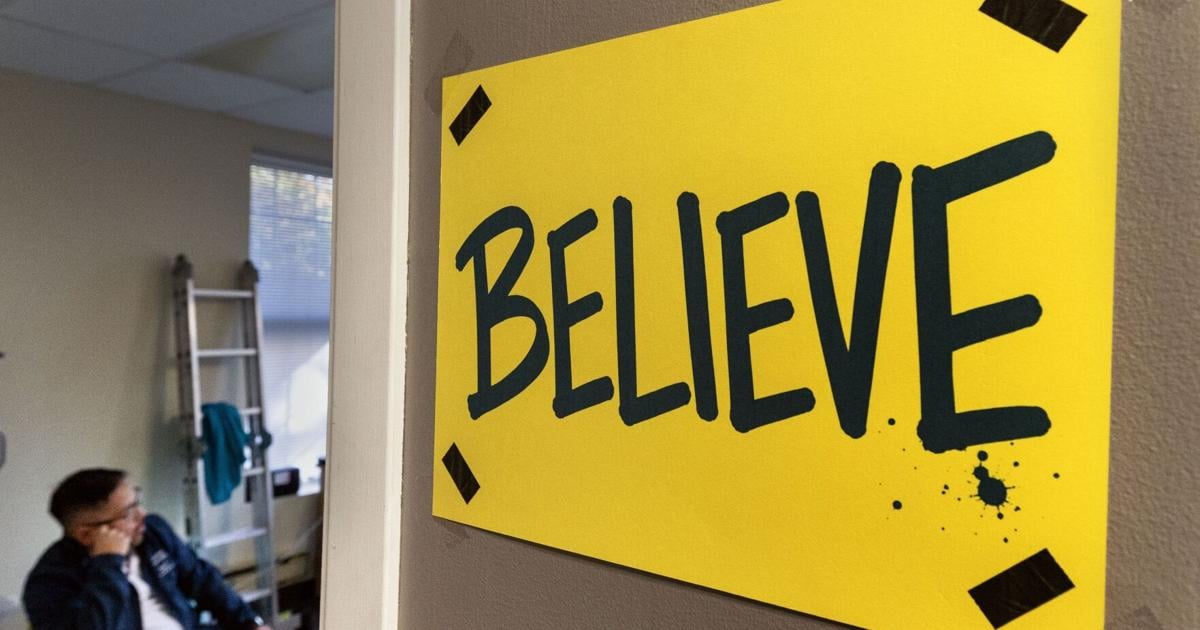
As Alvin Tedjo’s campaign team walks down the stairs to their basement office a few days after their victory over the current and former mayors of Mississauga — the biggest election night upset in the GTA — they reach up and tap the Ted Lasso-inspired, hand-drawn yellow sign above the stairwell.
It says “Believe.”
It’s almost too corny to be real, but just like coach Lasso’s underdog team in the hit Apple TV show, they triumphed against the odds with a poll-defying win — one they’re still not sure they can explain.
“When we saw the numbers rolling in, we were flabbergasted,” said deputy campaign manager Kelly Singh, sitting in the “Ministry of Content” room where the social strategy is still mapped out on pink Post-it notes.
Why did Alvin Tedjo win Mississauga?
It might have been the appealing (or, according to his opponents, pandering) policies targeting affordability and safety. Or the relentless, attention-grabbing social media ads that pushed Tedjo’s face into every feed. Maybe it was the meet-and-greets they held everywhere from a pickleball court (Tedjo’s mom’s idea) to Ridgeway Plaza, or the all-hands-on-deck get-out-the-vote push on election day.
Maybe it wasn’t something they did at all.
Perhaps the feuding front-runners, Carolyn Parrish and Bonnie Crombie, took each other out, in their scorching attacks on and off the debate stage.
Or even more simply, maybe voters were hungry for change in Mississauga and elsewhere. According to the Association of Municipalities of Ontario, nearly half of incumbent heads of council were defeated this election.
“I think we offered something really cool and that resonated with people, but I don’t think that gets tens of thousands of people to get off the couch,” Singh said.
“I think the culture of Mississauga is changing … I wish I could say there’s a recipe for that. There isn’t. I think that Mississauga is just a different place now.”
Did free ice cream help Alvin Tedjo win?
Singh and campaign manager Ryan Vopni both worked on Tedjo’s first run for mayor, taking on Parrish and others in the byelection just two years into his first term as councillor when Crombie left to become Ontario Liberal leader.
“In 2024, we had nothing,” said Vopni. “We had no money, no outside support, no hopes, no dreams.”
They joke their current office might have mould, but it was a big step up from the previous one — a former burrito shop where they had to repeatedly turn away customers.
This time they not only had more resources — along with an unlimited supply of “Diet Coke and anxiety” — they’d also learned from fighting their way into second place behind Parrish in 2024. Tedjo was going to be focused on reaching as many potential voters as possible who didn’t know who he was.
But with an assumed two-horse race taking up all the attention, they also needed to generate buzz.
An early idea was distributing branded freezies at mosques on Friday evenings — freezies for the property tax freeze Tedjo was proposing.
Sending a free ice-cream truck to a local high school that got the most votes in a social media contest was another attention ploy. But it was one that operations manager Jey Jeyarasalingam thought would get kids to talk to their parents about Tedjo and the election, or even sign up to volunteer for their community service hours.
The ice cream contest video ended up going viral, as thousands of kids pleaded for their school to win free soft-serve, lamenting the “extreme suffering from a lack of frozen desserts.”
“We need this, bro,” said another.
“I had this vision of a stampede, and literally that’s what happened,” Jeyarasalingam said of the day they went to Stephen Lewis Secondary School. Everyone, including Tedjo, was suddenly trying to manage a line of ice cream crazed teens. “It was actually the most fun thing we did, hands down.”
At the urging of constituents who may be old enough to vote in the next election, and on the advice of his three kids, Tedjo (a Mississauga high school graduate himself) has pledged to keep the free ice cream contest going as mayor.
Why Parrish and Crombie’s campaigns didn’t land
As his profile in the race grew, Tedjo’s moves were dismissed by his two biggest rivals.
Shortly before election day, Parrish ran an ad dismissing Tedjo’s platform as “free ice cream.”
“Not promising all the treats people were looking for, and not alleviating their pressure during a bad period in our economic history was my mistake,” Parrish said in her concession speech on election night.
Instead, the incumbent mayor tried to explain the budget stresses, police funding and her plan for downtown Mississauga in interviews and spreadsheet-filled newsletters she wrote herself. They didn’t land.
Parrish said her campaign chair had warned her that “if you have to explain something in more than one sentence it is too complicated for the taxpayers to follow.”
Crombie, having stepped down as Ontario Liberal leader after a failing to get elected as an MPP in the last provincial election, ran a more traditional campaign.
It was the kind that had worked for her in past mayoral runs, down to her touting the 2014 endorsement of Hazel McCallion, the current endorsement of McCallion’s granddaughter Erika and the praise of former Toronto mayor John Tory.
Crombie’s ads looked more traditional than Tedjo’s, too. Her communications strategist Jonathan Scott said having her try the more casual, front-facing video style mastered by Tedjo would only come off cringy.
“I don’t regret that she didn’t compete with him on that plane,” said Scott. “That was his secret sauce and, you know, it wouldn’t have worked for her.”
Tedjo’s director of communications, Madalyn Calzavara, said Tedjo’s campaign outspent both Crombie and Parrish’s on social media ads — a Meta ad analysis had them spending $103,600 compared to to $66,300 from Crombie and $10,500 from Parrish. (Crombie’s team said they spent $76,000 on Meta ads, Tedjo’s campaign says they spent more than $100,000.) On Election Day alone, the campaign had about 52 different ads running on various platforms, she said.
People are busy — they don’t answer their camera doorbells or pick up calls from people they don’t know, said Calzavara.
“We have to think about how to reach people in different ways and you have to find a way to break through,” she said.
Tedjo called the strategy “cookies and vegetables,” with the challenge being to find a way to entice people into consuming a policy idea or taking some kind of action.
So there were videos of Tedjo interviewing himself or Tedjo winning the hardest endorsement of all — his daughter’s. There was Tedjo drinking a durian shake, having lechon at Filipino supermarket Seafood City or grabbing a hot dog at Costco on election day (He promised to freeze taxes just like the big-box retailer froze the price of the $1.50 hot dog.)
But Tedjo also focused on his own story as the son of immigrant parents — one to which residents of Mississauga, which is now more than half made up of immigrants, can relate.
Tedjo is the first mayor of Mississauga who isn’t white. He’s also a millennial, and at 43 is part of the “sandwich generation” balancing raising kids and aging parents.
“I’m like almost exactly the median age of people who live in Mississauga. And I wanted people to know that I could connect with their struggles,” he said.
Did Tedjo’s Gaza stance help him win?
Tedjo’s campaign team said they wanted Tedjo’s positions to be clear, even on issues many politicians don’t want to touch.
Tedjo said he hadn’t publicly shared his personal views about Gaza before the election, in part because he didn’t want to seem like he was pandering. But during this campaign he was repeatedly asked directly what he thought, including at a mayoral debate co-hosted by Muslim Network TV and others.
“My family came to this country at a time of ethnic cleansing for Chinese-Indonesians,” he said at the debate. “I understand that the community here has a need to be heard and seen. They want their city leadership to step up and acknowledge there is a genocide in Gaza.”
Tedjo has also committed to table a related motion for the city to support a pledge, that includes “working to end all support to Israel’s apartheid regime, settler colonialism and military occupation.” A similar effort in Brampton was ultimately withdrawn due to “significant financial and legal concerns” identified by staff.
Ginella Massa, who co-hosted that debate, said Tedjo’s widely shared answers might have been the “deciding factor” for some Muslim voters, who make up one in six potential voters in the city. Parrish’s absence at the debate left her unable to make the case for her history of support for Palestinians.
But Massa also pointed out that other Muslim voters had concerns about the endorsement Tedjo received from the police union.
Singh said the campaign knew the endorsement would cost them some votes, but said that other than affordability, community safety was top of mind for residents Tedjo spoke to and they had a plan that included nonpolice safety measures, including having mental health professionals respond in some cases instead of police.
How a ‘Believe’ sign kept the team hopeful
Almost everyone on the campaign had their own moment when they thought they might actually win, but it never felt certain. Tedjo’s was about two weeks before election day.
“I said, ‘If we lose, I don’t understand anything. I don’t understand politics,’” he said. Support was showing up in the socials that Calzavara and deputy communications director Kris Pangilinan were seeing, but it wasn’t showing up as high in the polls.
Vopni and Singh were reluctant to trust that likes on Instagram would translate into votes and didn’t see any sign as good — not even indications that they’d done well in advance polls.
This is why Pangilinan made the first “Believe” sign.
“We kept talking about momentum,” he said. “I think there was a belief amongst all of us that we just needed to get over this one hump. And we didn’t know what the hump was … and I was like, ‘You know what? Let’s put a Believe sign up.’”
Singh cringes, but admits it helped.
“I hated myself the first time I tapped the sign,” she said.
Then came a day she felt “we’re going to get destroyed and I was coming down the stairs and I tapped the sign; I’m such a cornball, but now I tap it every time.”
Arlene Tedjo, the new mayor’s younger sister, thought they’d pull it off when she couldn’t keep up with the volunteer requests starting around Thanksgiving weekend. She was a handful of months into her maternity leave with her son, Emmett, when she realized the campaign needed a new volunteer co-ordinator, so she stepped up.
“I always knew Alvin was going to be mayor or something of that calibre,” she said, crediting their parents.
She is a nurse and their youngest brother is a psychotherapist. “We all have always, since we were really young, seen the value in helping people,” she said.
She suddenly burst into tears thinking about how hard her parents worked to get Tedjo elected — including their father, who’s in his seventies, putting up more than 500 signs.
“It was a full family effort to make sure that we did everything we could to help out and cross that finish line because we believe in him,” she said.
Can Alvin Tedjo deliver?
Tedjo doesn’t love the comparisons that have been made between him and New York Mayor Zohran Mamdani, both for their ease with social media and for making big and potentially unrealistic promises.
Flattering as it is, he wants to be seen as his own person. But he does think that he and Mamdani might have tapped into the same frustration from voters who see their leaders not fighting hard enough.
“People just want you to be trying to make their lives better,” he said.
That feeling might have helped him win, but now he has to make the change he promised.
“When we started this campaign six months ago, we knew it was going to be a tough road,” he said in his first press conference as mayor-elect. “The road ahead will be just as difficult.”

