Dean Burry has already stretched the patience and goodwill of his wife and two daughters, frequently recruiting them to try out the board games he invents. “You’ve got to be very careful when you have a limited number of playtesters because they start to resent it,” he says with a laugh.
That’s not an issue at Protospiel North, a twice-yearly Toronto gathering that brings together mostly hobbyist board-game designers and eager players willing to test works in progress.
On a recent Saturday inside a west-end Legion hall, several dozens of people roll dice, flip cards and offer candid feedback to hopeful creators who are chasing a similar dream: that the rough prototype in front of them could one day become the next Catan.
Burry, whose real job is as an opera composer and associate professor at Queen’s University, has invented six complete games with another 15 buried in what he describes as a graveyard of design ideas that didn’t quite work out. But that constant cycle of testing, failing and refining is exactly what makes the protospiel so valuable.
“I was absolutely enchanted by it,” Burry says of his first encounter with the event back in 2024. Now at his fourth convention, Burry is looking to gather input before making a few minor final tweaks to his strategic card game The Roots of All Evil, inspired in part by a tree root his daughter kept tripping over during pandemic-era nature walks.
“It’s the most supportive group of fun people,” says the 54-year-old. “Geeky, of course, we’re all extremely geeky … but I found the whole design community one of the most supportive communities I have ever been a part of.”
That spirit is immediately apparent in the room. Designers and playtesters — 100 of them have registered for the biggest turnout yet — are gathered around 20 black-linen-covered tables topped with prototypes. Some games consist of little more than rough pieces of paper. A few have polished mechanics and custom-made pieces; most fall in between. There’s a convivial buzz and an eagerness to learn. “Does it make somewhat sense?” asks one designer after explaining the rules to his tablemates.
Watching over all this from the welcome desk is Joe Slack. Together with Kevin Carmichael, he launched Protospiel North in Toronto in 2019, an iteration of similar game-design conventions, mostly south of the border, and deriving its name from the German for “early or first game.”
The timing was fortuitous. The city had already cemented its reputation as a hub for board game fans, thanks to the opening of the first Snakes & Lattes café in 2010, about the same time that Kickstarter began to fuel a boom in tabletop publishing. And even when the pandemic shut the world down, interest in board games surged as people increasingly tethered to screens for school and work turned to analog pursuits.
The industry is “booming,” says Slack, a professional game designer (Relics of Rajavihara) and instructor.
In the 1980s, only a few hundred board games were published each year; today, that figure is closer to 5,000, and analysts expect the global market to more than double over the next decade.
“Some say we are in a golden age of board games,” says Slack. “Others might say we’re facing a bit of a glut.”
But that isn’t stopping this room of creators from hoping theirs might just break through.
Building a board game
On his first visit to Protospiel North in 2021, Hafiz Printer was focused on presenting Baghdad, a 45-minute history-based game he had created while teaching high school. As the conference was wrapping up, someone asked him if he had anything quicker to play.
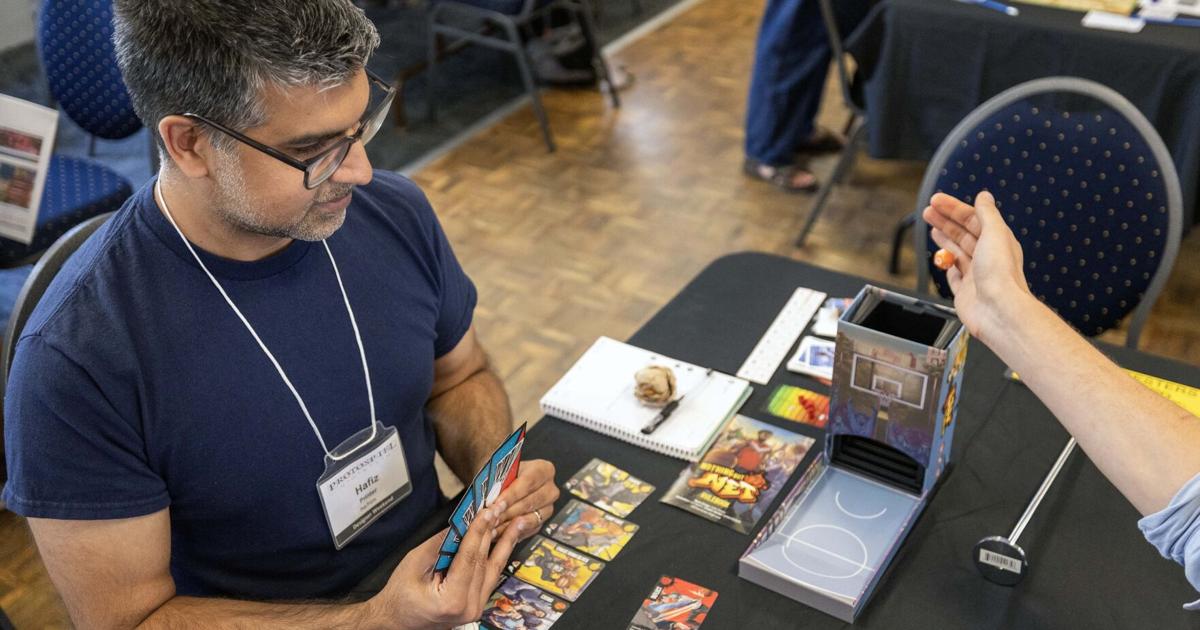
From his backpack, Printer pulled out a set of cards covered in hand-drawn stick figures doing basketball moves. “The pictures were hilarious because neither (my wife nor I) can really draw,” says the 41-year-old. He hadn’t even written the rules down yet.
But the deck-building spin on the streetball game 21 caught the attention of the man who turned out not to be just another playtester, but a publisher. He encouraged Printer to keep developing it.
Today, with a successful $25,000 crowdfunding campaign behind him, Printer’s Nothing But Net is slick and professional, complete with playful mechanics like a “net” through which players toss a basketball-shaped die, and cards drawn by an artist who captured the likenesses of Printer’s circle of friends and family, including his wife, who insisted on being immortalized on the game’s “trash talk” card.
“It’s very different from what it originally was,” says Printer, who has tracked every change beginning with Version 1.0. The game is now at Version 22.3.
The first iteration took shape during the pandemic, when lockdowns shuttered Printer’s fantasy league and he was looking for a way to channel his love of basketball. He had already been listening to podcasts and taking courses in an effort to improve Baghdad — a project sparked when, as a history teacher, he asked students to design their own board games and they all came back with spinoffs of Monopoly, making him realize he hadn’t properly modelled game board design and he had more to learn himself.
It also underscored Monopoly’s strong grip on the traditional sense of what a board game should be. Created in 1935, it is still one of the most globally recognized and most played board games. But more complex, strategic modern titles like Catan — invented by a German dental technician and released in 1995 — have helped revolutionize the hobby.
“In this day and age, there is so much variety,” says Grace Lee, a 42-year-old Toronto nurse, at Protospiel North to try out the multitude of games, not present one. “You can have really simple ones and cerebral ones; you can have fun, randomness or you can have strategy. There’s something for everyone’s preference, skill level or attention span.”
A game’s first audience
People like Lee are central to Protospiel North’s success and are in such demand that they are charged only $12 for a whole weekend of play — compared to $62 for designers. That need is visible throughout the hall: Yellow table flags indicate “playtesters wanted.”
Lee, a regular attendee, has witnessed designers toss out mechanics or rewrite rules as a result of constructive feedback. “I have not met a designer who did not want playtesters,” she says.
As Burry walks four participants through The Roots of All Evil, he constantly observes their body language and asks them plenty of questions, a process he says can be both exhilarating and exhausting. His game, which was a recent finalist for a Cardboard Edison Award, an international competition for unpublished games, has players summon a forest guardian by building root rings with numbered cards and placing offerings within. He’s looking to improve the integration of Roots’ theme and mechanics. “The point is to make the game better.”
And for the players, they have an opportunity to try something out before it potentially makes it big, says organizer Slack, “If the game one day gets published, you may have had a hand in making it, even in a small part.”
But behind that collaborative spirit is a harsh reality: few designers expect to get rich from board games. For most, success is measured less in financial reward than in whether a game finds its audience.
Printer — currently senior co-ordinator of educational programming at the Archives of Ontario — has brought a tournament version of Nothing But Net to Protospiel, where he eagerly explains the rules to his playtesters. He says this expansion set is 75 per cent there and is relying on the event to help shape the final quarter.
He would one day love to collaborate with the Toronto Raptors, but for now, his expectations are more modest. “If I’ve created something that a few hundred people might like and maybe it will be their favourite game, then I’m happy with that.”