

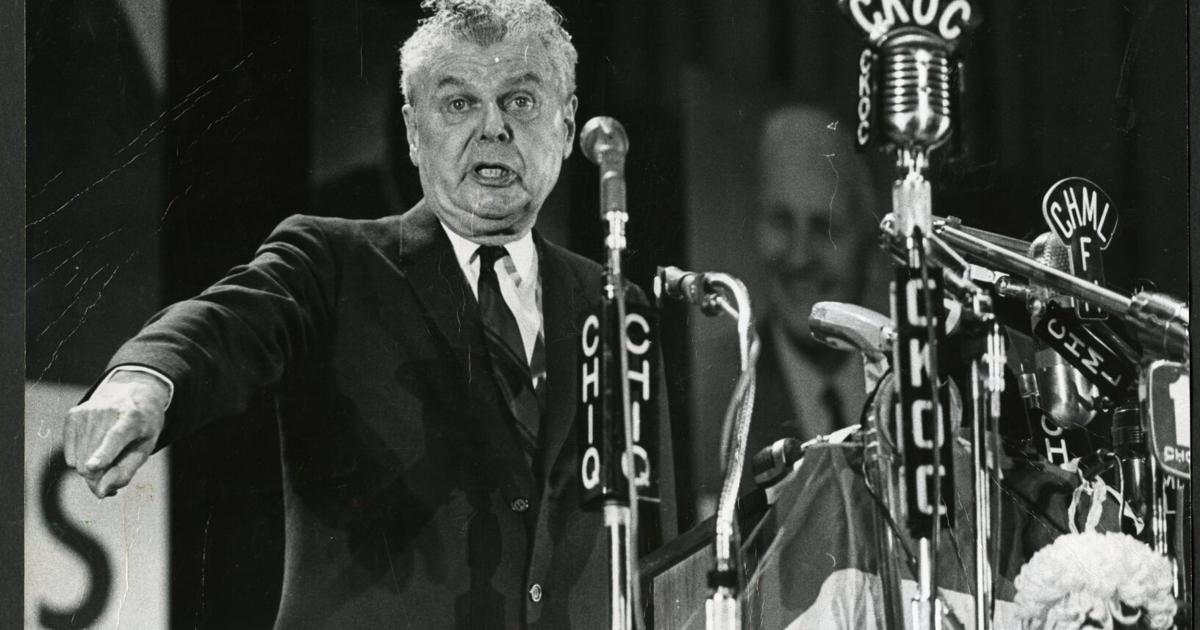
As a former prime minister, John Diefenbaker in the 1970s enjoyed one of the finest offices on Parliament Hill.
It wasn’t that the place was large or luxurious, but it was located on the fourth floor of the Centre Block, at the back of the building, so it afforded magnificent views of the Ottawa River and far beyond to the Gatineau Hills of Quebec.
Memorabilia hung on every wall and covered every surface. On display a swordfish Diefenbaker had caught in the Caribbean; there was also an RCMP horse blanket spread across a couch.
The House of Commons was packed to the rafters whenever Dief spoke. Some showed up in case this was his last speech; they wanted to be on hand for the great occasion. Others came because they admired his oratory or his supple capacity to get under the government’s skin. Dief never disappointed; he was always entertaining, even spellbinding at times.
Visitors to his office often saw a different Dief than the public persona.
This was a man who felt terribly wronged by his own party and could never forgive the “termites” — as he called them — who had done him in. None of his supportive acolytes were so misguided that they thought he was going to return to the glory days of the past, but there were many who listened to his tirades and fed his firm belief that no one matched his capacity for leadership, particularly that fellow who replaced him, Robert Stanfield.
Among the many who listened to Dief was Progressive Conservative Party President Donald Matthews. When he was growing up in Brantford, Ont., Matthews was the most enthusiastic among the 10 siblings about what his father did on city council. When his father ran for mayor in 1946, Matthews was involved and put up lawn signs.
But it wasn’t just his father who stimulated his interest in public life and community service. His mother also cared about anyone who was in need. She told Matthews to bring any friends home after school if they had brought no lunch and she would give them sandwiches, cheese and glasses of milk.
Once Matthews became party president, he called upon Dief to pay his respects. The first thing they talked about was Matthews’ visit to the Queen’s University model parliament back when Matthews was leader of the Co-operative Commonwealth Federation (CCF). Dief remembered the occasion vividly and recalled the question Matthews put to him. Dief replayed the incident perfectly and showed particular relish in describing how he had then shot down Matthews in flames.
But Dief’s bigger problem was with Dalton Camp, one of the party presidents before Matthews. Hatred might be too strong a word, but not by much. After all, it was Camp who had toppled Dief from the leadership.
Camp had been elected party president in 1964 and called for a leadership review in 1966. While Camp portrayed the vote as simply an exercise in democracy, Dief viewed it as nothing more than a sign of disloyalty and disobedience. Dief had won two majority governments in 1958 and 1962, then lost twice to Lester Pearson, in 1963 and 1965, both happening after Camp had convinced everyone Dief would never win office as long as Dief was in charge.
In those days, there were famous names in the Parliamentary Press Gallery, such as Bruce Phillips, Tim Ralfe, and Lubor Zink. Others went on to have pride of place in the Senate including Pamela Wallin and Mike Duffy.
As a senator Duffy was charged with fraud, among other misdeeds, but was eventually cleared, and resumed his official duties.
Joyce Fairbairn was among the very few Ottawa hands who, at one time or another, served in all three possible pursuits on the Hill: journalism, legislative assistant to Prime Minister Pierre Trudeau, and as government leader in the Senate under Jean Chretien.
Every morning, a few Dief loyalists from the press gallery would visit Dief, hoping their visit had been spotted by Stanfield’s staff. For them, it was all part of the Stanfield putdown. As result, Stanfield never enjoyed the honours he should have. Even coming close to victory as he did in 1974 wasn’t enough. He’d lost three elections: 1968, 1972 and 1974. His party remained Her Majesty’s Loyal Opposition, but after that many defeats, Stanfield had little choice but to resign as leader of the opposition.
Dief could only revel in Stanfield’s humiliation.

