

City councillors marked the Charter of Rights and Freedoms’ 44th anniversary on Friday by hearing a wide range of arguments from dozens who attended a joint committee meeting to debate the constitutionality of Ottawa’s contentious
“bubble” bylaw
.
The proposed bylaw, which aims to restrict protests near schools,
hospitals
, long-term care and community health facilities, is meant to establish “safe access zones” for citizens around those facilities and would extend 50 metres from the walkways, doorways and driveways to those buildings.
Councillors wrestled with a balance between
the bylaw’s potential impact on Charter-protected rights and faith leaders’ concerns regarding a rise in hate crimes at their places of worship.
Labour union representatives, advocates and legal experts also laid out their concerns in the nearly seven-hour meeting at the
Emergency Preparedness and Protective Services and Public Works and Infrastructure’s joint committee.
Knoxdale-Merivale Coun. Sean Devine, warning of what he said were the bylaw’s “unintended consequences,” moved an amendment that would have limited it to prohibiting “conduct that interferes with access” rather than a “categorical prohibition on demonstrations.”
That motion was defeated by the committee 15-2, though, supported only by Devine and Gloucester-Southgate Coun. Jessica Bradley.
Paul Champ, an Ottawa-based constitutional lawyer, echoed the same sentiment and said one section of the bylaw was too broad in its definition of a “demonstration” and could prevent people trying to express any political opinion from doing so. Champ, who successfully argued for a court injunction to halt the blaring of truck horns during the
2022 convoy protest
, singled out that section as one of the most “flagrantly unconstitutional aspects” of the bylaw.
Champ argued other cities’ bylaws similar to the one proposed for Ottawa were fairly narrow in scope and tended to address specific instances of protest-induced violence. In an interview, Champ cited the example of violent incidents where Vancouver women seeking medical services at an abortion clinic had been physically restrained and harassed.
“That’s why we have those kinds of bubble zones, but we don’t have any evidence of that kind of activity (in Ottawa),” he said. “Feeling uncomfortable when you see someone waving a flag or marching or saying certain things you disagree with, that’s not grounds to stop a protest and certainly doesn’t justify a bylaw like this.”
Richard Robertson of B’Nai Brith Canada said the country was in the midst of a “crisis of antisemitism” and that Jewish institutions in Ottawa had been targets of “caustic protests” in recent weeks.
“Jewish houses of worship and Jewish institutions in this province have been targeted with gunfire, underscoring the vulnerability of our institutions and the pressing need to further insulate them,” Robertson said. “The right of Ottawa’s residents to access vulnerable infrastructure must be protected. The right of every resident to enter and make use of such infrastructure must not be treated as secondary to the rights of nefarious actors to engage in nuisance protests.
“The right to peaceful assembly does not include the right to intimidate, harass, obstruct or otherwise compromise the ability of others to exercise their own rights and freedoms.”
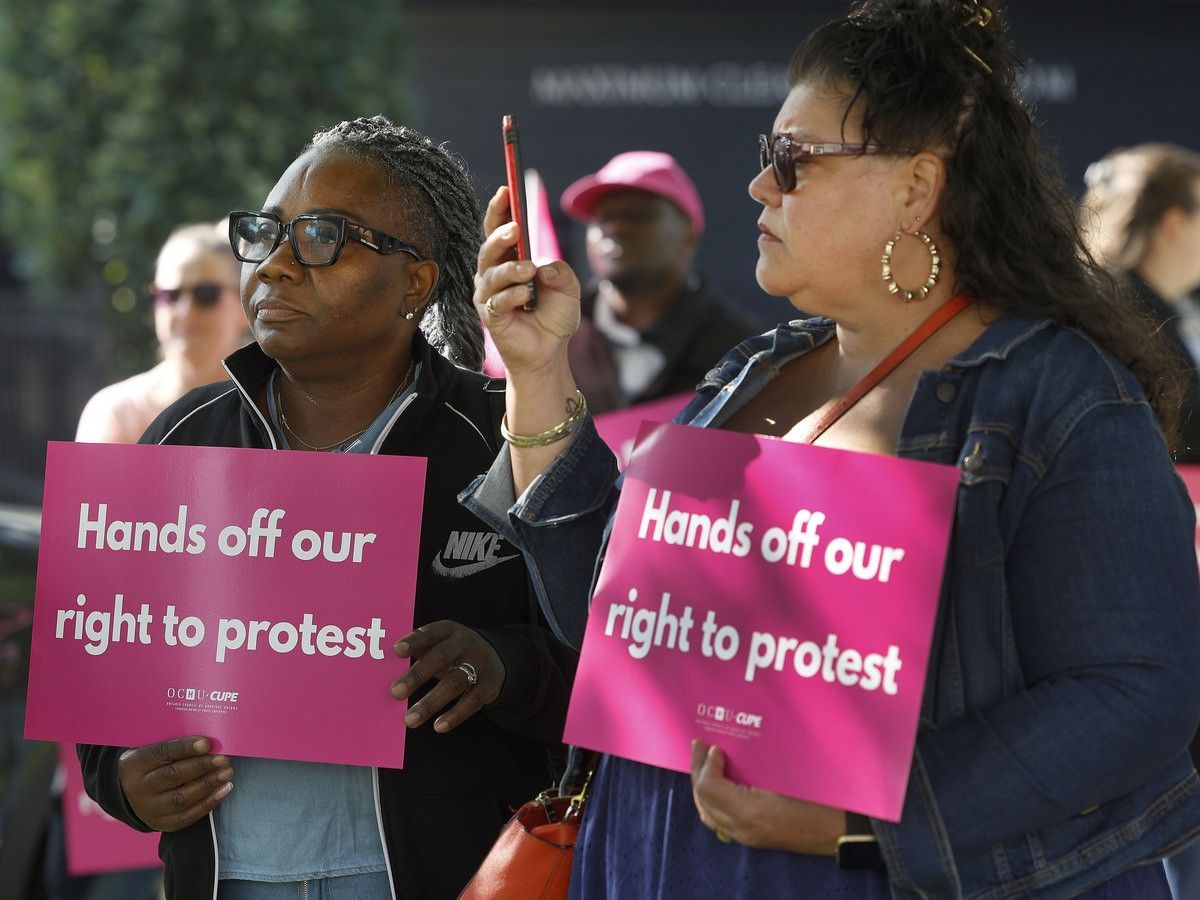
Karin Galldin, a lawyer representing the Ontario Council of Hospital Unions, urged committee members to reject the bylaw on the basis that it “curtails vital Charter rights.”
OCHU represents 45,000 workers at hospitals and long-term care facilities across Ontario, with women accounting for 85 per cent of its “disproportionately racialized” membership and members who have experienced “harmful or hateful activities,” Galldin said.
“Despite this, OCHU members oppose the proposed bylaw and we believe that police have all the powers that they need to protect individuals and institutions
under the Criminal Code
,” she said.
OCHU members do not have the right to strike under Ontario legislation, Galldin said, and workers “regularly participate in demonstrations outside of hospitals or long-term care facilities for issues such as cuts in funding or the privatization of services.”
The bylaw “now risks taking even more of these workers’ expressive activity away,” Galldin argued.
City staff said the 50-metre distance — instead of the original 80 metres proposed last year — would still allow protesters to be heard while allowing people to access those facilities and would also prevent protests from spilling into residential areas and impacting neighbouring communities. That measure is consistent with restrictions in other Ontario municipalities like Toronto and Oakville, which passed similar bylaws in 2025.
The bylaw could also ban loudspeakers and other sound amplification devices as well as pyrotechnics.
If passed by Ottawa council, the bylaw would take effect in August 2026. Facilities would have to apply for the safe-access zone status, which would be valid for one year with a chance to renew it. These designations would apply 24/7 to residential-care facilities and to between one hour before opening and one hour after closing time at others.

City staff said the regulation would provide more flexibility for demonstrations and wouldn’t interfere with public use of the facilities. Labour disputes and marches passing through one of these facilities would be exempt from the bylaw, staff said.
Councillors heard wide-ranging input from the community last year, when the proposed bylaw was introduced by Barrhaven West Coun. David Hill. Staff said the amended bylaw “responds to council’s direction and is designed to prioritize safe access to vulnerable social infrastructure while ensuring that measures are proportionate and minimally impair fundamental freedoms, including freedom of expression, assembly, and association.”
Champ said Friday that Ottawa already had laws to “stop unlawful activities of protests” and cited the Criminal Code as well as other Ottawa-specific municipal bylaws.
“If people are engaging in violent protests, if people are blocking entrances, we already have laws in place that can stop that,” Champ said in an interview with the Ottawa Citizen.
The ultimate message the bylaw would send, Champ said, is that protests are unwelcome in Canada’s capital.
“(Ottawa) is the place where people come to protest,” Champ said. “Ottawa should embrace that.”
The city council vote on the proposed bylaw is expected on April 22.
With files from Aedan Helmer
Related
Our website is your destination for up-to-the-minute news, so make sure to bookmark our homepage and sign up for our newsletters so we can keep you informed.

