Jay Baruchel loves Canada.
“I’m very proud,” says the 44-year-old actor. “I have a maple leaf tattooed over my heart.”
Patriotism has long paved Baruchel’s path to the Toronto International Film Festival. His drive to tell Canadian stories saw him co-write and act in the cult 2011 festival pick “Goon,” a valentine to hockey set in the Maritimes, directed by Michael Dowse. In 2023, Baruchel played Canadian businessman Mike Lazaridis in Matt Johnson’s TIFF hit “BlackBerry.”
This year, Baruchel reunites with Dowse for “The Stunt Driver,” an uproarious retelling of Montreal daredevil Ken Carter’s quest to conquer a 1-mile jump across the Saint Lawrence River in a rocket car. As Carter, Baruchel layers a larger-than-life personality with fragile ambition.
Introducing the world to overlooked Canadians is Sean Menard’s mission. The documentary director made his TIFF debut in 2017 with “The Carter Effect,” a sports documentary examining former Raptors star Vince Carter’s impact on Canada’s relationship with basketball in the late ‘90s. (Drake was the executive producer.) In 2023, Menard spotlighted MuchMusic VJs in “299 Queen Street West.” Now, the Hamilton director’s Terry Fox documentary “Run Terry Run” is premiering at this year’s festival. The film, featuring never-before-seen archival footage, offers a reintroduction to a Canadian icon.
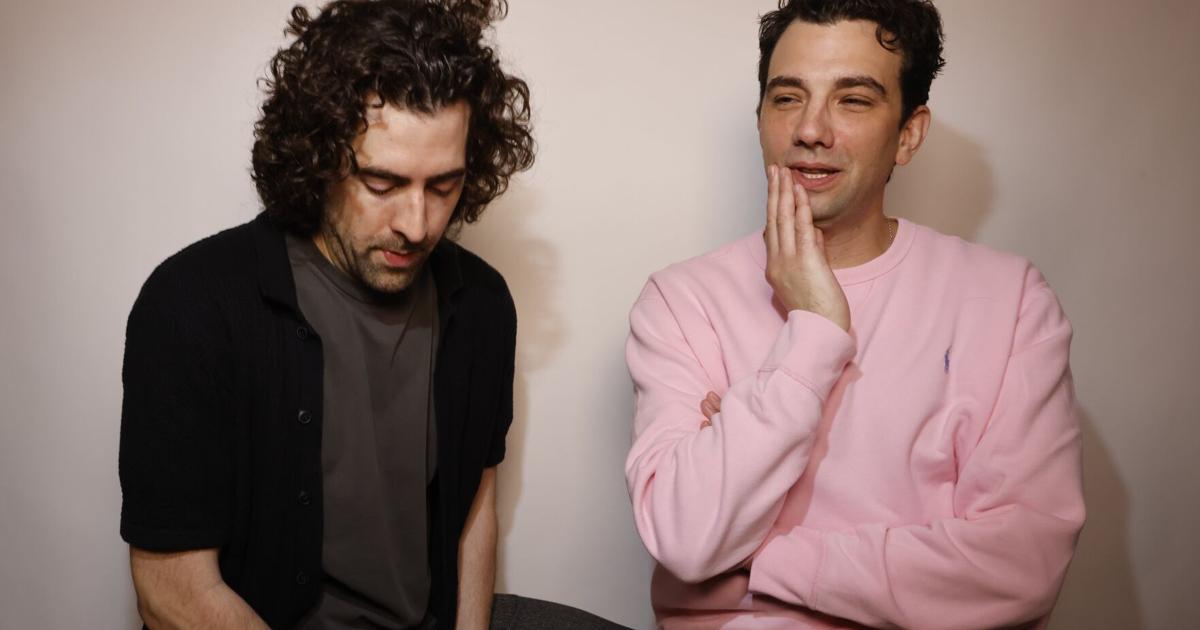
Baruchel and Menard met up before TIFF at the Star offices to talk about their upcoming premieres and their enduring passion for Canadian stories.
Hanging out with Terry Fox: “His own family members never heard him speak about these things”
Jay Baruchel: Man, you made such a beautiful movie. I remember doing Terry Fox runs and learning about him in school. I get goose bumps thinking about your movie because I was really faced with his humanity and it drove home that this (man on the screen) was effectively a child. So, thank you for giving us a chance to hang out with him. We never hang out with him. We learn about him, and we’re inspired by him, but you allow us to hang with him.
Sean Menard: I would see a statue (of Terry Fox), and I would stare at it and go, “Who was he? What was his laugh like? What was he really having to endure out there?” And I didn’t have the answers. I didn’t know the details of the journey. I think that happens sometimes in our country with a lot of this stuff, right? The details get forgotten over time.
J.B.: We seem to be caught in a push and pull of thinking we’re too good to distil our history into romantic little flash points because there are other countries around us that are very good at doing that, and we think that we’re better than them. But we need them, like anybody else, in any other culture. Terry Fox is as iconically photographed a Canadian as there ever was. We grow up seeing that … probably just one crew’s footage that’s been repurposed for years. How did you find this other footage?
S.M.: I was touring my last film, and something about Terry popped into my head. I remember being in Charlottetown, and I jumped on YouTube, looking for clips. All the footage of Terry was very grainy — it looked like it had been taken from VHS, but I could tell at some point that it was shot on film. It didn’t make sense to me that someone would throw that footage out.
J.B.: It had to be sitting somewhere.
S.M.: If you’re filming that, and he goes on to be Canada’s hero, I don’t think you’re just gonna turf it. So I reached out to the family and asked if there was any footage out there. They had maybe four reels that no one had seen before. They sent it over but they were labelled number five to nine. So it became a search: “Where are these missing four?” Eventually I found a storage facility, and it was five streets lights from my house.
J.B.: Are you serious?
S.M.: Yeah, and it wasn’t climate controlled. The footage was deteriorating. It wasn’t labelled, and it ended up being over 90 reels.
J.B.: The reels that the family had, were you the first to come knocking and asking about the footage?
S.M.: I think so. It does seem nuts, right? His own family members never heard him speak about some of these things. I had a private screening; I flew out west for the family and one of the family members said, “Thanks for letting me learn about who my uncle was. It just felt like I spent two hours with him.”
Chasing the Ken Carter story: “If you could make anything, what would you make?”
S.M.: On your film, you kind of did the opposite of mine. With “The Stunt Driver,” it has moments where it’s trying purposely to feel like a doc.
J.B.: I’ve been lucky enough to call (director) Michael Dowse one of my dear friends for over 20 years. When we first started hanging out, we would have those conversations that anybody that’s interested in making movies has, which is, “If you won the 649 — if you could make anything — what would you make?” The first thing he said was the Ken Carter story.
S.M.: Was it a struggle to get the film made?
J.B.: It was very hard. Five years ago, Mike and I are having lunch at Fran’s Diner by Massey Hall and he’s like, “I wrote a Ken Carter script, and I actually think you could play him.” Because when we were first talking about it, I was like a 24-year-old young pup …
S.M.: You didn’t think much of it. But then once you have the all-day breakfast at Fran’s; you digest it …
J.B.: 60 pounds heavier, you know. (Laughing) I got the script, and I read about half of it before I called him and was like, “We have to do this movie.” There’s an urgency, right? When you like something, and you don’t want to miss the chance. Except then he was stuck with me and there are far more famous people than me. I was walking this tightrope of “I wanna be in this movie, but I also want my friend to get to make his movie.” I called him four times and said, “Do not feel bad. Get the famous guy.” Every time he and his wife Jennifer, who produced it with him, said “No, you’re the guy.”
A health crisis: “There was a chance I wouldn’t be on set for a long time”
J.B.: Without getting into melodramatic kind of territory, I had some pretty crazy health challenges last year, and it was touch and go about whether or not I’d ever get to make this movie. Then I got the call that I was OK to work, and that was around the same 48-hour period that they secured their financing. Then we just went, bro. I was like literally on set a month and a half after crazy invasive surgery. It was heavy. When Mike and I made “Goon,” we were kind of hooligans. Now, he’s got two kids that have graduated high school and I’m gonna have a daughter in January.
S.M.: Oh, congrats!
J.B.: Thank you very much. This just means we’re super soft now and this movie is impossibly emotional for both of us.
S.M.: I feel like it brings it to another level because you realize with a lot of these stories that it’s like a tiny miracle when you can bring them to life.
J.B.: It’s a window, man. I don’t think people realize how hard it is to make a f—-ing movie. I was raised in a grand tradition of “be many things, but humble above all,” and be ashamed of ambition.
Canada, patriotism and ambition: “I was treated like garbage in Toronto before I started working in the United States”
S.M.: Did you feel that more when you were in Hollywood?
J.B.: What I found was, up here, if you weren’t content to just watch movies, you wanted to make movies, and you weren’t content to just listen to music, you wanted to be in the band, the initial first thought that everybody around always has is, “Who the f—- do you think you are?” I’m a very proud Canadian — I’m so patriotic, I could be accused of nationalism, right, so, it sucks that I have to say what I’m gonna say, which is I was always treated like garbage in Toronto until I started working in the States.
S.M.: Oh man.
J.B.: Someone’s asking if I’m excited for TIFF, and it’s like, I have a strange … love-hate thing with TIFF, as I’m sure a lot of people that work in Canadian movies do.
S.M.: My last film was literally an address, “299 Queen Street West,” and I couldn’t get into TIFF. I had to rent Roy Thomson Hall the weekend after, and it created some friction, but I felt that that film with those VJs deserved the biggest stage.
J.B.: No s — t! So here’s my question, if it has changed, because I do notice that it has changed …
S.M.: We’re part of the change.
J.B.: I’d like to think so.
S.M.: You made a film about a Canadian that is taking on a big American, and it was a Canadian company that did it. Canadian director. Canadian star. As opposed to a British team with a bigger resumé or an American team with more financing. They come in and they tell our story.
J.B.: Yeah, I know.
S.M.: They might have those advantages, but what they don’t have is the passion and the determination to get things accurate and to really commit to something.
J.B.: And the stakes will never be as high for them because it’s not their own culture that they’re trying to foster and keep alive.
S.M.: You felt those stakes when you’re making “Stunt Driver.” Same for me, (making a movie) about a guy who has seven statues across the country.
J.B.: It means something. Thinking out s — t is worth doing … I want it to be less of an outlier.
S.M.: People want to come out (and) support great Canadian stories, if done well.
J.B.: One of the things that I’ve always gotten very clear in my head and heart is there’s how I feel about the thing, and there’s the how the world feels about the thing. Ideally, they’re similar — but who knows? I think I know some stuff about movies, but one thing I’ve never been able to figure out is if someone’s going to like a thing or not. And why people like a thing.
S.M.: That’s the magic code that nobody knows. But how do you separate that?
J.B.: I think because it’s not mine anymore. The minute that our movies are in a theatre, they’re not ours anymore. They belong to the world.
This interview has been condensed for length and clarity.