Chances are you wouldn’t feel like tap dancing to Leonard Cohen’s bleak “Everybody Knows,” which finds humanity bereft of truth, love and happiness (“Everybody’s got this broken feeling / Like their father or their dog just died”).
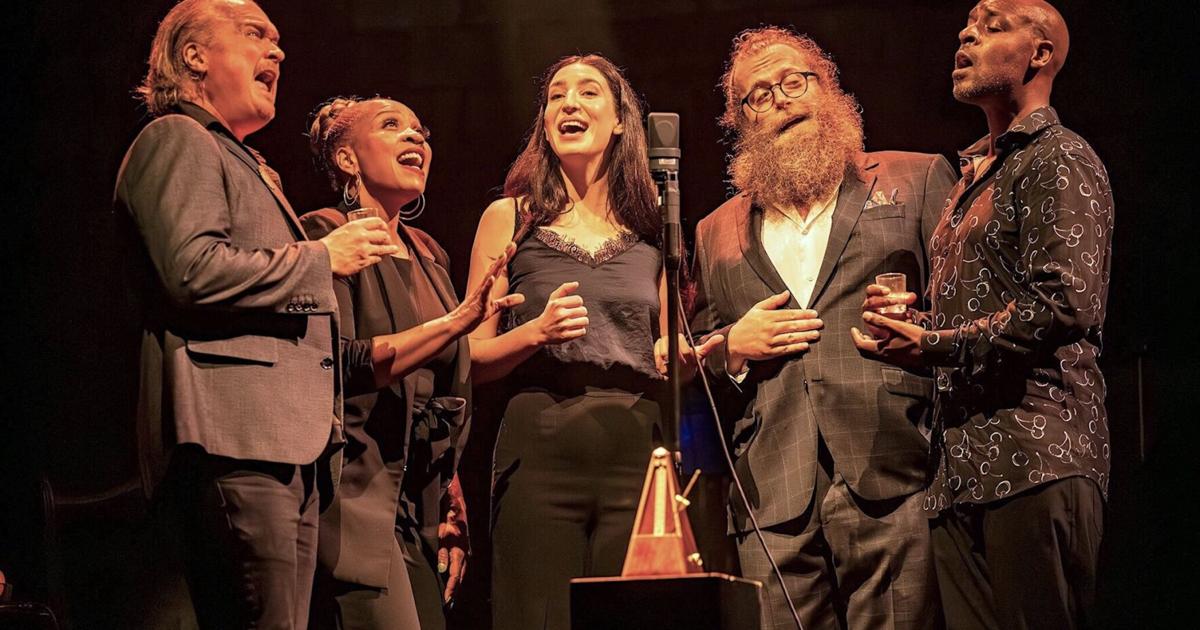
And yet everybody isn’t dancer and singer Travis Knights. The fleet-footed hoofer turns the song into a joyful tippity-tap across the stage of Toronto’s CAA Theatre, prompting much audience applause, as he and nine other performers and musicians celebrate the late Bard of Montreal during a return to town of “The Secret Chord: A Leonard Cohen Experience.”
Knights’ singing and dancing on “Dance Me to the End of Love,” inspired by music and beauty persisting despite the Holocaust’s hell, is similarly swoon-worthy.
“The Secret Chord” covers 16 songs — 17 if you count as two a medley combining Cohen’s “Chelsea Hotel #2” with Janis Joplin’s “Piece of My Heart” — making the show more of a mood piece than a biography.
Interstitial snippets of Cohen’s life memories and views are taken from interviews and live stage remarks by the man himself.
You know who else would probably enjoy it? Cohen himself, who was never as gloomy as his reputation suggested, even if his pen often seemed to contain poison rather than ink. He evolved from cynic to sage over his decades-long career, able to view the world with a jaundiced eye, but also able to see the good in it, too.
Hence Cohen’s uplifting “Hallelujah,” his mid-career masterpiece, a hymn to life that Bob Dylan praised as a prayer more than a song. Bookending the show, it’s the lyrical source of “The Secret Chord” referenced in the title of this show, a Mirvish Productions revival of a Soulpepper Theatre Company original that premiered in 2017.
The current production, set on a stage resembling a cabaret in a brick-walled basement, also features Divine Brown, Ben Caplan, Hailey Gillis and Andrew Penner. They’re backed by the groove-driven quintet of musicians Jacob Gorzhaltsan (reeds), Joel Joseph (piano, music director), Tom Moffett (trumpet), Lowell Whitty (drums) and Roger Williams (bass).
The selected tunes span nearly 50 years: from “Suzanne,” “So Long, Marianne” and “Hey, That’s No Way to Say Goodbye,” released in 1967 on Cohen’s debut album, to “You Want It Darker,” released in 2016 shortly before his death at age 82. They’re not presented in chronological order.
Most of the songs would fit any fan’s compilation of essential Leonard Cohen tracks, but the show’s not simply a greatest hits recitation. The performers and musicians add new textures and interpretations to each number, such as Brown’s spectacular rendition of “I’m Your Man,” delivered with finger-snapping authority as she sits in a high-backed chair.
Brown also commands all eyes, ears and hands with a powerhouse rendering of “Tower of Song,” which had me thinking of that moment in “The Blues Brothers” when Aretha Franklin electrifies a Chicago diner with her performance of “Think.”
A more traditional take on Cohen comes from Caplan and Penner, who approximate the artist’s baritone growl. Especially the bushy-bearded Caplan, who finds the paradoxical smile within the mortal surrender of “You Want It Darker” (“I struggled with some demons / They were middle class and tame”).
Penner uses a bullhorn to commence his performance of “The Future,” a prophetic song that’s become more like current headlines since its 1992 release. He emphasizes what may be Cohen’s darkest lyrics, and that’s really saying something: “Things are going to slide in all directions / Won’t be nothing, nothing you can measure anymore.”
He concludes the number with a warning from one of Cohen’s latter-day poems that positively chills the blood, considering the volatility of our southern neighbour: “Oh, and one more thing: You aren’t going to like what comes after America.”
Both performers have a wink in their eyes; they recognize how Cohen understood the balance between gloom and wit. When I once asked Cohen in an interview about his motivation for writing “The Future,” he offered a mock apology for his grim vision: “I think I left my antidepressant pills at home.”
Despite Cohen’s warning of the world about to “slide in all directions,” the show’s tribute to him is steady as she goes, creating a warm and mostly contented vibe that occasionally includes an image of a smiling Cohen projected onto the black-painted wall at the rear of the stage.
The concert ends with a sublime full performance of “Hallelujah,” led by the perfectly composed Gillis, who conveys the song’s awe as well as its ache.
At 90 minutes, the show leaves you wanting more. Not just more songs, though a few are missed — I waited in vain for “Sisters of Mercy” and “First We Take Manhattan” — but more of Cohen himself. This is a celebration that captures his spirit yet only sketches the man.