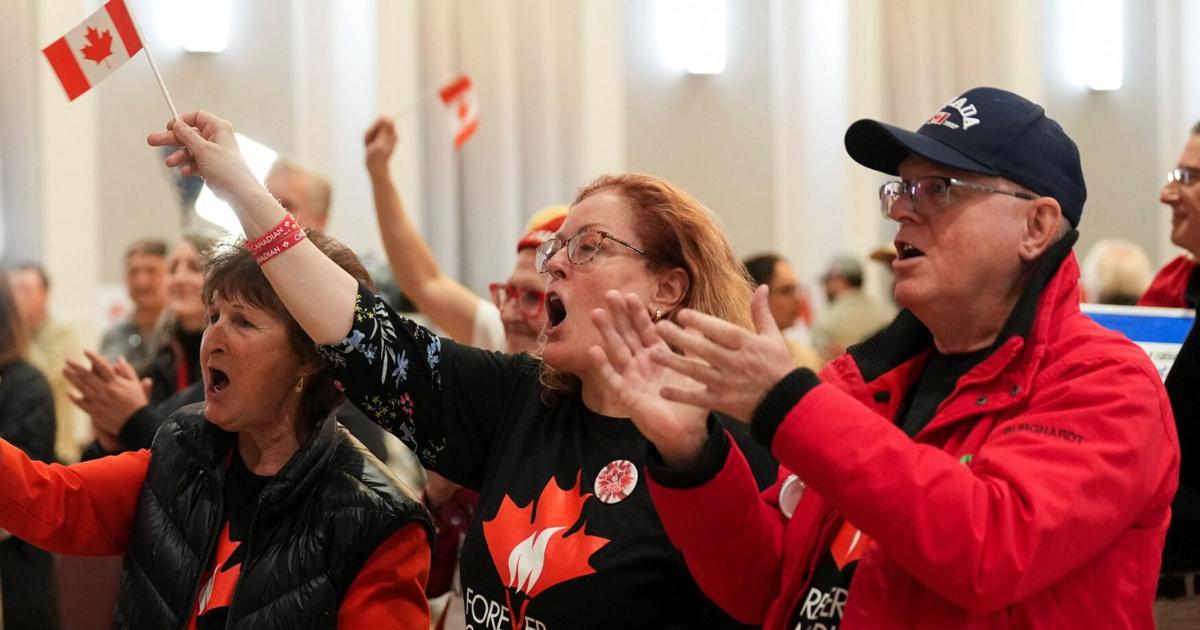
OTTAWA—Prime Minister Mark Carney hailed the Alberta referendum result as an endorsement of a united Canada as he vowed to work “pragmatically” with provinces on addressing immigration levels and other issues, saying he is open to constitutional reform but only if necessary to effect change.
“I’m thrilled that Albertans have chosen unity,” Carney told reporters on his way into a cabinet meeting. “They’ve chosen to build together. They’ve chosen to continue to take care of each other … to move forward together with purpose, high ambition.”
Conservative Leader Pierre Poilievre echoed the sentiment: “Conservatives are thrilled to see Albertans vote for a stronger province within a united Canada.”
But he interpreted the results very differently, endorsing instead what he said was Albertans’ frustration with out-of-control immigration levels and the high cost of living — which he squarely blamed on Carney. His Conservative caucus would fight in Ottawa to restore the “promise of Canada,” he said.
Both party leaders spoke Tuesday morning with Alberta Premier Danielle Smith. Both said they talked about the need for additional federal support for victims of the devastating accident at CFB Wainwright, and then about the outcome of the votes.
Carney called the outcome of the independence question on the ballot — and its rejection of the separatists’ siren call — “a great result for Canada.”
With 83 per cent of the votes counted, 76 per cent opted to remain in Canada defeating the 24 per cent who voted to trigger a second, binding legal referendum on Alberta independence.
“It’s a great day for Canada,” said Carney, noting that ballots were still being counted on the other nine questions. Those covered the gamut from immigration levels and judicial appointments to more provincial power to reject federal programs yet receive compensation.
Carney said his government is already addressing many of Albertans’ concerns, particularly “moving to a more sustainable pace of immigration.”
Citing “a reduction in asylum seekers of 70 per cent, a reduction in temporary foreign worker flows of 60 per cent, a reduction in foreign students of 80 per cent over the course of the last 18 months,” Carney said his government has “recognized from the start the need to take back control” of immigration.
The reductions in temporary residents began under the Justin Trudeau government and continued apace after Carney took office. The prime minister recently told the New York Times that he foresees allowing the levels of immigration to rise again in a “controlled increase.”
“I’m not saying that that stabilization is complete,” he said Tuesday, “but where we go from here needs to be established in co-operation with the provinces.” Carney said that approach is “very much the spirit” of one of the referendum questions.
Four of the 10 questions asked whether Alberta should take more control over immigration “for the purposes of decreasing immigration to more sustainable levels, prioritizing economic migration and giving Albertans first priority on new employment opportunities”; and whether the province should be able to limit access to provincially funded health care, education and other social services for non-permanent residents, or charge “a reasonable fee” for access to health or education. A fifth tested support for requiring people to provide proof of citizenship to vote in a provincial election.
Carney did not specifically address the whole range of proposals — after urging Albertans last week to vote “no to the nine” — but said his government is focused on delivering practical change, and does not believe constitutional change is necessary. But as the Star first reported, he remains open if it is required.
In French, Carney said, “if it is necessary to have constitutional changes, yes, we can do that, but we don’t start — and it’s not necessary to have constitutional change, in my view, on these issues.”
“What I favour is working now pragmatically to common solutions,” he said in English. “Constitutional change is difficult. It’s long.”
“I believe, for example, on the issue of immigration and co-operation between the federal government and the provinces for sustainable immigration, a system that works for Canadians, works for our economy, works for our society, and treats those who come to our country, who choose to come to our country, with the dignity and standards … that they deserve, that we can accomplish that without constitutional change.”
In English he further clarified that he would not open up the country’s foundational governing document as a first resort.
“Look,” he told reporters. “There’s one approach which is to say, ‘oh let’s wait until — we’re just going to park the important issues — whether it’s immigration, whether it’s the judiciary, other aspects, let’s just park that unless we have constitutional change.’
“Or, let’s work together, let’s find common solutions now, and then if it were to become necessary … It’s this question of priorities — and starting. And this is a government that very much is focused on results for Canadians. It’s very focused on working with the provinces. It’s very focused on working with Indigenous Peoples and finding solutions now to the issues that our country faces, and really, above all, seizing the many opportunities for Canadians, which are considerable.”
Poilievre told reporters it was “inappropriate” for Carney last week to tell Albertans to vote “no to the nine” questions, saying it appears voters “rejected Mark Carney’s direction on this.
“They have said they want to take back control of immigration after a decade of reckless, unvetted mass migration and open borders. That means cutting off the deluxe benefits that the federal government is imposing on provinces, that go to people who have never paid into the system and are not even Canadian permanent residents. Things that Canadians don’t even get. We’ve got to cut back on that.”
“We need real results in the real lives of real people,” said Poilievre. “Mr. Carney will be judged on that, and we deliver those results. I believe we will have a country that is more united than ever.”
But Poilievre dodged a question about whether he would open the constitution to address some of the changes Alberta is seeking, saying he’d wait until all the vote results are finalized.
New Democratic Party Leader Avi Lewis slammed Smith for the cost — which he pegged at $130 million — and for calling the vote, saying the “entire process was unnecessary. Nobody asked for it. Danielle Smith’s career has been defined by a slow walk towards separation. All of the questions are designed to stoke division in Alberta. And she is the one who is responsible for that,” he said.
Still, he hailed the result, saying it “represents a clear rejection of the politics of division.”
More than a million Albertans gave Canadians “something all too rare these days: a moment of hope,” he said.
“We know things are tough in Alberta, from health care to the cost of living to the embattled education system and so much more. People around the country can relate. And the frustrations that preceded this referendum don’t disappear now that the vote is over.
“But as so many Albertans have shown us, we don’t fix our problems by turning on each other. We fix them by coming together, doubling down on those features of Canadian life that bind our fates together, help us take care of each other, and strengthen solidarity in our society.”
Lewis also called for clarity around “efforts by MAGA-aligned operatives to influence the outcome of these votes.”
Error! Sorry, there was an error processing your request.
There was a problem with the recaptcha. Please try again.
You may unsubscribe at any time. By signing up, you agree to our terms of use and privacy policy. This site is protected by reCAPTCHA and the Google privacy policy and terms of service apply.
Want more of the latest from us? Sign up for more at our newsletter page.