EVIAN-LES-BAINS, France — Canada’s message to the United States at this G7 summit goes something like this: we may not go to the ends of the Earth to get our old trading relationship back, but we’ll gladly cross the ocean to plead our case.
Sure, there was lots on the summit agenda Tuesday. A hopeful morning meeting on Ukraine. An afternoon roundtable on the state of the Middle East. A bunch of bilateral discussions in the breaks and on the sidelines.
But for Prime Minister Mark Carney, the G7 summit was perhaps most importantly a place to plead Canada’s case to U.S. President Donald Trump.
Sure, the two North American leaders had the occasion to talk about a host of matters Tuesday.
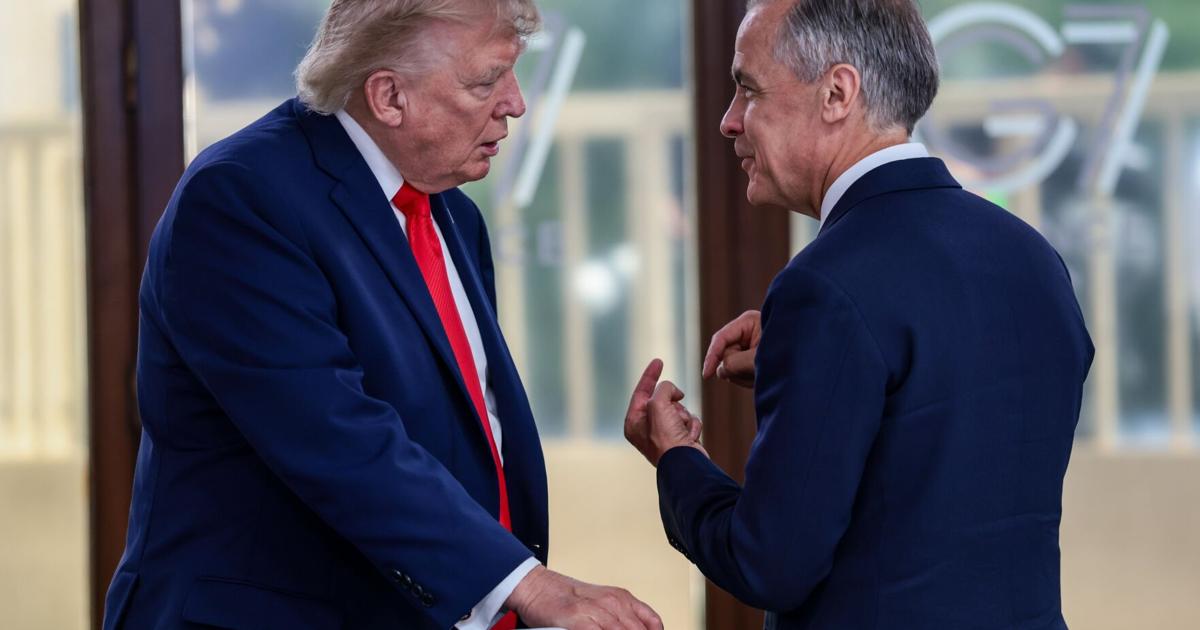
But it just so happened that an open microphone and roving television camera captured the Canadian leader hunched over and explaining to a seated Trump just how wrong the criticisms were of a Canadian deal struck with China to allow the sale of Chinese-made electric vehicles.
“It’s less than three per cent of our market — 49,000 cars,” Carney was heard telling Trump. “I thought you’d actually like that.”
The agreement, signed in January, lowered Canadian tariffs on the Chinese cars in exchange for relief for Canadian canola and seafood exports.
“That’s good. I like that,” Trump responded.
It was one small snippet of a conversation. But in that presidential appreciation, there is hope it could represent a giant leap for the cross-border trading relationship, which is now hobbled by American tariffs on Canadian steel, aluminum and softwood lumber tariffs.
Canada-U.S. Trade Minister Dominic LeBlanc told reporters at the G7 summit Tuesday that the explanation Carney provided to Trump was “not new.”
“It was a discussion that we had with the Americans following the visit of Mr. Carney in China in January,” he said. “So the prime minister took the opportunity to remind Mr. Trump precisely what it meant.”
He said that there was “a lot of confusion” about the Chinese EV deal when it was struck.
But the word “confusion” doesn’t quite capture the American reaction so much as “fury.”
Said Scott Bessent, the U.S. treasury secretary: “We can’t let Canada become an opening that the Chinese pour their cheap goods into the U.S.”
He also offered the critique that, in his opinion, Carney was not “doing the best job for the Canadian people.”
Said Howard Lutnick, the U.S. commerce secretary: Canada’s Chinese EV agreement risked creating a “road map” to the rewriting of the Canada-U.S.-Mexico trade deal, known as CUSMA in Canada and USMCA in America.
Since January, there have been accusations that Canada has delayed engaging in formal talks with the Americans to renew the continental trade agreement, which has a July 1 deadline.
That has been followed by threats of additional tariffs on Canada for not cracking down on imports made with forced labour and, more recently, the delayed opening of the Gordie Howe Bridge between Windsor and Michigan, reportedly at the direction of the White House.
While Canada has been focused on increasing trade to non-U.S. countries and pivoting from its traditional American markets, there was a definitive sense Tuesday of an urgency to engage with the President Trump and his inner circle with less than two weeks until the deadline for the trade deal’s renewal arrives.
The very fact that LeBlanc was present on the margins of the G7, along with Canada’s chief U.S. trade negotiator, Janice Charette, was itself a telling sign.
The global economy was on the official G7 agenda. Canada-U.S. trade was not.
Nor was there an official bilateral meeting scheduled between Carney and Trump, which is significant since the two leaders have not had a face-to-face meeting since December, when Trump took offence to Ontario Premier Doug Ford’s antitariff advertisement broadcast during the World Series.
LeBlanc explained his own presence at the G7 summit as his acceptance of U.S. Trade Rep. Jamieson Greer’s invitation to meet two weeks after their last face-to-face discussion in Washington.
“It would have been irresponsible to say that it was a long trip and that it didn’t interest us,” LeBlanc said. “On the contrary, we are very interested, and that’s why I am once again optimistic and happy to have had the chance to meet Jamieson and to talk more.”
As per usual, the veteran Liberal politician didn’t broach the details of his discussions with Greer. But he did say that he had a “long and constructive” meeting with Greer, one that reviewed the work that had been completed over the last two weeks and concluded with an agreement to “be in touch again” next week.
“We talked about a number of other issues that the United States raises with us, but we also talked about issues that are important to Canadian workers and the Canadian economy,” he said.
“It’s by no means a one-way conversation.”
But it’s one that, with every passing day, is becoming more urgent.