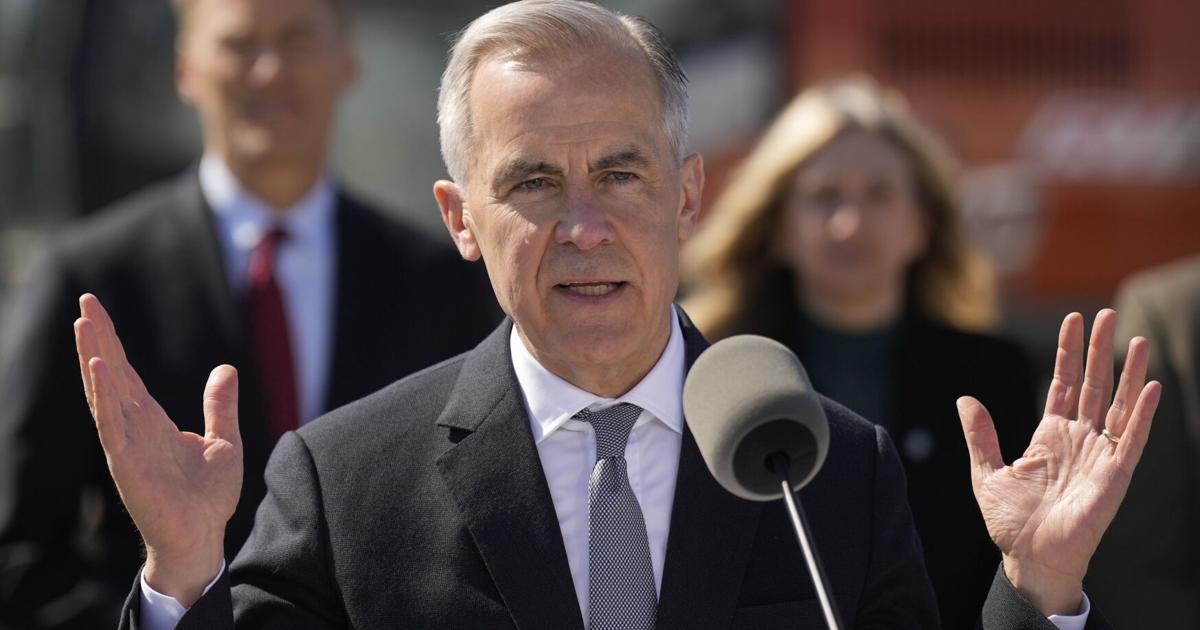
OTTAWA — Prime Minister Mark Carney announced the creation of Canada’s first national sovereign wealth fund Monday, claiming it will spread benefits from major projects to all Canadians as the Liberal government drives to lessen economic dependence on the United States.
Called the “Canada Strong Fund” — after the Liberals’ political slogan — it will launch with $25 billion over three years that will be used to buy public equity stakes “alongside the private sector in nation-building projects,” Carney said.
It will also invite investment by individual Canadians, the prime minister said, suggesting that latching onto the investment “opportunity” is akin to other consumer actions Canadians have taken, like avoiding travel or vacations in the U.S., or choosing to eat, drink or buy Canadian-made products.
Pointing to his government’s push to advance projects in energy, trade, critical minerals, transportation and data, Carney said Canadians have made clear by their actions they want to participate in making the country “stronger, more resilient, and more independent.”
“And if you have a bit of extra money, we’ll make it easy for you to invest in the fund to help build Canada strong for all,” Carney said.
It was not immediately clear where the $25 billion to launch the fund will come from, but a government background document said it will increase over time “from the returns that it generates, and through other assets that the government may allocate to it.”
The prime minister promised consultations to come and more details in Tuesday’s economic update, which he hinted would report good news about the government’s “performance against our deficit targets” and its effort to rein in spending, allowing it to “invest more” in major projects.
Sovereign wealth funds are run by countries including Norway, which has one worth about US$2 trillion, China ($1.5 trillion), and several oil-rich Middle Eastern countries.
Conservative Leader Pierre Poilievre later mocked the government’s proposal, saying, “You need to have wealth for those funds.
“Norway, Singapore and Saudi Arabia run big budget surpluses, which they accumulate and then put into their sovereign wealth funds,” said Poilievre. “Carney has no surplus and therefore no wealth to put in such a fund. He’s talking about a sovereign debt fund.
“He wants to put another $25 billion on the national credit card to gamble on a Liberal slush fund that will enrich Liberal insiders at the expense of hard-working Canadians.”
Saskatchewan Premier Scott Moe told reporters he supports the concept of a national sovereign wealth fund, and has considered a provincial version.
However, Moe emphasized that the way to attract private sector investment into projects that would make Canada an energy superpower, as Carney wants, is to “fix some of the wrongs that have been introduced in the regulatory environment.”
“A sovereign wealth fund is essentially a national savings and investment account,” said Carney. “It’s designed to grow wealth for future generations of Canadians.”
Major projects built in Canada in the past have provided financial returns “only to those who built and ran them,” whereas the new fund will allow more direct returns to flow back to Canadians, he said.
The fund will not be restricted to investing in so-called “nation-building” or the major projects that Ottawa is prepared to fast-track.
The prime minister said those “will mostly be built by private companies” and Carney anticipates investing “alongside the private sector in Canadian projects and companies driving our economic transformation.” A news release said this includes projects in clean and conventional energy, critical minerals, agriculture and infrastructure.
Carney denied it’s a sign there is not enough interest by private investors in Canadian projects, or that his government would be picking winners and losers among project proposals. He cast it instead as a matter of fairness to “all Canadians.”
“It is fair, right, just, smart for Canadians to have a share directly of those profits, and that’s what the fund is going to make possible,” he told reporters.
The fund will be “professionally managed and operate as an arm’s length independent Crown corporation,” Carney said, as he distinguished it from the federal infrastructure bank or other federal agencies which loan money to businesses with an eye on repayment with low interest rates.
It would allow the public to reap equity returns on a project that are “if it’s well-run, substantially higher than the returns for debt,” he said.
Ottawa will allow individuals to get a piece of the action because, he said, Canadians want to be “involved in building the country.”
The fund will offer the opportunity to “all Canadians … if they have a little bit of money, we’re not talking big money, but a little bit of money to invest alongside” the federal investment, he said.
“It is not something for … rich people. It’s something for Canadians, for all Canadians, everyday Canadians,” Carney said.
Individuals’ investments would be “protected” consistent with a government savings bond, Carney said, adding it “has the upside, the additional return when these projects realize their potential.”
Sovereign wealth funds are often used by resource-rich governments to save wealth for future generations, to smooth out budgeting highs and lows, or to increase wealth through financial investment, often abroad.
Carney’s recent trips to the United Arab Emirates and Qatar led to promised investments in Canadian major projects by those countries’ sovereign wealth funds, although it is not clear where any funds have been directed.
Several environmental groups like Greenpeace Canada, Environmental Defence, and Sierra Club Canada raised alarms about Canada using such a fund to boost oil and gas megaprojects, saying the government should instead invest in green energy.
“With oil companies raking in excess profits due to the U.S.-Israeli war on Iran, now would be the perfect moment for Canada to copy Norway by hiking taxes on oil and gas and investing that money in a sovereign wealth fund,” said Keith Stewart of Greenpeace Canada.
The prime minister suggested that the fund would initially direct investment into Canadian projects, but he underscored other countries have later branched out to invest abroad.
On Monday, the government also gave notice that it would present legislation to create a financial crimes agency, which was a 2021 election campaign promise. Last fall’s budget outlined plans to “bring together the required expertise to investigate crimes such as money laundering, and online fraud and financial scams, and recover criminals’ illicit proceeds.”
In last fall’s budget, the deficit for the 2025-26 fiscal year was forecast to hit $78.3 billion, more than double the year before, and this year’s deficit was projected at $65.4 billion.
Error! Sorry, there was an error processing your request.
There was a problem with the recaptcha. Please try again.
You may unsubscribe at any time. By signing up, you agree to our terms of use and privacy policy. This site is protected by reCAPTCHA and the Google privacy policy and terms of service apply.
Want more of the latest from us? Sign up for more at our newsletter page.