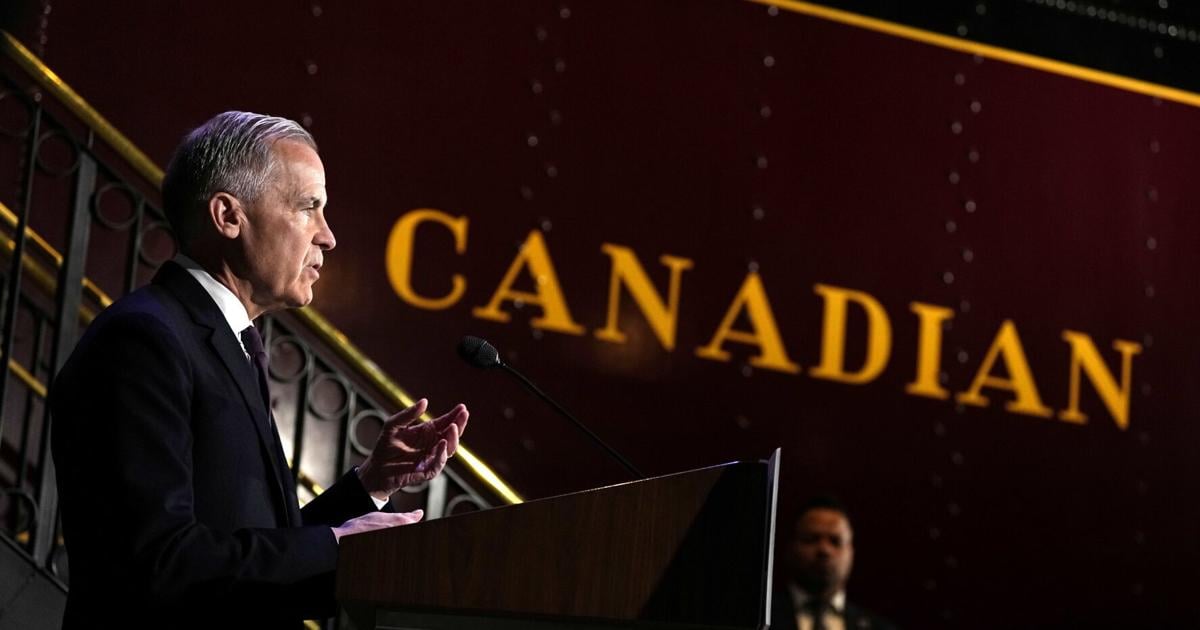
Think of Prime Minister Mark Carney’s foreign investment summit, this coming Monday and Tuesday, as a speed-dating session.
Sure, there will be speeches — most notably by Carney himself, as well as by Stephen Harper — at the gathering of global CEOs at Toronto’s Four Seasons Hotel. Plus panels, breakout sessions, and other stuff you’d typically associate with a conference.
There will also probably be a few announcements of commitments by overseas or American attendees to invest now in Canadian projects, lined up in advance to show early momentum toward Carney’s goal of attracting $1-trillion in capital over the next five years.
What this event is really about, though, is trying to introduce visiting executives to domestic proponents of energy, mining, infrastructure and manufacturing opportunities — not to strike immediate deals, but to begin what Ottawa hopes will be fruitful long-term relationships.
That’s reflected in an itinerary that will include one-on-one matchmaking sessions. It’s also supposed to happen more informally, at dinners or drinks or however else extremely wealthy people choose to spend their time in Yorkville.
We all have a lot riding on the Canadians at the table making positive first impressions.
There are absolutely valid concerns about how much control might be ceded if and when the dollars really start flowing. But if ever there were a moment to open ourselves to the world, with due sovereignty protections in place and a prioritization of foreign builders over rent-seekers, this is surely it.
Needless to say, U.S. President Donald Trump’s escalating assault on Canada’s economy has upped the stakes since Carney first conceived of the summit many months ago. Building capacity to sell natural resources, goods and services to the rest of the world — and to meet our own needs, as international trade becomes less reliable — has never been more urgent.
But more than merely trying to survive America’s growing instability, this is also our window to capitalize on it.
Among the reasons direct foreign investment in Canada has recently reached highs (nearly $100-billion in 2025) not seen in nearly two decades is that overexposure to the U.S. has become a worry for overseas and even stateside funds. And as they seek to diversify, safe harbours — places with stable governments, rule of law and business cultures — are in high demand.
That’s also much of the reason Carney, an embodiment of grown-up professionalism juxtaposed against Trump’s erraticism, has been able to leverage his Rolodex to attract a who’s who of attendees — the leaders of everything from the Saudi and Singapore sovereign wealth funds to overseas pension plans to U.S. giants like Blackrock and Berkshire Hathaway.
But if steadiness is helping get them in the door, dynamism will need to be on display once they’re here.
The last thing anyone wants is an echo of what happened earlier this summer, when the Financial Times reported that the United Arab Emirates approached Carney’s Major Projects Office and came away with the impression that no major projects were yet investable.
The prospectus that Ottawa distributed to attendees on Thursday, days before the summit will begin, was a pretty good start to pushing back on that perception. Despite what was by most accounts a messy process of pulling it together, its rundown of 167 investable opportunities makes for a fairly compelling and concise read — even if those opportunities ranged from shovel-ready or at least permitted, to so preliminary that near-term capital commitments are unlikely at best.
It’s also a somewhat encouraging document, for Canadians worried about ceding ownership of existing assets, particularly after mergers and acquisitions largely accounted for the recent foreign-investment surge. The pitches in it almost entirely involve project financing — trying to get foreign interests to take a stake in building or expanding nuclear stations, LNG terminals, wind farms, copper mines, ports, etc. — as opposed to selling off what we already have. (That’s not to say privatization of entities like airports won’t be a subject of discussion, but that doesn’t seem to be the summit’s main aim.)
Those pitches, though, are each scarcely longer than a paragraph. That may be enough to catch the interest of foreign suitors, but it will be up to the proponents to pique interest further.
While going some distance toward shrinking regulatory barriers and other alleged impediments, Carney has also been prodding the private sector (along with domestic institutional investors and provincial governments) to spend less time grumbling about our business environment and more time aggressively advocating for it. For those who’ve cracked the guest list, here’s a pretty good test of their willingness and ability to do so.
The same goes for the leaders of growth-stage companies, largely in tech, who will be attending an ancillary event being hosted on Monday by the Canadian Venture Capital and Private Equity Association, aimed at connecting them with foreign executives in town for the main event.
It won’t be easy to immediately gauge how well any of this has gone, since for public consumption the event will probably end with niceties either way.
It’ll also be hard to assess how worried Canadians should be about the shape of deals that might eventually be struck — how much control over management of strategic infrastructure might be given to foreign entities, for instance.
Those assessments will only be possible if any when these relationships blossom.
For starters, let’s see how many second dates we get.