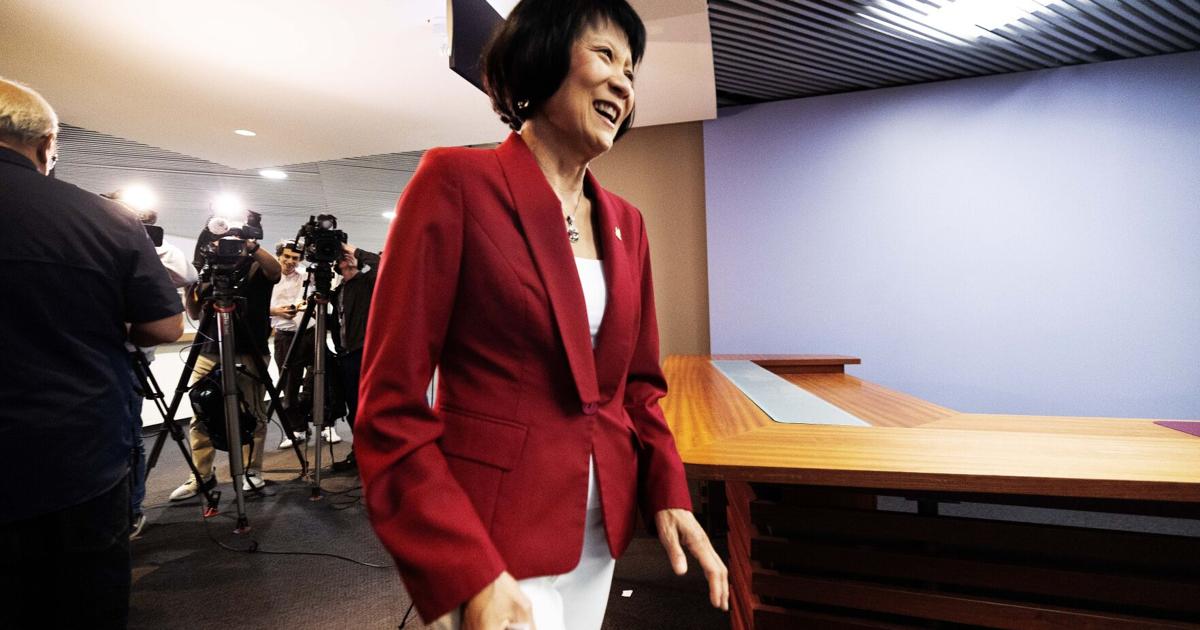
Olivia Chow ended months of speculation Monday by declaring she would seek re-election, setting up a fall mayoral race that increasingly appears be a contest between two candidates with starkly different approaches to some of the same core issues — safety, congestion and the cost of living.
“I registered today to say one thing to the people of Toronto: I am in your corner. I’ve always been and always will be,” Chow told reporters at city hall, shortly after the Star initially broke the news that she had submitted her paperwork to run.
“There’s more to do,” she said. “But there’s plenty of time to campaign in the fall. Right now, I’m going to spend my time serving the people of Toronto (as mayor).”
It also sets the stage for what’s expected to be a bitter contest against Coun. Brad Bradford, who announced last year he would run to take her job come the Oct. 26 vote, positioning himself as the centre-right alternative to Chow.
Bradford, who’s held campaign-style events for nearly a year, announcing platform policies before registering to run, has accused the mayor of effectively campaigning before announcing her intentions.
In a release Monday, Bradford said he was “delighted that Mayor Chow has finally recognized that campaigning on the public dime is wrong.”
“This election is not about who loves Toronto. We all do,” Bradford added. “It is about what we are willing to accept.”
The latest poll by Liaison Strategies released earlier this month showed if the election was held now, Chow could coast to victory.
Doug Ford responds to Olivia Chow’s reelection bid
At a ceremonial groundbreaking for the new Ontario Science Centre at Ontario Place on Monday, Premier Doug Ford praised Chow on her reelection bid.
“Well, I really like the mayor,” he said. “I know exactly where Olivia’s coming from. She knows where I’m coming from.”
However, the premier emphasized he would not endorse any candidate in Toronto’s mayoral race, striking a notably different tone than in the 2023 mayoral byelection that first brought Chow to power, when he said she would be an ”unmitigated disaster” as mayor.
In a press release responding to Chow’s announcement, left-leaning advocacy group Progress Toronto, which backed her in 2023, said a second term means “building on progress” already made.
“This election is a clear choice: continue investing in Toronto’s future, or hand the keys back to the conservative politicians who created this mess,” it said in a press release.
Meanwhile, centre-right advocacy group ABC Toronto said Torontonians are “frustrated” that “too many basic things no longer feel like they work.”
The group pointed to congestion, perceptions of safety, the affordability crisis and residents feeling like “city hall is focused on ideology over execution.”
“The question Torontonians should ask is simple: is the city better today than it was three years ago?” ABC Toronto’s statement said.
A two-horse race with similar priorities
Randy Besco, a political science professor at the University of Toronto, said Toronto’s mayoral race appears to be on track to be a contest between just the two since the campaign runway is getting short for lesser-known candidates.
“It would be different if a major big-name candidate tosses their hat in,” he said, adding that someone with name recognition, resources and contacts can get ready in a short period.
Mayoral contests typically start with a few front-line contenders then whittle down, “so it would definitely be an anomaly to have just a prime two-candidate race,” said Myer Siemiatycki, professor emeritus of politics from Toronto Metropolitan University. He said a name candidate would need to get in the race within the next month or two because it’s expensive to run for mayor, citing how Ana Bailão spent over $2 million in the 2023 byelection and lost.
Both Chow and Bradford have the same campaign priorities, but different political approaches. Bradford’s focus is crime, congestion and costs. Chow has pointed to safety, congestion and affordability.
“Candidates will try to make the election about an issue where they have credibility or that will make voters choose them, whether they’re the right person for it or not,” Besco said.
But, “they’re always going to be constrained by reality … What will matter is their approach.”
Chow’s first term saw tax hikes, ‘new deal’
As the winner of the 2023 byelection to replace former mayor John Tory, Chow became the first progressive elected Toronto mayor in 17 years.
In the past few months, she has pitched herself to Torontonians as a mayor focused on making the city an “affordable, caring and safe” place to live, passing a budget this year that included a TTC fare freeze for the third straight year and a lower-than-expected property tax increase of 2.2 per cent.
That tax hike was well below the 9.5 per cent and 6.9 per cent hikes of her first two budgets, increases she said were necessary to replenish a city that had fallen into disrepair after years of “austerity” under her predecessors.
During her three-year term, Chow expanded the city’s emergency crisis service, revived the pandemic-era outdoor dining program CaféTO, set aside spots for locals in free recreation programs, increased funding for school nutrition programs and expanded library hours. She also claimed credit for the Scarborough busway’s early opening and the Gardiner Expressway construction finishing early.
In one of her most notable moves, Chow secured a “new deal” with the province in November 2023 as a way to fix the city’s pandemic-ravaged finances. In return, Chow ended her fight against the controversial Therme mega spa development despite campaigning on preserving Ontario Place as a public park.
More recently, Chow has been at odds with Ford’s government over moves to rip up bike lanes, outlaw speed cameras — and usurp the city’s role in the tripartite agreement that governs Billy Bishop airport, which Chow called a “land grab.”
On Monday, she didn’t talk about her relationship with Ford, but said she’s negotiated billions from Ottawa and Queen’s Park for investments like cutting development charges to get more housing or purchasing new subway cars for the TTC’s Line 2.
Chow comes under fire by progressives
During her first term, Chow came under fire from progressive critics for increasing the police budget, which has gone up each year. She justified the increases by pointing to 911 wait times and response times significantly dropping.
The latest police budget bump came amid a corruption scandal, and was in sharp contrast to her first police budget, which saw her locked in a standoff with the police and its union.
On testy debates such as legalizing neighbourhood corner stores or sixplex housing, Chow has also been criticized for not leading council to get such policies through citywide. Instead, council watered down both proposals.
The mayor has also been scrutinized over her response to the Israel-Gaza conflict, which included calling the war a “genocide” and voting in favour of a controversial “bubble zone” bylaw to restrict protests.
With files from Robert Benzie