

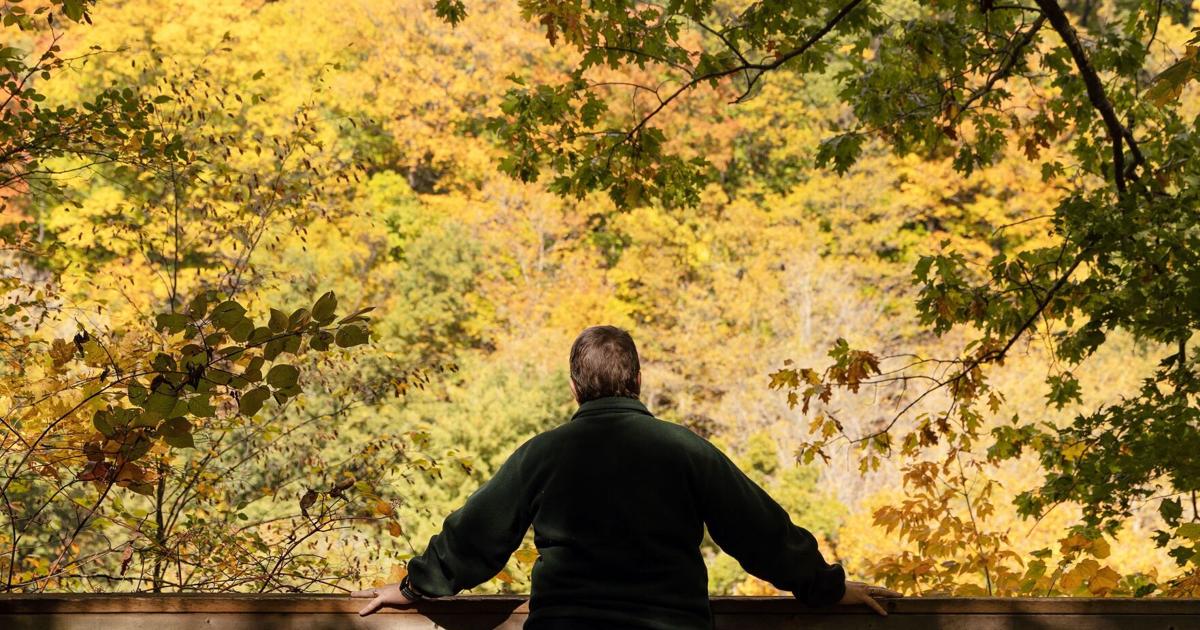
On a damp October morning, Sheila Wiebe looks out at the trees in Oakville’s Bronte Creek Provincial Park, where she works, and asks herself the question on the minds of most visitors: What colour are the leaves today?
It is not an exact science. A few sugar maples near the park entrance are starting to blush red. A cluster of black locusts is glowing yellow, but only on one side. Orange peeks out from a willow that is otherwise green. Sometimes two trees of the same kind, just steps apart, will be different colours. Even the same maple can turn red one year and orange the next. Still, she and dozens of other Ontario Parks staff make their best call and send it to the Fall Colour Report.
Asked about special tools or technology, Wiebe, Bronte Creek’s marketing and education specialist, laughs. “Nope. We basically look out the window.”
The Ontario Parks Fall Colour Report, which turns 20 this year, tracks the percentage of colour change and leaf fall at more than 70 provincial parks, with updates weekly or even daily. Online since 2006, with an interactive map added around 2012, it logged more than 450,000 page views last year as nature enthusiasts and Instagram influencers alike tried to time their weekend road trips to peak autumnal beauty.
Wiebe joined Ontario Parks in the late 1980s and remembers the days before the report went online, when parks faxed their updates to be read aloud on local radio. “I grew up in southern Ontario, so I thought that everybody experienced (the colours),” she says. Her brother, now in Whistler, B.C., set her straight: out west, fall is mostly yellow. “I’m like, ‘Oh, we are special.’” Ontario Parks now draws leaf-peepers from as far away as Japan, and photographers call her office asking whether it’s peak yet.
Her viewing tip: look for contrast. A hillside of red is brilliant, she says, “but you need that one deep green conifer to go, oh, that’s really amazing.”
While a day trip to Bronte Creek or showstopping parks like Algonquin — where the Fall Colour Report is showing 90 per cent leaf change this week — remains a bucket-list trip for many in the GTA, you don’t need a car to see the show. Toronto’s own urban forest includes an estimated 11.5 million trees, more than 600,000 of them street trees, according to the city.
On a blustery Monday evening, about 15 people gather outside the Riverdale library branch for a neighbourhood tree tour led by city Urban Forestry staff. Among them is Jared Ong, 39, who lives nearby and volunteers at the library’s pollinator garden.
“Pollinators are all, like, down on the groundy things,” he says. “I wanted to learn more about up-in-the-tree kind of things.”
The group winds along Jack Layton Way and into Hubbard Park, stopping at a tulip tree, a hackberry, a basswood, a black walnut. There isn’t much colour to behold in this park yet. An exception: a Freeman maple, a red and silver maple cross, showing off its fiery side.
That maple is one of a lucky few, says Sean Thomas, a professor of forest ecology at the University of Toronto. Red leaves aren’t simply green fading away. They’re the result of new pigments, called anthocyanins, produced when trees get the right signal: “a combination of cold, but not hard frost, temperatures plus high light conditions.” The reds work like sunscreen, protecting the leaf while the tree pulls back nitrogen to reuse the following year — a “happy biochemical accident” of trees being thrifty.
This year, the GTA hasn’t had those near-frost nights, and summer wildfire smoke stressed many leaves into browning or dropping early. But red maples under stress, Thomas says, “tend to turn earlier and have brighter colours.”
But the guide urges the group to look beyond colour: touch a leaf’s fuzzy underside, feel the rough bark. A collective “aha” greets her explanation of leaflets, that what looks like a cluster of leaves can be one compound leaf.
Near a large oak, Toronto’s official tree, Ong is hunting for acorns and examining them for clues.
“I had no idea there were so many different trees in my own neighbourhood,” he says. He’s also trying to rely less on AI apps that identify plants from a photo. “Instead of looking at my phone, I can be wandering around looking at trees, with my community.”
The city expects colours to keep intensifying over the coming weeks, and its Ravine Days events this month offer more opportunities to nerd out. Farther afield, Ontario Parks suggests checking the report, visiting midweek and booking a daily vehicle permit in advance.
Just don’t wait too long. Back at Bronte Creek, the colours are fully orange now, but Wiebe knows the one thing the report can’t tell you.
“We never know when peak is until the day after,” she says. One windy, rainy night, and it’s gone.

