

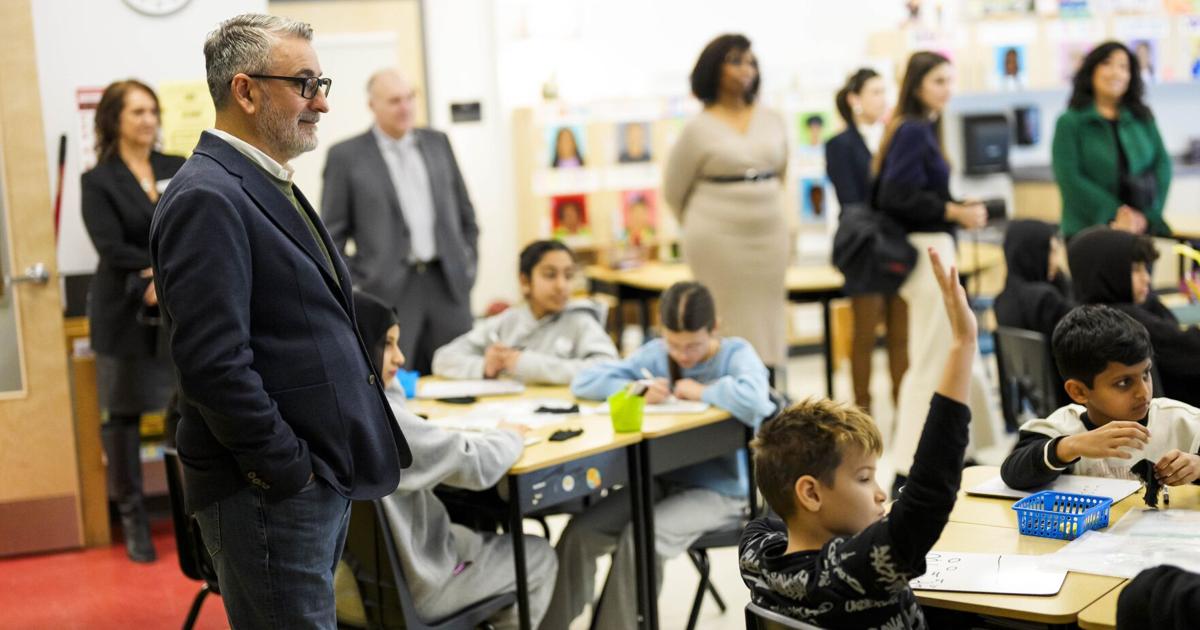
Kids will be back in class, teachers and school staff will be on the job.
The province’s new family support offices are opening in every school board. Kindergarten students will learn a revamped curriculum, there are new history lessons in Grade 7, 8 and 10 — a grade where teens will also have mandatory financial literacy lessons, with a must-pass test. High schoolers will be marked on attendance and participation, and have to write exams in almost all courses.
But there’s one big question no one has the answer to as this school year begins: Will there be labour peace?
The answer is: for now. But with talks in limbo as everyone awaits a labour board ruling, the year begins with many unknowns.
“The first few days are really exciting, and that’s the first thing on their minds, and they then have (bargaining issues) in the back of their minds,” said René Jansen in de Wal, president of the Ontario English Catholic Teachers’ Association, referring to the teachers.
The unions have appealed to the board after an early disagreement with the government, which is seeking to add items for provincial negotiations that they feel are better suited for local units and boards to hammer out under Ontario’s two-tier bargaining system.
While waiting for that decision, the five big education unions — representing 275,000 public, Catholic and French elementary and secondary teachers, as well as support staff — have planned an in-school day of solidarity and rallies while watching and waiting for the labour board decision.
No strike votes have been planned as yet and no possible job action can happen until there have been meaningful negotiations.
“This could drag on for a few months before we get much indication which way it’s going to go,” said Rob Kristofferson, a labour studies expert at Wilfrid Laurier University.
Education Minister Paul Calandra is optimistic a deal can be reached without labour strife, saying “everything that we’re doing is about putting student achievement first. Every teacher I talk to, every educator I talk to, has the exact same mission.”
He said the changes coming this fall “aren’t revolutionary changes. Some of these things bring us back to a time when we were having better student achievement, better outcomes, and teachers have better control of their classroom, and I am confident that our educators can deal with the changes.”
On the labour front, he said he was “heartened” to hear David Mastin, president of the Elementary Teachers’ Federation of Ontario, say there will be no job action early on.
“I fully expect that there is an opportunity for the government and the unions to come to an agreement,” Calandra said. “We’ll be working hard on that. I don’t expect any labour challenges; I think students will be in school for a number of months going ahead … It behooves us to work together to come to an agreement so students stay in the classroom. And I still remain optimistic.”
But for Stephanie Ross, a labour studies expert at McMaster University, “the fact that we have not gotten to some meaningful discussions yet, and that we’re still dealing with process, that means people should be paying close attention.”
She believes “the likelihood of disruption is greater than the last time because of the strategies of the unions to be more united,” adding that doesn’t necessarily mean a strike down the road, but “there could be various kinds of pressure techniques that are used.”
Indeed, in a recent memo to members obtained by the Star, the Catholic teachers’ union advised it “is actively planning and preparing for the next steps, should they become necessary.”
Martha Hradowy, president of the Ontario Secondary School Teachers’ Federation, said “families have dealt with alot of uncertainty in public education over the last several years, and nobody wants another school year to be dominated by labour negotiations — I would say our members don’t want that either.
“But the best way to create stability is to bargain, to sit down, to deal seriously with the issues, find compromises where we can, and to get agreements.”
She said her union is “asking the government to work with us on three fundamental things: better supports for students, meaningful investment in public education, and respect for teachers and education workers. I think if we start there, I think that there’s a path forward.”
Among the other changes this year are $750 spending cards for teachers, who began ordering in an online Staples portal Sept. 1, with a list of 200-plus items to start. A number of teachers reported finding lower prices at the retail site, leading Staples to say it will price match.
The province is also spending $16.8 million over three years for experienced teachers who help mentor younger educators.
Meanwhile, the new policy that ties attendance to marks for high school students — 15 per cent of final marks in Grades 9 and 10, and 10 per cent in grades 11 and 12 — has led to some confusion, with Ontario principals seeking clarification. They are hoping to meet with Calandra soon.
Error! Sorry, there was an error processing your request.
There was a problem with the recaptcha. Please try again.
You may unsubscribe at any time. By signing up, you agree to our terms of use and privacy policy. This site is protected by reCAPTCHA and the Google privacy policy and terms of service apply.
Want more of the latest from us? Sign up for more at our newsletter page.

