

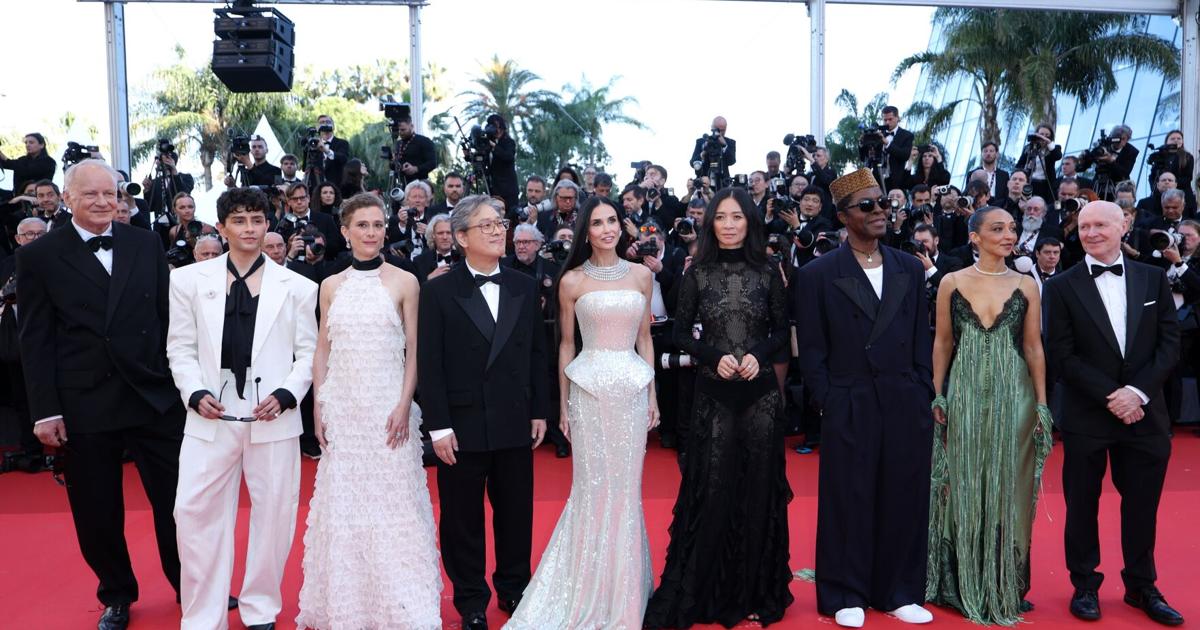
CANNES, France — Politics can be expressed through film and other art but care must be taken to avoid making propaganda, warned South Korean filmmaker Park Chan-wook, the president of this year’s Palme d’Or competition jury at the 79th Cannes Film Festival.
The veteran festival participant, whose workplace warfare satire, “No Other Choice,” won the inaugural International People’s Choice Award at last year’s Toronto International Film Festival, was clearly prepared to be quizzed about how cinema should respond to war and other conflicts, in the Middle East and elsewhere. It’s been a hot-button topic on the festival circuit for months.
“I don’t think politics and art should be divided. I think it’s a strange concept to think that they’re in conflict with each other,” Chan-wook said through an interpreter, speaking at a meet-the-jury press conference on Tuesday, the opening day of the festival.
“Just because a work of art has a political statement, it should not be considered an enemy of art … At the same time, just because a film is not making a political statement, that film should not be ignored.”
And politics must never be allowed to overwhelm artistic values, he further cautioned.
“Even if you are to make a brilliant political statement, if it’s not expressed artfully enough, it will just be propaganda.”
Irish-Scottish screenwriter Paul Laverty, one of nine jurors on the Palme panel, noted how the Greek roots of the word “politics” means something that refers to “the deepest sense of how we treat each other.”
Another way of expressing it is to ask, “Am I my brother’s keeper?” Laverty added, echoing a question often posed in the pro-worker films he’s penned for director Ken Loach, a frequent Cannes participant and two-time Palme winner.
Politics “is like the air we breathe,” Laverty said. “And it’s always struck me that many times when people say they’re non-political, they’re actually often the most political and don’t quite realize it.”
Another contentious issue at Cannes and elsewhere is the growing use of AI in all aspects of film and other art. Actor-producer Demi Moore, another jury member, was asked for her thoughts on the matter. She was last at Cannes in 2024, where her body horror film “The Substance” premiered to acclaim and later scored a best picture nomination at the Oscars, along with a best actress nod for her.
Moore chose her words carefully in her reply: “AI is here, and so to fight it is to, in a sense, to fight something that is a battle that we will lose. To find ways in which we can work with it, I think, is a more valuable path to take,” she said.
But she’s not afraid of artificial intelligence.
“The truth is, there really isn’t anything to fear because what it can never replace is what true art comes from, which is not the physical, it comes from the soul. It comes from the spirit of each and every one of us sitting here.”
Moore added, however, that she’s concerned there’s “probably not” enough protections built into AI to keep it from causing harm to humans.
Laverty agreed, warning that the “tech bros” who are developing and pushing AI don’t care enough what it does to humanity.
“It’s far too important to leave it to these guys.”
The Cannes jury will hand out the Palme and other prizes to the 22 films in the competition when the festival concludes May 23.
Besides Chan-wook, Moore and Laverty, the other Palme panel members are Swedish actor Stellan Skarsgård, Irish-Ethiopian actor-producer Ruth Negga, Ivorian-American actor Isaach De Bankolé, Chinese director-screenwriter Chloé Zhao, Belgian director-screenwriter Laura Wandel and Chilean director-screenwriter Diego Céspedes.
Skarsgård, Oscar nominated for “Sentimental Value,” which premiered at Cannes last year, said he’s looking forward to being a juror at Cannes this year.
“It’s much more comfortable to be the judge than to be judged,” he said.

