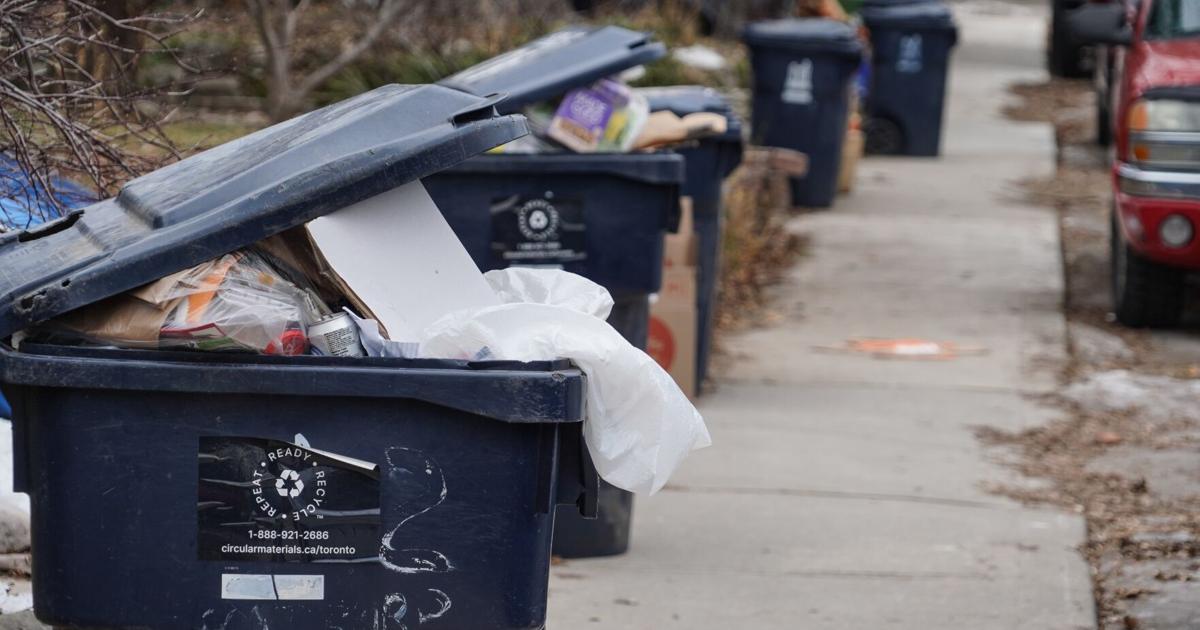
Proposed changes to Ontario’s residential Blue Box program could result in less household waste being recycled and run counter to the original goal of privatizing collection, environmental groups say.
If adopted, the Ontario government proposals, outlined in a technical briefing document provided to the Star earlier this week, would see the end of flexible plastic in blue bins.
That means plastic rice and cereal pouches, coffee bags, chip bags, bubble wrap, snack wrappers and other soft plastic packaging could end up in the garbage.
The amendments, since posted online, would also phase out a requirement for waste companies to pick up bundles of cardboard and overflow recycling in clear bags placed outside blue bins.
The delivery of extra bins would also end, except for residents with accessibility needs or those without access to depot collection.
“Plastic and the increasing use of plastics and disposable products, disposable clothing, disposable packaging is driving waste. And it’s expensive to collect,” said Karen Wirsig of Environmental Defence.
When the Ontario government first announced it was privatizing the Blue Box program, one of the goals was to off-load the cost of recycling onto the companies that produce and sell the packaging in the hopes that they would switch to more environmentally-friendly materials.
But instead of driving companies to change their packaging, Wirsig said the government is now proposing changes that could result in less material being recycled to reduce costs.
“This is the inevitable result if you have a government that’s not committed to the original principles of the Circular Economy Act,” said Wirsig, “and is just here to serve … the consumer goods lobby that is saying let us keep doing what we’re doing and don’t make us pay for it.”
The proposed changes to the recycling program coincide with a recent announcement by Ontario’s environment minister that the province hopes to burn more garbage for energy and build more landfills as the province runs out of space to dump its trash.
On Tuesday, the government tabled an omnibus bill, Building Ontario Faster Act, that seeks to speed up the permitting and approval regime across all ministries, including for new landfill sites or incinerators.
Ontario’s landfills will be full within 10 years and the province needs to act quickly, Environment Minister Todd McCarthy said.
Emily Alfred, a senior campaigner with Toronto Environmental Alliance, said if the proposed changes to the recycling program are enacted, consumers will be literally left holding the bag, the final arbiters of deciding whether a myriad of plastic packaging goes in the garbage or recycling bin.
“People really relate to recycling and their blue bin as one way that they can have an impact on the environment,” said Alfred. “But it’s just so frustrating.”
She said she’s concerned that consumers are “getting confusing messaging about how to manage waste” and the changes could ultimately mean more recyclables and plastics ending up in landfills and incinerators.
Since Ontario fully transitioned to a producer-run Blue Box system in January of this year, the companies that now have to pay for the program, including packaged goods producers, supermarkets and other retails, have complained that costs have skyrocketed.
The Retail Council of Canada estimated in 2025 that Ontario’s Blue Box recycling program would cost companies $740 million to operate in 2026, nearly four times what they paid when they shared costs with municipalities prior to the province’s transition to privatized recycling, which began in 2023.
Circular Materials, founded by companies such as Costco, Loblaw, and Procter and Gamble, administers the province’s recycling program, negotiating contracts and setting fees for recycling. It is also a Producer Responsibility Organization, competing with other PROs in Ontario while holding 80 per cent of the market.
Producers have complained that there is not enough transparency about what they are being charged for by Circular Materials or why their fees are increasing.
The government has said it may replace Circular with a new independent administrator.
Gary Sands, senior vice-president of the Canadian Federation of Independent Grocers, said one independent grocery store in Toronto was billed $83,315 by Circular Materials in 2024, a charge that rose to $141,996 the next year and $178,262 in 2026.
“For an independent grocer on a two per cent margin, those continuing escalating costs are not sustainable and are disproportionately more significant,” said Sands. “In the context of acute consumer angst around affordability, these increasing costs should be even more concerning to government.”
Sands said it’s too early to say whether the amendments will help bring down costs, but he said that his membership would welcome more transparency, especially because they don’t have a small business representative on the Circular Materials’ board.
“If this provides more transparency and sheds more light on the revenue that’s being collected, where that revenue is going, costs, all the things that are outlined in the amendments,” said Sands, “our members would welcome that.
“Because the first step to getting a resolution is having a better understanding and more information about what’s going into these fees.”
Confounding the problem in Ontario is a volatile market for recycled plastic, said Elena Mantagaris, a senior adviser for the Association of Plastic Recyclers. Cheap plastic resin from overseas is being dumped on the Canadian market, she said, undercutting prices here for post-consumer recycled plastic resin.
Although Ontario has instituted Extended Producer Responsibility (EPR), Mantagaris said the problem is there is no federal regulation requiring recycled content. “We built the front end of the system, but have done nothing to create the right market conditions for the use of post-consumers resin,” she said.
Circular Materials said in an email that it is reviewing the proposed amendments and will provide a response during the current 30-day period for public comment.
The Environment Ministry said in an email that it is “currently consulting on how these changes may help the industry better plan for the future, so that producers pay their fair share of Blue Box costs without surprise fees or changes that could impact their operations.”
With files from Estella Ren and The Canadian Press